Steinbeis Fridolin, Kedor Claudia, Meyer Hans-Jakob, Thibeault Charlotte, Mittermaier Mirja, Knape Philipp, Ahrens Katharina, Rotter Gabriele, Temmesfeld-Wollbrück Bettina, Sander Leif Erik, Kurth Florian, Witzenrath Martin, Scheibenbogen Carmen, Zoller Thomas
Charité - Universitätsmedizin Berlin, corporate member of Freie Universität Berlin and Humboldt-Universität zu Berlin, Department of Infectious Diseases, Respiratory Medicine and Critical Care, Berlin, Germany.
Charité - Universitätsmedizin Berlin, corporate member of Freie Universität Berlin and Humboldt Universität zu Berlin, Institute of Medical Immunology, Berlin, Germany.
ERJ Open Res. 2024 Oct 7;10(5). doi: 10.1183/23120541.01027-2023. eCollection 2024 Sep.
Patients with post-COVID-19 condition frequently suffer from chronic dyspnoea. The causes and mechanism for dyspnoea in these patients without evidence of structural lung disease are unclear.
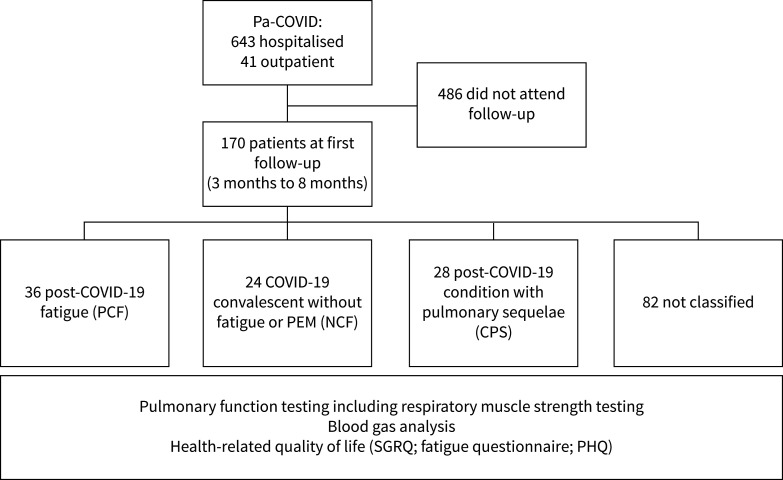
Patients treated for COVID-19 at Charité University Hospital in Berlin received pulmonary function testing including respiratory muscle strength tests and completed health-related quality-of-life questionnaires during follow-up. Patients with post-COVID-19 condition during outpatient follow-up with fatigue and exertional intolerance (PCF) were compared to patients with post-COVID-19 condition with evidence of chronic pulmonary sequelae (post-COVID-19 restriction (PCR)) as well as to patients without post-COVID-19 condition (NCF).
A total of 170 patients presented for follow-up. 36 participants met criteria for PCF, 28 for PCR and 24 for NCF. PCF patients reported dyspnoea in 63.8%. % predicted value of respiratory muscle strength (median (IQR)) was reduced in PCF (55.8 (41.5-75.9)) compared to NCF and PCR (70.6 (66.3-88.9) and 76.8 (63.6-102.2), respectively; p=0.011). A pattern of reduced forced vital capacity (FVC), but normal total lung capacity (TLC), termed complex ventilatory dysfunction defined as TLC - FVC >10% predicted was observed and occurred more frequently in PCF (88.9%) compared to NCF and PCR (29.1% and 25.0%, respectively; p<0.001).
Dyspnoea in PCF is characterised by reduced respiratory muscle strength and complex ventilatory dysfunction indicating neuromuscular disturbance as a distinct phenotype among patients with post-COVID-19 condition. These observations could be a starting point for developing personalised rehabilitation concepts.
新冠后综合征患者常患有慢性呼吸困难。这些无结构性肺病证据的患者出现呼吸困难的原因和机制尚不清楚。
在柏林夏里特大学医院接受新冠治疗的患者在随访期间接受了肺功能测试,包括呼吸肌力量测试,并完成了与健康相关的生活质量问卷。将门诊随访期间出现疲劳和运动不耐受的新冠后综合征患者(PCF)与有慢性肺部后遗症证据的新冠后综合征患者(新冠后限制(PCR))以及无新冠后综合征的患者(NCF)进行比较。
共有170名患者前来随访。36名参与者符合PCF标准,28名符合PCR标准,24名符合NCF标准。PCF患者中有63.8%报告有呼吸困难。与NCF和PCR相比,PCF患者的呼吸肌力量预测值百分比(中位数(四分位间距))降低(分别为55.8(41.5 - 75.9)、70.6(66.3 - 88.9)和76.8(63.6 - 102.2);p = 0.011)。观察到一种用力肺活量(FVC)降低但肺总量(TLC)正常的模式,即定义为TLC - FVC >预测值10%的复杂通气功能障碍,与NCF和PCR相比,在PCF中更常见(分别为88.9%、29.1%和25.0%;p < 0.001)。
PCF中的呼吸困难表现为呼吸肌力量降低和复杂通气功能障碍,表明神经肌肉紊乱是新冠后综合征患者中的一种独特表型。这些观察结果可能是制定个性化康复方案的起点。