Department of Endocrinology, The Eighth Affiliated Hospital of Sun Yat-sen University, Shenzhen, Guangdong, China.
Front Endocrinol (Lausanne). 2024 Sep 23;15:1452664. doi: 10.3389/fendo.2024.1452664. eCollection 2024.
A newly developed technique, the Triglyceride-glucose (TyG) index, supplies a more straightforward method to identify IR than the HOMA-IR (Homeostasis Model Assessment of Insulin Resistance). Yet no methodical analysis has looked into the link involving the TyG index and low muscle mass (LMM), low muscle strength (LMS), and sarcopenia within the US. Thus, this study intended to find any connection concerning the TyG index and LMM, LMS, and sarcopenia.
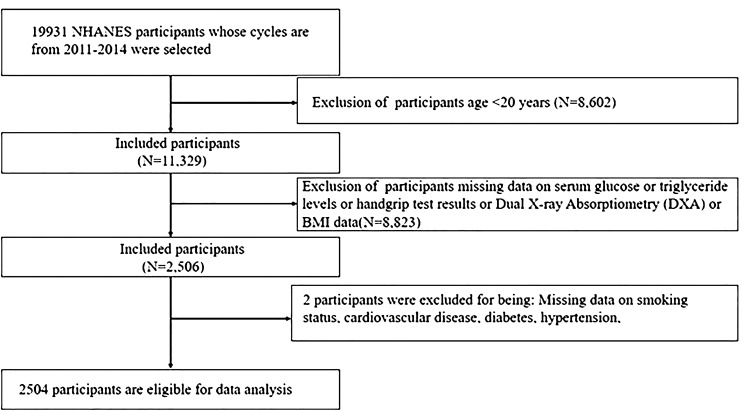
Between 2011 to 2014, data from the NHANES were used to conduct a nationally representative study involving 2,504 participants. LMM, LMS, and sarcopenia were the outcome variables. Moreover, this positive correlation persists irrespective of age and gender.
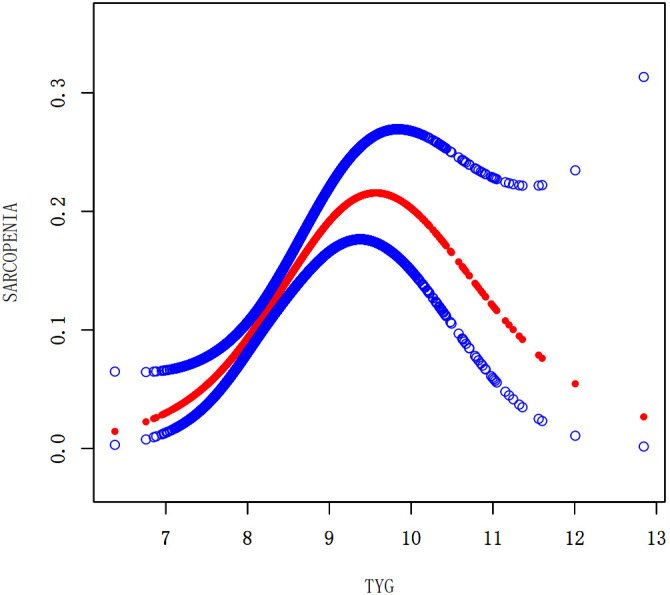
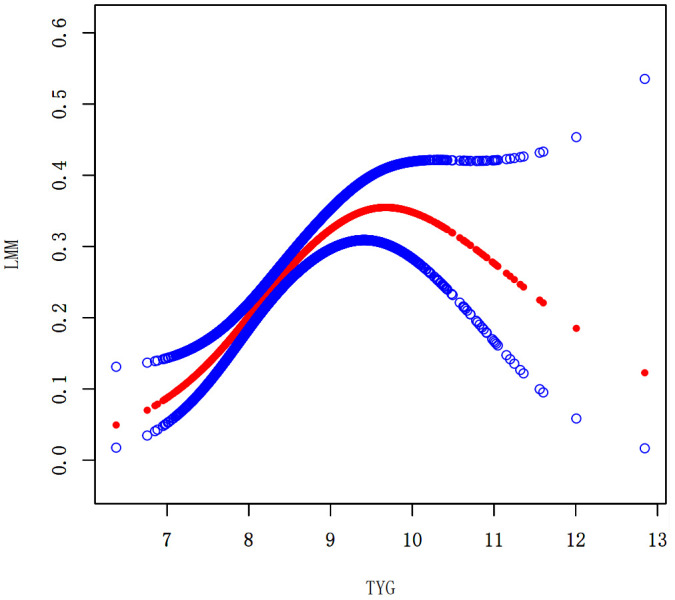
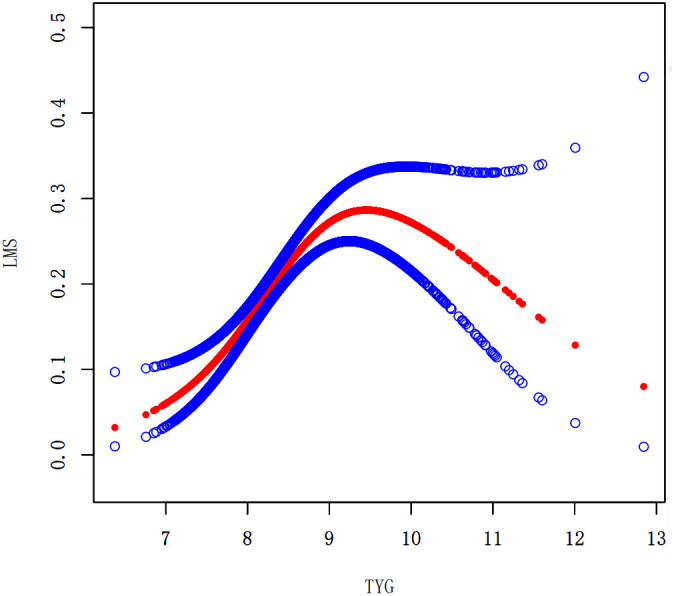
The TyG index revealed a significant correlation with the prevalence of developing LMM (OR = 1.63(1.26-2.11), =0.001), LMS (OR = 1.61(1.36-1.91), <0.001) and sarcopenia (OR = 1.59 (1.23-2.07), <0.001), after correcting for all variables. Utilizing smooth curve fitting alongside two-piecewise linear regression models, an inverted U-shaped correlation between the TyG index and the prevalence of LMM, LMS, and sarcopenia. Finally, subgroup analysis revealed that the association between the TyG index and LMM, LMS, and sarcopenia was particularly evident in all gender, age subgroups, and individuals with a normal BMI of 25.
Sarcopenia and the TyG index reveal an essential positive link. It highlights the potential utility of the TyG index as a screening tool for identifying individuals at risk of sarcopenia earlier.
新开发的技术,甘油三酯-葡萄糖(TyG)指数,提供了一种比胰岛素抵抗评估的稳态模型(HOMA-IR)更直接的方法来识别 IR。然而,还没有系统的分析研究过 TyG 指数与美国低肌肉量(LMM)、低肌肉力量(LMS)和肌少症之间的联系。因此,本研究旨在探讨 TyG 指数与 LMM、LMS 和肌少症之间的关系。
在 2011 年至 2014 年期间,利用 NHANES 数据进行了一项全国代表性研究,涉及 2504 名参与者。LMM、LMS 和肌少症是结果变量。此外,这种正相关关系在不受年龄和性别影响的情况下仍然存在。
TyG 指数与 LMM 的患病率呈显著相关(OR=1.63(1.26-2.11),=0.001),LMS(OR=1.61(1.36-1.91),<0.001)和肌少症(OR=1.59(1.23-2.07),<0.001),在调整所有变量后。利用平滑曲线拟合和两段线性回归模型,TyG 指数与 LMM、LMS 和肌少症的患病率之间呈倒 U 型关系。最后,亚组分析显示,TyG 指数与 LMM、LMS 和肌少症之间的关联在所有性别、年龄亚组以及 BMI 正常(25)的个体中尤为明显。
肌少症和 TyG 指数之间存在重要的正相关关系。这突出了 TyG 指数作为一种早期识别肌少症风险人群的筛查工具的潜在效用。