Raut Ashwinikumar, Tripathi Raakhi, Marathe Padmaja A, Uchil Dinesh A, Agashe Shubhada, Rege Nirmala, Vaidya Ashok B
Clinical Research and Integrative Medicine Department, Kasturba Health Society, Medical Research Centre, Mumbai, IND.
Pharmacology and Therapeutics Department, King Edward Memorial Hospital and Seth Gordhandas Sunderdas Medical College, Mumbai, IND.
Cureus. 2024 Sep 8;16(9):e68940. doi: 10.7759/cureus.68940. eCollection 2024 Sep.
Sarcopenia is associated with chronic inflammation, a sedentary lifestyle, and ageing. However, there exists no drug, which is safe and effective for long-term use. Ashwagandha ( (L.) Dunal) has the potential to fill this therapeutic gap based on its efficacy and safety profile; hence, the present study was planned to evaluate its effect on inflammatory biomarkers and muscle status in healthy volunteers.
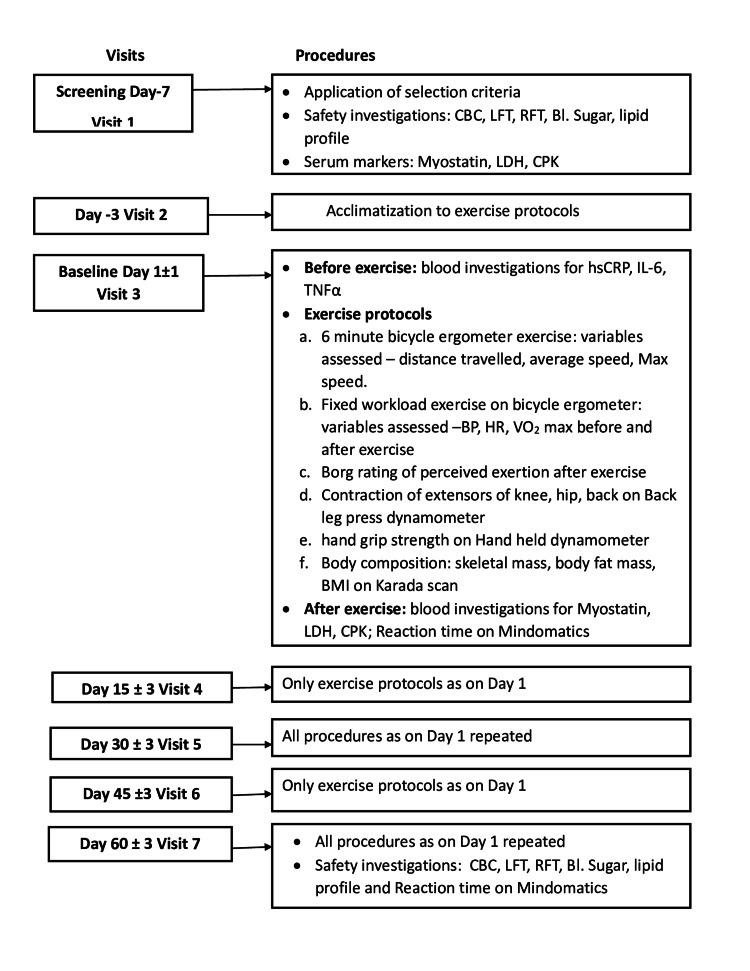
A prospective, double-blind, randomized, placebo-controlled clinical study was conducted to evaluate the effects of Ashwagandha extract in healthy volunteers (February 2021 to May 2022) who received either Ashwagandha extract tablets 250 mg or a placebo twice daily for 60 days. The physical performance on a bicycle ergometer, inflammatory/muscle status biomarkers, body composition, reaction time, hemogram, and organ function tests was assessed at baseline, day 30, and day 60.
In the Ashwagandha group, there was a statistically significant (p<0.05) improvement in total distance travelled (Ashwagandha 2.85 ± 0.54 km vs placebo 2.16 ± 0.62 km), average speed achieved (Ashwagandha 25.6 ± 5.7 km/hour vs placebo 22.2 ± 5.48 km/hour) on a bicycle ergometer from the baseline visit (V3) to the last visit (V7) as compared to the placebo group. The observations on hand-grip strength, back-leg press, skeletal muscle mass, and VO max showed an increasing trend from V3 to V7, whereas the results of the three inflammatory markers (hs-C-reactive protein (CRP) mg/L; IL-6; TNF-alpha ) and the muscle marker (myostatin) revealed a decreasing trend from V3 to V7 in the Ashwagandha group. Ashwagandha extract was found to be safe in healthy volunteers as evidenced by the clinical profile, laboratory investigations, and reaction time test.
Ashwagandha extract supplementation was safe and effective in enhancing physical performance and strengthening muscle mass and could be a potential candidate for treating sarcopenia.
肌肉减少症与慢性炎症、久坐不动的生活方式以及衰老有关。然而,目前尚无长期使用安全有效的药物。基于其功效和安全性,南非醉茄(Withania somnifera (L.) Dunal)有潜力填补这一治疗空白;因此,本研究旨在评估其对健康志愿者炎症生物标志物和肌肉状态的影响。
进行了一项前瞻性、双盲、随机、安慰剂对照的临床研究,以评估南非醉茄提取物对健康志愿者(2021年2月至2022年5月)的影响,这些志愿者每天两次服用250毫克南非醉茄提取物片或安慰剂,持续60天。在基线、第30天和第60天评估自行车测力计上的身体表现、炎症/肌肉状态生物标志物、身体成分、反应时间、血常规和器官功能测试。
在南非醉茄组中,与安慰剂组相比,从基线访视(V3)到最后一次访视(V7),自行车测力计上的总行驶距离(南非醉茄组2.85±0.54千米,安慰剂组2.16±0.62千米)和平均速度(南非醉茄组25.6±5.7千米/小时,安慰剂组22.2±5.48千米/小时)有统计学意义的改善(p<0.05)。从V3到V7,握力、后腿部压力、骨骼肌质量和最大摄氧量的观察结果呈上升趋势,而南非醉茄组中三种炎症标志物(高敏C反应蛋白(CRP)毫克/升;白细胞介素-6;肿瘤坏死因子-α)和肌肉标志物(肌肉生长抑制素)的结果从V3到V7呈下降趋势。临床概况、实验室检查和反应时间测试证明,南非醉茄提取物在健康志愿者中是安全的。
补充南非醉茄提取物在提高身体表现和增强肌肉质量方面是安全有效的,可能是治疗肌肉减少症的潜在候选药物。