Department of Computer Science Engineering and School of Engineering and Applied Sciences, Bennett University, Plot Nos 8-11, TechZone II, Greater Noida, 201310, Uttar Pradesh, India.
Department of Occupational Therapy and Graduate Institute of Behavioral Sciences, College of Medicine, Chang Gung University, No. 259, Wenhua 1st Rd., Taoyuan, Taiwan.
J Neuroeng Rehabil. 2020 Sep 29;17(1):131. doi: 10.1186/s12984-020-00758-3.
Accurate prediction of motor recovery after stroke is critical for treatment decisions and planning. Machine learning has been proposed to be a promising technique for outcome prediction because of its high accuracy and ability to process large volumes of data. It has been used to predict acute stroke recovery; however, whether machine learning would be effective for predicting rehabilitation outcomes in chronic stroke patients for common contemporary task-oriented interventions remains largely unexplored. This study aimed to determine the accuracy and performance of machine learning to predict clinically significant motor function improvements after contemporary task-oriented intervention in chronic stroke patients and identify important predictors for building machine learning prediction models.
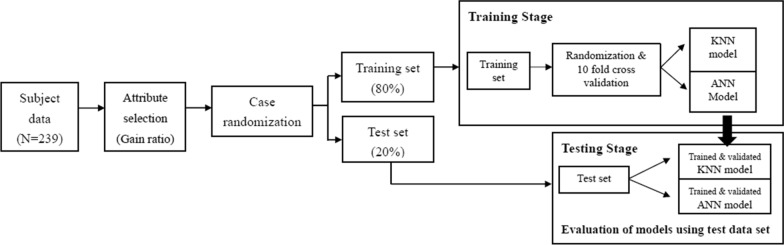
This study was a secondary analysis of data using two common machine learning approaches, which were the k-nearest neighbor (KNN) and artificial neural network (ANN). Chronic stroke patients (N = 239) that received 30 h of task-oriented training including the constraint-induced movement therapy, bilateral arm training, robot-assisted therapy and mirror therapy were included. The Fugl-Meyer assessment scale (FMA) was the main outcome. Potential predictors include age, gender, side of lesion, time since stroke, baseline functional status, motor function and quality of life. We divided the data set into a training set and a test set and used the cross-validation procedure to construct machine learning models based on the training set. After the models were built, we used the test data set to evaluate the accuracy and prediction performance of the models.
Three important predictors were identified, which were time since stroke, baseline functional independence measure (FIM) and baseline FMA scores. Models for predicting motor function improvements were accurate. The prediction accuracy of the KNN model was 85.42% and area under the receiver operating characteristic curve (AUC-ROC) was 0.89. The prediction accuracy of the ANN model was 81.25% and the AUC-ROC was 0.77.
Incorporating machine learning into clinical outcome prediction using three key predictors including time since stroke, baseline functional and motor ability may help clinicians/therapists to identify patients that are most likely to benefit from contemporary task-oriented interventions. The KNN and ANN models may be potentially useful for predicting clinically significant motor recovery in chronic stroke.
准确预测中风后的运动功能恢复对于治疗决策和规划至关重要。机器学习因其高精度和处理大量数据的能力而被提出是一种很有前途的技术,用于预测结果。它已被用于预测急性中风后的恢复;然而,机器学习是否能够有效地预测慢性中风患者接受常见的现代任务导向干预后的康复结果,在很大程度上仍未得到探索。本研究旨在确定机器学习在预测慢性中风患者接受现代任务导向干预后临床显著运动功能改善的准确性和性能,并确定构建机器学习预测模型的重要预测因素。
本研究是使用两种常见的机器学习方法(k 最近邻 (KNN) 和人工神经网络 (ANN))对数据进行的二次分析。纳入接受 30 小时任务导向训练的慢性中风患者(N=239),包括强制性运动疗法、双侧手臂训练、机器人辅助治疗和镜像治疗。主要结局是 Fugl-Meyer 评估量表(FMA)。潜在的预测因素包括年龄、性别、病变侧、中风后时间、基线功能状态、运动功能和生活质量。我们将数据集分为训练集和测试集,并使用交叉验证程序根据训练集构建机器学习模型。在构建模型后,我们使用测试数据集评估模型的准确性和预测性能。
确定了三个重要的预测因素,即中风后时间、基线功能性独立性测量(FIM)和基线 FMA 评分。预测运动功能改善的模型是准确的。KNN 模型的预测准确率为 85.42%,受试者工作特征曲线下的面积(AUC-ROC)为 0.89。ANN 模型的预测准确率为 81.25%,AUC-ROC 为 0.77。
将机器学习纳入使用三个关键预测因素(包括中风后时间、基线功能和运动能力)进行临床结果预测中,可能有助于临床医生/治疗师识别最有可能从现代任务导向干预中获益的患者。KNN 和 ANN 模型可能有助于预测慢性中风患者的临床显著运动恢复。