Department of Neuroscience, University of Wisconsin, Madison, WI, USA.
McPherson Eye Research Institute, University of Wisconsin, Madison, WI, USA.
Nat Commun. 2024 Oct 12;15(1):8821. doi: 10.1038/s41467-024-53061-3.
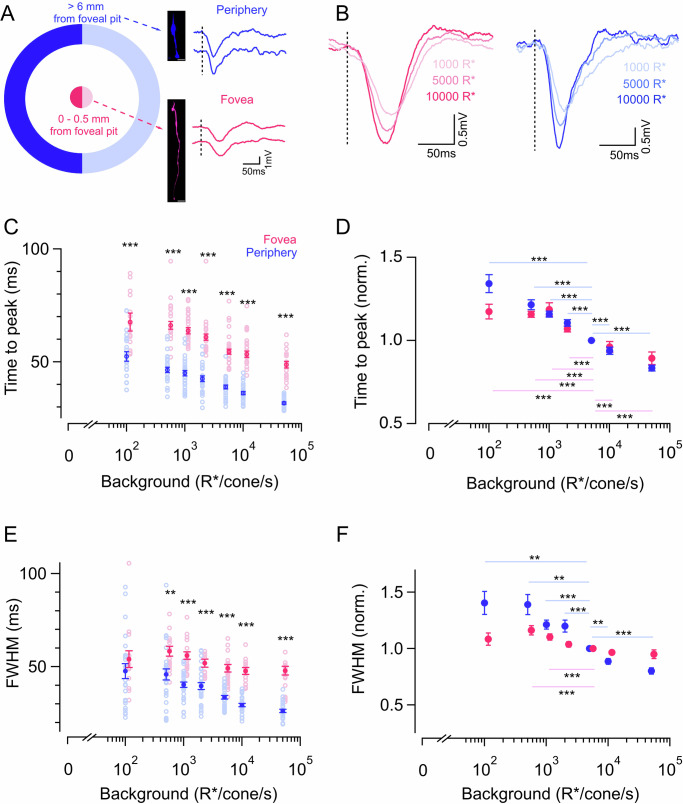
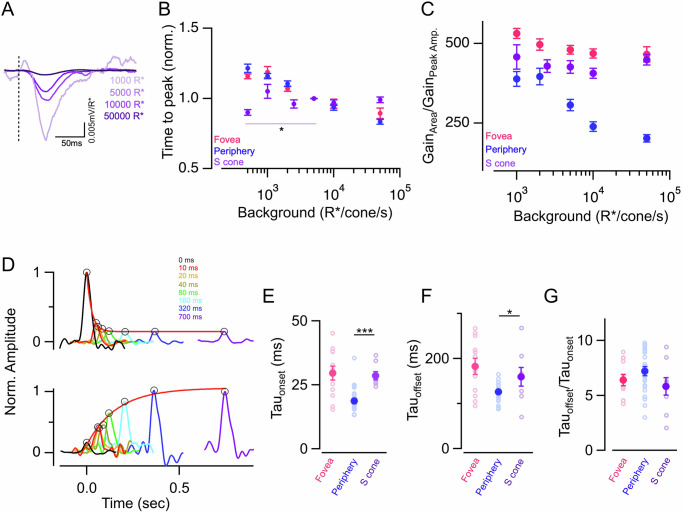
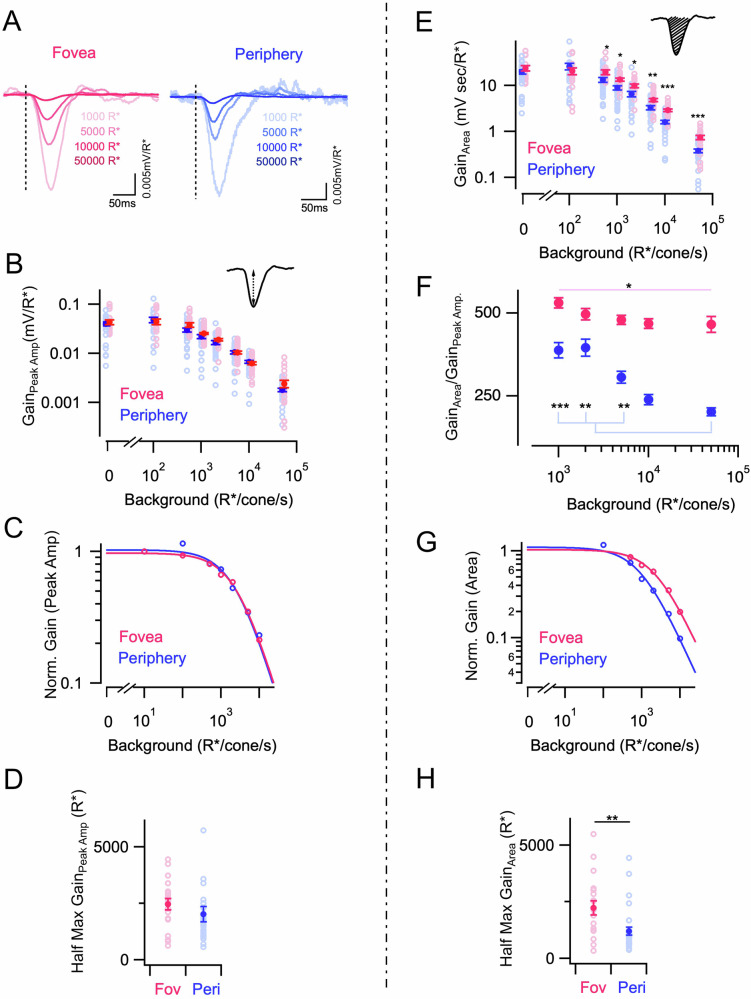
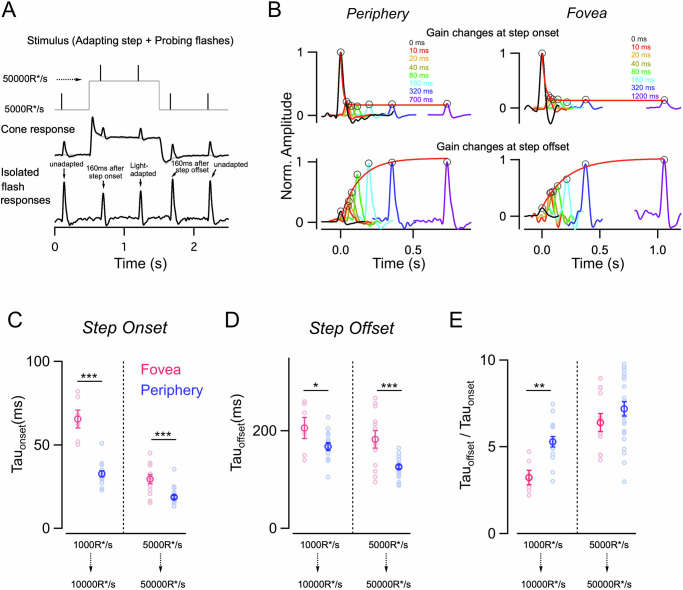
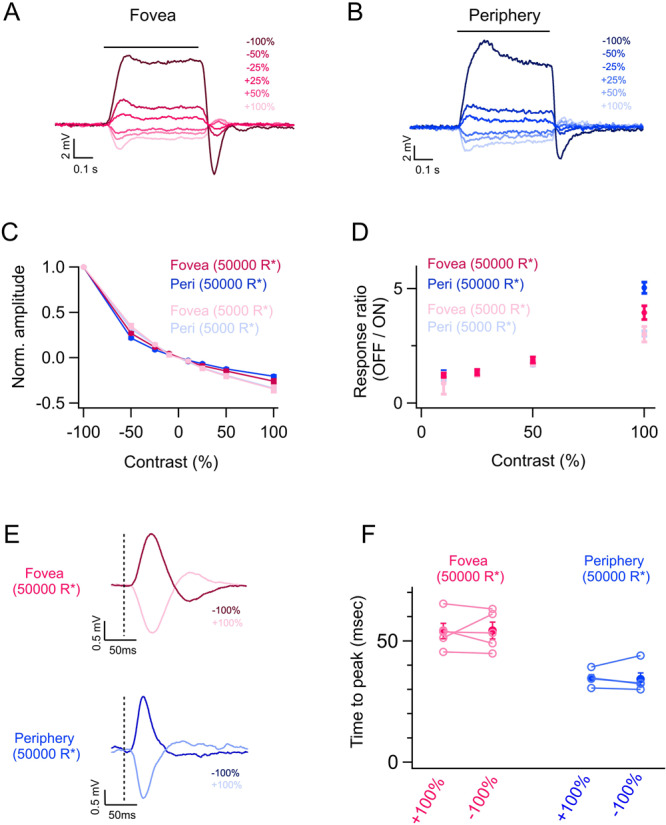
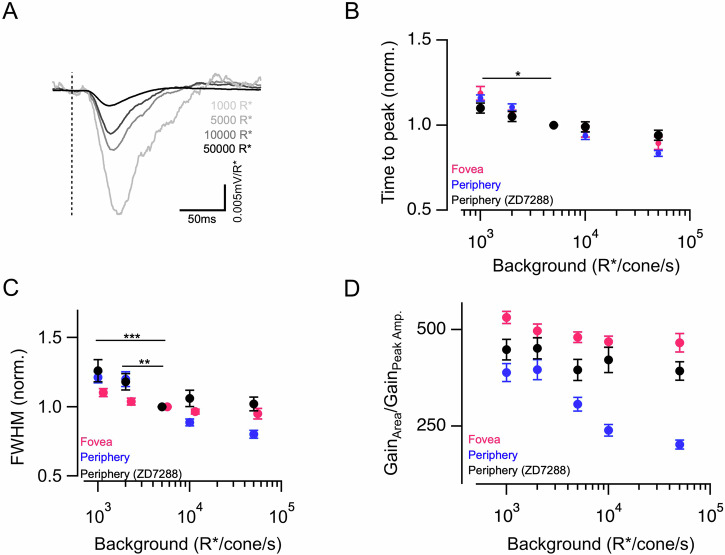
Adaptation in cone photoreceptors allows our visual system to effectively operate over an enormous range of light intensities. However, little is known about the properties of cone adaptation in the specialized region of the primate central retina called the fovea, which is densely packed with cones and mediates high-acuity central vision. Here we show that macaque foveal cones exhibit weaker and slower luminance adaptation compared to cones in the peripheral retina. We find that this difference in adaptive properties between foveal and peripheral cones is due to differences in the magnitude of a hyperpolarization-activated current, I. This I current regulates the strength and time course of luminance adaptation in peripheral cones where it is more prominent than in foveal cones. A weaker and slower adaptation in foveal cones helps maintain a higher sensitivity for a longer duration which may be well-suited for maximizing the collection of high-acuity information at the fovea during gaze fixation between rapid eye movements.
视锥细胞的适应能力使我们的视觉系统能够在极其广泛的光强范围内有效地运作。然而,对于在灵长类动物中央视网膜的一个特殊区域——中央凹的视锥细胞适应特性,我们知之甚少。中央凹内密集分布着视锥细胞,负责介导高分辨率的中央视觉。在这里,我们发现与周边视网膜的视锥细胞相比,猴眼的中央凹视锥细胞的亮度适应能力较弱且较慢。我们发现,中央凹和周边视锥细胞之间适应特性的这种差异是由于超极化激活电流 I 的幅度不同所致。该 I 电流调节周边视锥细胞亮度适应的强度和时程,其作用比中央凹视锥细胞更为显著。中央凹视锥细胞较弱且较慢的适应有助于在较长时间内保持较高的灵敏度,这可能非常适合在快速眼球运动之间的注视过程中,最大限度地收集中央凹处的高分辨率信息。