Muller Angela M, Manning Victoria, Wong Christy Y F, Pennington David L
University of California San Francisco, Department of Psychiatry, San Francisco, California, USA.
Northern California Institute for Research and Education (NCIRE), San Francisco, California, USA.
medRxiv. 2024 Sep 27:2024.09.26.24314399. doi: 10.1101/2024.09.26.24314399.
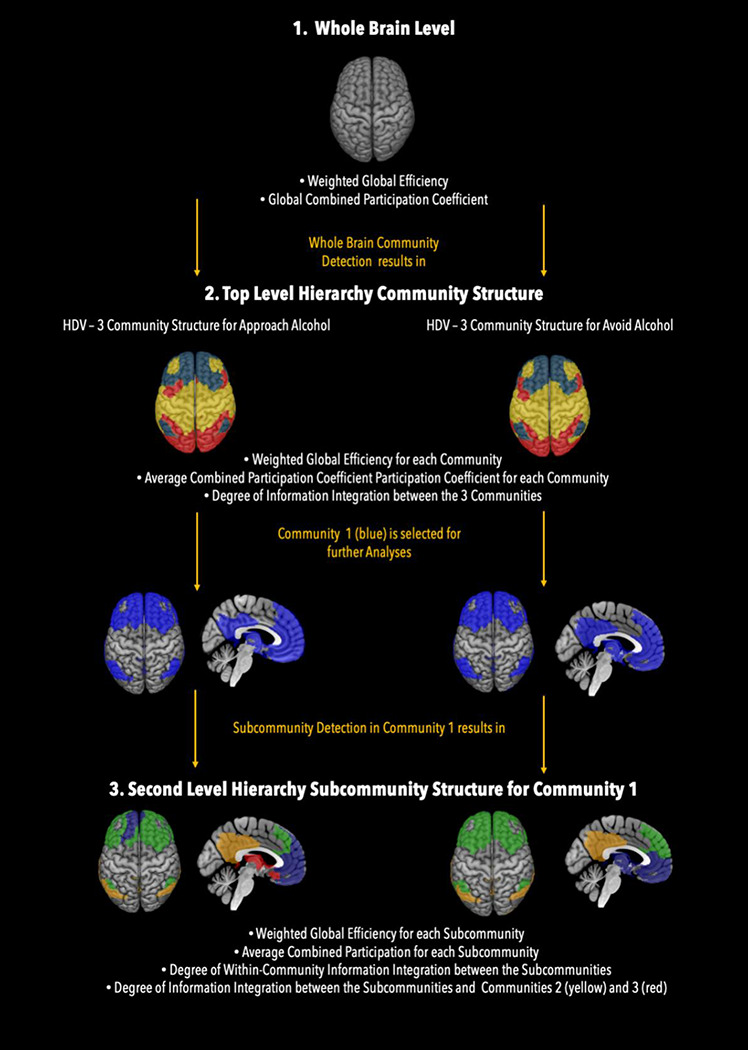
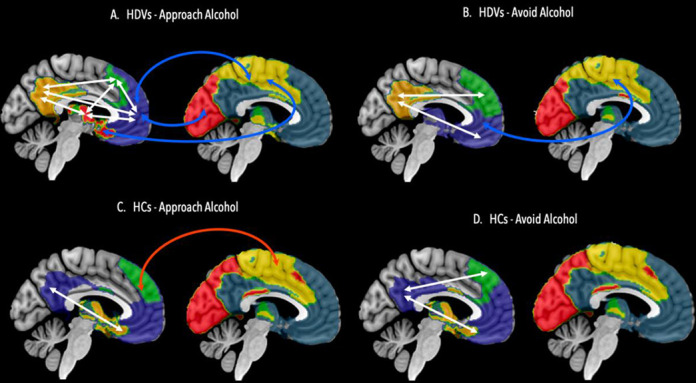
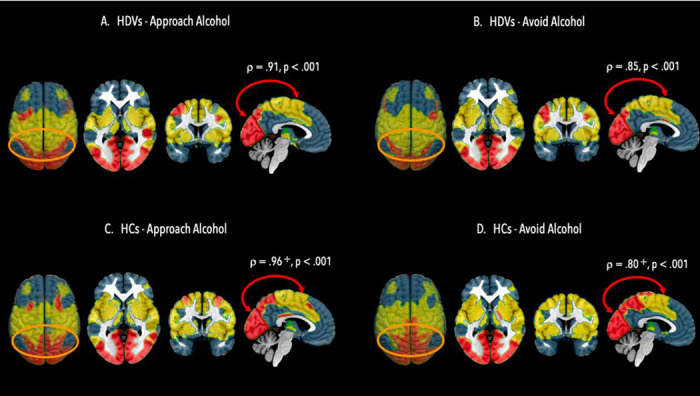
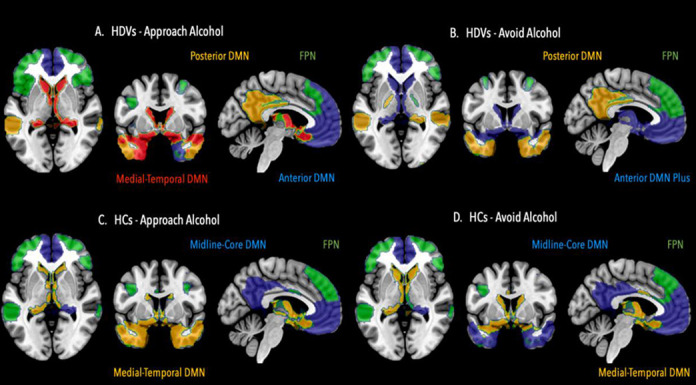
Alcohol approach bias, a tendency to approach rather than to avoid alcohol and alcohol-related cues regardless of associated negative consequences, is an emerging key characteristic of alcohol use disorder (AUD). Reaction times from the Approach-Avoidance Task (AAT) can be used to quantify alcohol approach bias. However, only a handful of studies have investigated the neural correlates of implicit alcohol approach behavior. Graph Theory Analysis (GTA) metrics, specifically, weighted global efficiency (wGE), community detection, and inter-community information integration were used to analyze functional magnetic resonance imaging (fMRI) data of an in-scanner version of the AAT from 31 heavy drinking Veterans with AUD (HDV) engaged in out-patient treatment and 19 healthy Veterans as controls (HC). We found a functional imprint of alcohol approach bias in HDVs. HDVs showed significantly higher wGE values for approaching than for avoiding alcohol, indicating that their brain was more efficiently organized or functionally set to approach alcohol in the presence to alcohol-related external cues. In contrast, Brains of HCs did not show such a processing advantage for either the approach or avoid condition. Further post-hoc analyses revealed that HDVs and HCs differed in how they implemented top-down control when approaching/avoiding alcohol and in how the fronto-parietal control network interacted with subsystems of the default mode network. These findings contribute to understanding the complex neural underpinnings of alcohol approach bias and lay the foundation for developing more potent and targeted interventions to modify these neural patterns in AUD patients.
酒精趋近偏向,即无论有无相关负面后果,都倾向于趋近而非回避酒精及与酒精相关线索的一种趋势,是酒精使用障碍(AUD)新出现的一个关键特征。趋近-回避任务(AAT)的反应时间可用于量化酒精趋近偏向。然而,仅有少数研究探究了内隐酒精趋近行为的神经关联。具体而言,采用图论分析(GTA)指标,即加权全局效率(wGE)、社区检测和社区间信息整合,来分析31名接受门诊治疗的患有AUD的重度饮酒退伍军人(HDV)和19名作为对照的健康退伍军人(HC)在扫描仪内进行的AAT版本的功能磁共振成像(fMRI)数据。我们在HDV中发现了酒精趋近偏向的功能印记。HDV在趋近酒精时的wGE值显著高于回避酒精时的wGE值,这表明在存在与酒精相关的外部线索时,他们的大脑在组织上更高效或在功能上更倾向于趋近酒精。相比之下,HC的大脑在趋近或回避条件下均未表现出这种处理优势。进一步的事后分析表明,HDV和HC在趋近/回避酒精时实施自上而下控制的方式以及额顶叶控制网络与默认模式网络子系统的相互作用方式上存在差异。这些发现有助于理解酒精趋近偏向复杂的神经基础,并为开发更有效、更有针对性的干预措施以改变AUD患者的这些神经模式奠定基础。