Adelphi Values, Adelphi Mill, Grimshaw Lane, Bollington, Macclesfield, SK10 5JB, UK.
Department of Kinanthropology, Charles University, Prague, Czechia.
J Patient Rep Outcomes. 2024 Oct 14;8(1):118. doi: 10.1186/s41687-024-00789-7.
Medication non-adherence is a common issue in chronic illness. The World Health Organization has recognized a need for a valid and reliable method of measuring adherence to understand and mitigate non-adherence. This study aimed to psychometrically evaluate the English version of the Adelphi Adherence Questionnaire (ADAQ©), a questionnaire designed to assess patient-reported medication adherence across multiple therapy areas, in patients with Osteoarthritis (OA).
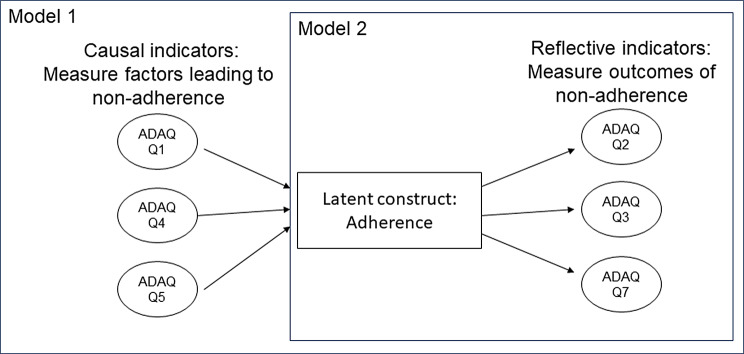
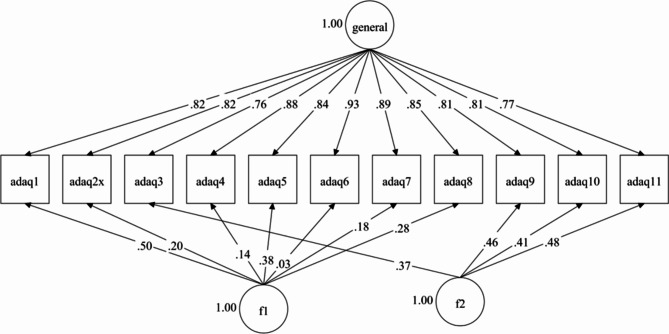
Data from the Adelphi OA Disease Specific Programme™, a survey of physicians and their consulting adult patients with OA conducted in the United States, November 2020 to March 2021, was used to assess the psychometric properties of the ADAQ. Patients completed the ADAQ, Adherence to Refills and Medication Scale (ARMS), Western Ontario and McMaster Universities Arthritis Index (WOMAC), and EQ-5D-3L. The measurement model of the 13-item ADAQ was assessed and refined using latent variable modelling (Multiple Indicator Multiple Cause, confirmatory and exploratory factor analyses, item response theory, Mokken scaling, and bifactor analyses). Correlational analyses (Spearman's rank and polyserial as appropriate) with ARMS, WOMAC, and EQ-5D-3L scores assessed construct validity. Anchor- and distribution-based analyses were performed to estimate between-group clinically important differences (CID).
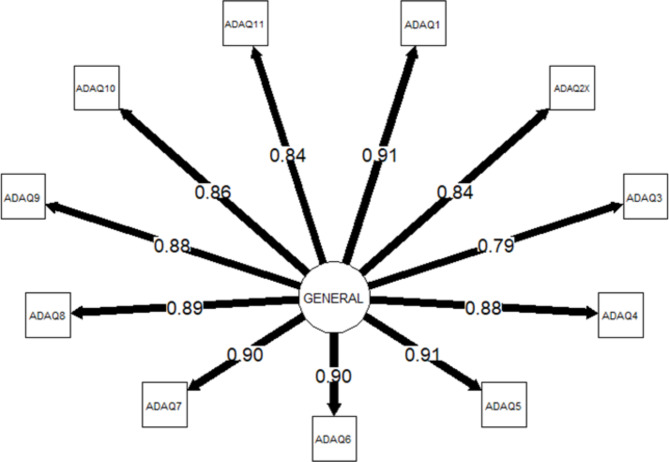
Overall, 723 patients were included in this analysis (54.5% female, 69.0% aged ≥ 60). Latent variable modelling indicated a unidimensional reflective model was appropriate, with a bifactor model confirming an 11-item essentially unidimensional score. Items 12 and 13 were excluded from scoring as they measured a different concept. The ADAQ had high internal reliability with omega hierarchical and Cronbach's alpha coefficients of 0.89 and 0.97, respectively. Convergent validity was supported by moderate correlations with items of the ARMS, and physician-reported adherence and compliance. Mean differences in ADAQ score between high and low adherence groups yielded CID estimates between 0.49 and 1.05 points, with a correlation-weighted average of 0.81 points.
This scoring model showed strong construct validity and internal consistency reliability when assessing medication adherence in OA. Future work should focus on confirming validity across a range of disease areas.
药物依从性是慢性病中的一个常见问题。世界卫生组织已经认识到需要一种有效的、可靠的方法来衡量依从性,以了解和减轻不依从性。本研究旨在对评估患者在多个治疗领域的报告药物依从性的 Adelphi 药物依从性问卷(ADAQ©)的英文版本进行心理测量评估,该问卷是为评估骨关节炎(OA)患者的药物依从性而设计的。
使用 2020 年 11 月至 2021 年 3 月在美国进行的 Adelphi OA 疾病专项计划™的医生及其咨询的成年 OA 患者调查数据,评估 ADAQ 的心理测量特性。患者完成 ADAQ、药物续用和用药量表(ARMS)、西安大略和麦克马斯特大学关节炎指数(WOMAC)和 EQ-5D-3L。使用潜在变量建模(多指标多原因、验证性和探索性因素分析、项目反应理论、Mokken 标度和双因子分析)评估和改进 13 项 ADAQ 的测量模型。与 ARMS、WOMAC 和 EQ-5D-3L 评分的相关性分析(适当使用 Spearman 秩和多序列)评估结构效度。进行基于锚定和分布的分析,以估计组间的临床重要差异(CID)。
总体而言,本分析纳入了 723 名患者(54.5%为女性,69.0%年龄≥60 岁)。潜在变量建模表明,单维反射模型是合适的,双因子模型证实了一个 11 项的基本单维评分。由于第 12 和 13 项测量了不同的概念,因此将其从评分中排除。ADAQ 的内部信度很高,omega 层次和 Cronbach's alpha 系数分别为 0.89 和 0.97。与 ARMS 项目以及医生报告的依从性和遵从性的中等相关性支持了收敛效度。高依从性和低依从性组之间 ADAQ 评分的平均差异产生了 0.49 至 1.05 点的 CID 估计值,相关加权平均值为 0.81 点。
在评估 OA 患者的药物依从性时,该评分模型显示出较强的结构有效性和内部一致性信度。未来的工作应集中在跨一系列疾病领域确认有效性。