MOE Key Laboratory of Bioinformatics, Center for Synthetic and Systems Biology, School of Life Sciences, Tsinghua University, Beijing, 100084, China.
Department of Dermatology, Beijing Tsinghua Changgung Hospital, School of Clinical Medicine, Tsinghua University, Beijing, 102218, China.
Cell Death Dis. 2024 Oct 14;15(10):748. doi: 10.1038/s41419-024-07121-7.
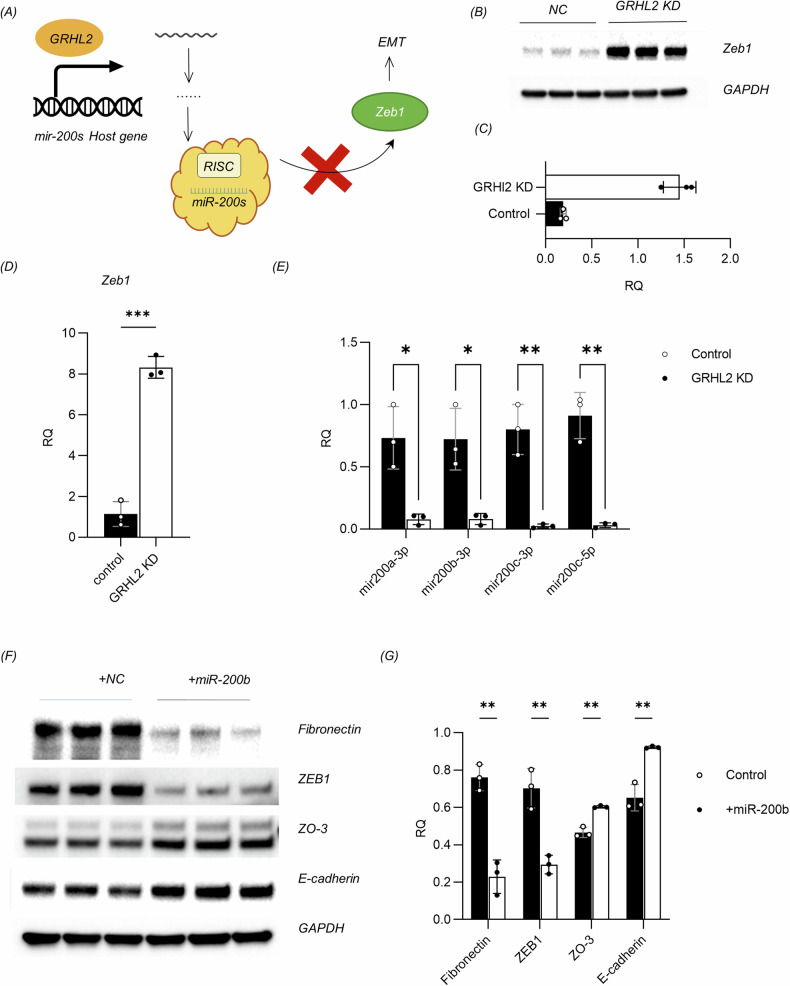
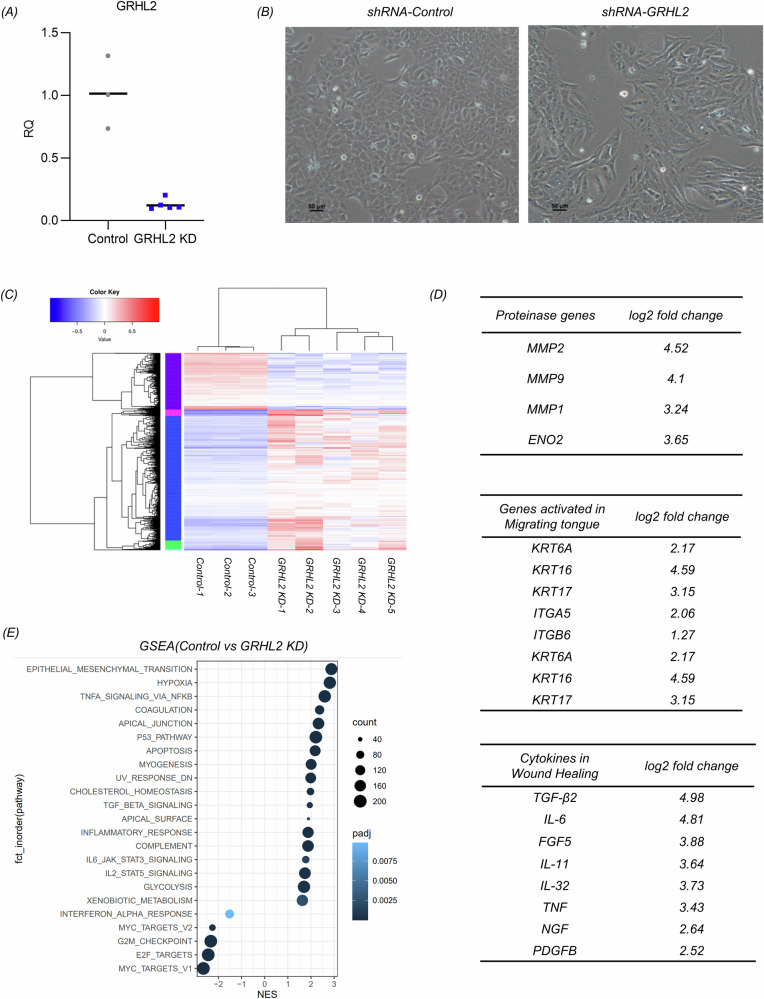
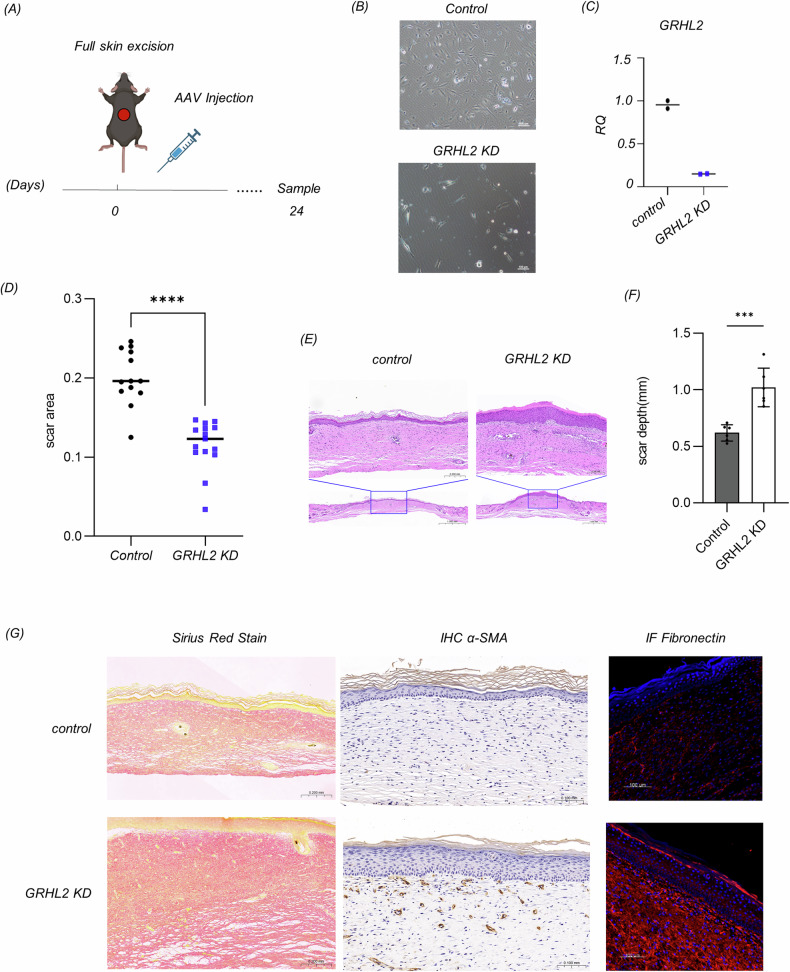
After cutaneous wounds successfully heal, keratinocytes that underwent the epithelial-mesenchymal transition (EMT) regain their epithelial characteristics, while in scar tissue, epidermal cells persist in a mesenchymal state. However, the regulatory mechanisms governing this reversion are poorly understood, and the impact of persistent mesenchymal-like epidermal cells in scar tissue remains unclear. In the present study, we found that during wound healing, the regulatory factor GRHL2 is highly expressed in normal epidermal cells, downregulated in EMT epidermal cells, and upregulated again during the process of mesenchymal-epithelial transition (MET). We further demonstrated that interfering with GRHL2 expression in epidermal cells can effectively induce the EMT. Conversely, the overexpression of GRHL2 in EMT epidermal cells resulted in partial reversion of the EMT to an epithelial state. To investigate the effects of failed MET in epidermal cells on skin wound healing, we interfered with GRHL2 expression in epidermal cells surrounding the cutaneous wound. The results demonstrated that the persistence of epidermal cells in the mesenchymal state promoted fibrosis in scar tissue, manifested by increased thickness of scar tissue, deposition of collagen and fibronectin, as well as the activation of myofibroblasts. Furthermore, the miR-200s/Zeb1 axis was perturbed in GRHL2 knockdown keratinocytes, and transfection with miR-200s analogs promoted the reversion of EMT in epidermal cells, which indicates that they mediate the EMT process in keratinocytes. These results suggest that restoration of the epithelial state in epidermal cells following the EMT is essential to wound healing, providing potential therapeutic targets for preventing scar formation.
皮肤创伤成功愈合后,经历上皮-间充质转化(EMT)的角质形成细胞恢复其上皮特征,而在瘢痕组织中,表皮细胞持续处于间充质状态。然而,调控这种逆转的机制尚不清楚,且在瘢痕组织中持续存在的间充质样表皮细胞的影响也尚不清楚。在本研究中,我们发现,在伤口愈合过程中,调节因子 GRHL2 在正常表皮细胞中高表达,在 EMT 表皮细胞中下调,在间充质-上皮转化(MET)过程中再次上调。我们进一步证实,干扰表皮细胞中 GRHL2 的表达可有效诱导 EMT。相反,在 EMT 表皮细胞中过表达 GRHL2 可导致 EMT 部分逆转至上皮状态。为了研究表皮细胞中 MET 失败对皮肤伤口愈合的影响,我们干扰了皮肤创伤周围表皮细胞中的 GRHL2 表达。结果表明,表皮细胞持续处于间充质状态促进了瘢痕组织中的纤维化,表现为瘢痕组织厚度增加、胶原和纤维连接蛋白沉积增加以及肌成纤维细胞激活。此外,GRHL2 敲低的角质形成细胞中 miR-200s/Zeb1 轴被扰乱,并且转染 miR-200s 类似物促进了 EMT 在表皮细胞中的逆转,这表明它们介导了角质形成细胞中的 EMT 过程。这些结果表明,EMT 后表皮细胞恢复上皮状态对于伤口愈合至关重要,为预防瘢痕形成提供了潜在的治疗靶点。