Chiu I-Min, Chen Tien-Yu, Zheng You-Cheng, Lin Xin-Hong, Cheng Fu-Jen, Ouyang David, Cheng Chi-Yung
Department of Emergency Medicine, Kaohsiung Chang Gung Memorial Hospital, Kaohsiung, Taiwan.
Department of Cardiology, Smidt Heart Institute, Cedars-Sinai Medical Center, Los Angeles, CA, USA.
NPJ Digit Med. 2024 Oct 15;7(1):282. doi: 10.1038/s41746-024-01269-4.
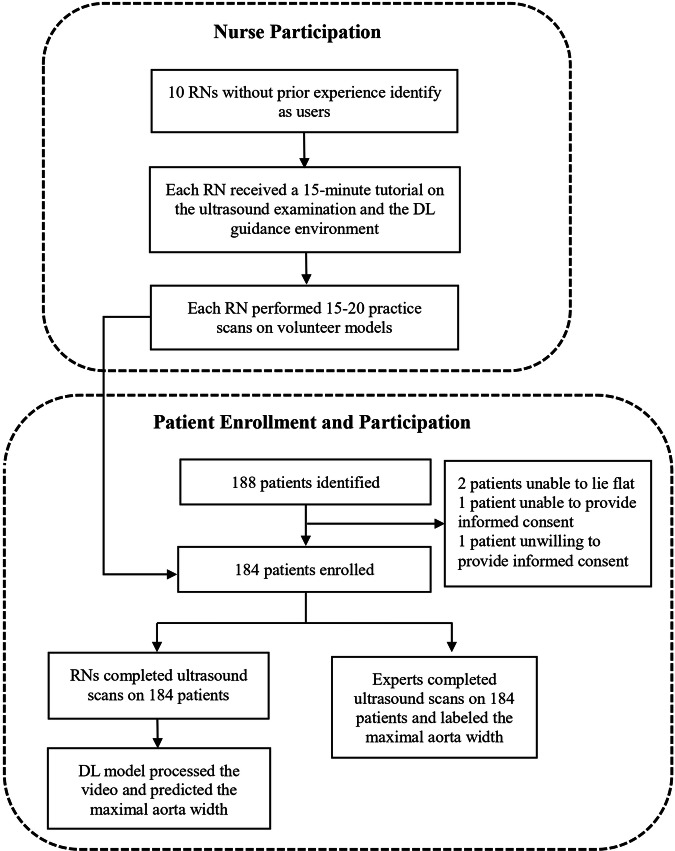
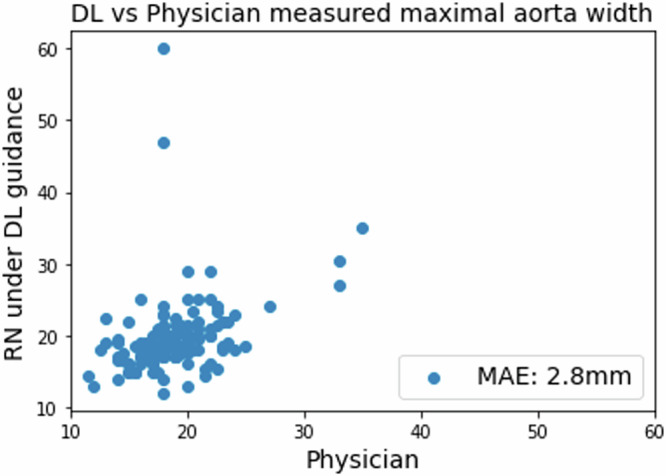
Abdominal aortic aneurysm (AAA) often remains undetected until rupture due to limited access to diagnostic ultrasound. This trial evaluated a deep learning (DL) algorithm to guide AAA screening by novice nurses with no prior ultrasonography experience. Ten nurses performed 15 scans each on patients over 65, assisted by a DL object detection algorithm, and compared against physician-performed scans. Ultrasound scan quality, assessed by three blinded expert physicians, was the primary outcome. Among 184 patients, DL-guided novices achieved adequate scan quality in 87.5% of cases, comparable to the 91.3% by physicians (p = 0.310). The DL model predicted AAA with an AUC of 0.975, 100% sensitivity, and 97.8% specificity, with a mean absolute error of 2.8 mm in predicting aortic width compared to physicians. This study demonstrates that DL-guided POCUS has the potential to democratize AAA screening, offering performance comparable to experienced physicians and improving early detection.
腹主动脉瘤(AAA)通常在破裂前都未被发现,因为诊断性超声检查的机会有限。本试验评估了一种深度学习(DL)算法,以指导没有超声检查经验的新手护士进行AAA筛查。10名护士在DL目标检测算法的辅助下,对65岁以上的患者每人进行15次扫描,并与医生进行的扫描结果进行比较。由三名不知情的专家医生评估的超声扫描质量是主要结果。在184名患者中,DL指导的新手在87.5%的病例中获得了足够的扫描质量,与医生的91.3%相当(p = 0.310)。DL模型预测AAA的AUC为0.975,灵敏度为100%,特异性为97.8%,与医生相比,预测主动脉宽度的平均绝对误差为2.8毫米。这项研究表明,DL指导的床旁超声检查有潜力使AAA筛查民主化,其性能与经验丰富的医生相当,并能改善早期检测。