Chiu I-Min, Vukadinovic Milos, Sahashi Yuki, Cheng Paul P, Cheng Chi-Yung, Cheng Susan, Ouyang David
Department of Cardiology, Smidt Heart Institute, Cedars-Sinai Medical Center, Los Angeles, CA, USA.
Department of Emergency Medicine, Chang Gung Memorial Hospital Kaohsiung Branch, Kaohsiung, Taiwan.
medRxiv. 2024 Dec 1:2024.11.27.24318110. doi: 10.1101/2024.11.27.24318110.
Timely and accurate detection of pericardial effusion and assessment cardiac tamponade remain challenging and highly operator dependent.
Artificial intelligence has advanced many echocardiographic assessments, and we aimed to develop and validate a deep learning model to automate the assessment of pericardial effusion severity and cardiac tamponade from echocardiogram videos.
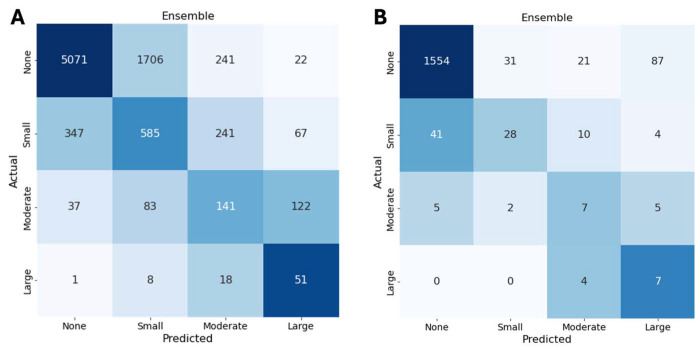
We developed a deep learning model (EchoNet-Pericardium) using temporal-spatial convolutional neural networks to automate pericardial effusion severity grading and tamponade detection from echocardiography videos. The model was trained using a retrospective dataset of 1,427,660 videos from 85,380 echocardiograms at Cedars-Sinai Medical Center (CSMC) to predict PE severity and cardiac tamponade across individual echocardiographic views and an ensemble approach combining predictions from five standard views. External validation was performed on 33,310 videos from 1,806 echocardiograms from Stanford Healthcare (SHC).
In the held out CSMC test set, EchoNet-Pericardium achieved an AUC of 0.900 (95% CI: 0.884-0.916) for detecting moderate or larger pericardial effusion, 0.942 (95% CI: 0.917-0.964) for large pericardial effusion, and 0.955 (95% CI: 0.939-0.968) for cardiac tamponade. In the SHC external validation cohort, the model achieved AUCs of 0.869 (95% CI: 0.794-0.933) for moderate or larger pericardial effusion, 0.959 (95% CI: 0.945-0.972) for large pericardial effusion, and 0.966 (95% CI: 0.906-0.995) for cardiac tamponade. Subgroup analysis demonstrated consistent performance across ages, sexes, left ventricular ejection fraction, and atrial fibrillation statuses.
Our deep learning-based framework accurately grades pericardial effusion severity and detects cardiac tamponade from echocardiograms, demonstrating consistent performance and generalizability across different cohorts. This automated tool has the potential to enhance clinical decision-making by reducing operator dependence and expediting diagnosis.
及时、准确地检测心包积液并评估心脏压塞仍然具有挑战性,且高度依赖操作人员。
人工智能已推动了许多超声心动图评估的发展,我们旨在开发并验证一种深度学习模型,以实现从超声心动图视频中自动评估心包积液严重程度和心脏压塞。
我们使用时空卷积神经网络开发了一种深度学习模型(EchoNet - 心包),以实现从超声心动图视频中自动进行心包积液严重程度分级和压塞检测。该模型使用来自雪松西奈医疗中心(CSMC)85380份超声心动图的1427660个视频的回顾性数据集进行训练,以预测各个超声心动图视图的心包积液严重程度和心脏压塞,并采用一种结合五个标准视图预测结果的集成方法。对来自斯坦福医疗保健(SHC)的1806份超声心动图的33310个视频进行了外部验证。
在预留的CSMC测试集中,EchoNet - 心包检测中度或更大心包积液的AUC为0.900(95%CI:0.884 - 0.916),检测大量心包积液的AUC为0.942(95%CI:0.917 - 0.964),检测心脏压塞的AUC为0.955(95%CI:0.939 - 0.968)。在SHC外部验证队列中,该模型检测中度或更大心包积液的AUC为0.869(95%CI:0.794 - 0.933),检测大量心包积液的AUC为0.959(95%CI:0.945 - 0.972),检测心脏压塞的AUC为0.966(95%CI:0.906 - 0.995)。亚组分析表明,在年龄、性别、左心室射血分数和房颤状态方面,模型表现一致。
我们基于深度学习的框架能够准确地对心包积液严重程度进行分级,并从超声心动图中检测心脏压塞,在不同队列中表现出一致的性能和可推广性。这种自动化工具有可能通过减少对操作人员的依赖并加快诊断来增强临床决策。