Faculty of Agro-Industry, Department of Food Science and Technology, Kasetsart University, Chatuchak, Bangkok, Thailand.
Faculty of Agriculture, Department of Animal Science, Kasetsart University, Chatuchak, Bangkok, Thailand.
J Insect Sci. 2020 Jan 1;20(2). doi: 10.1093/jisesa/ieaa014.
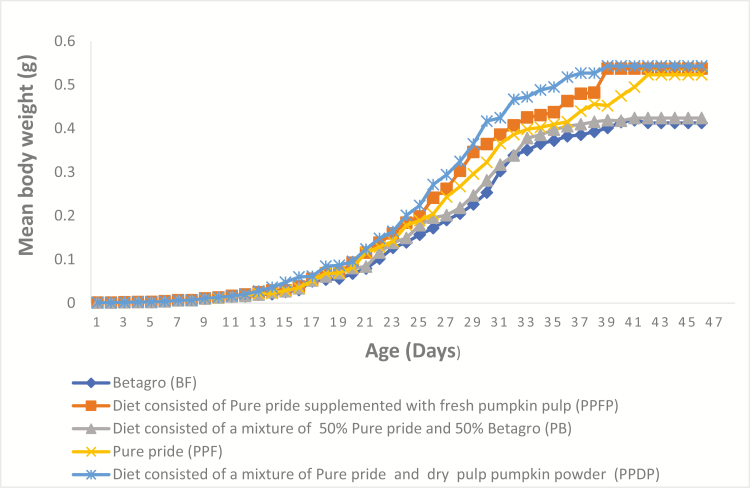
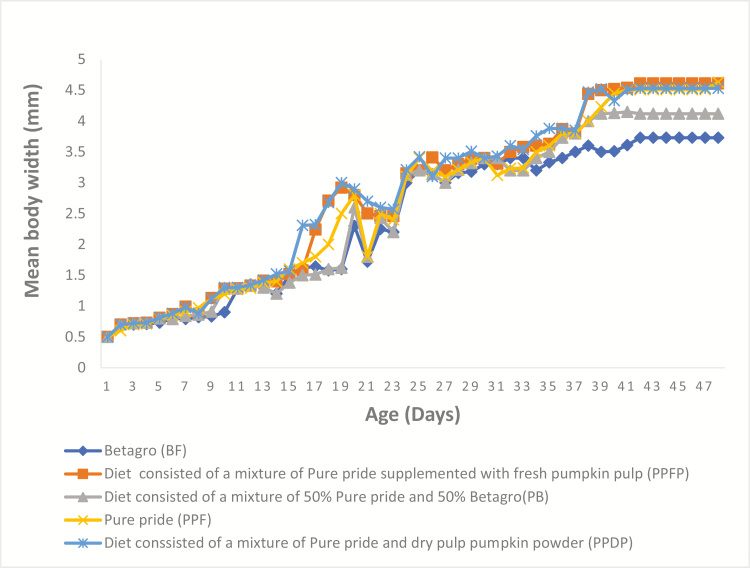
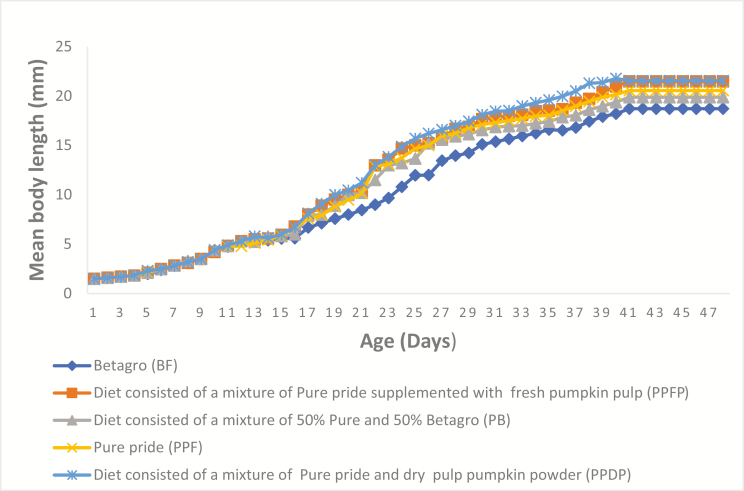
The house crickets, Acheta domesticus, are sustainable and nutritious future sources of food, due to their nutritional benefits, particular high protein content and potential in solving global malnutrition. Different diets, particularly protein content, can influence the growth and nutritional value of crickets. The aim of this present study was to evaluate the effects of commercial diets and other formulated diets on the nutritional composition and growth parameters of the house crickets, being a major challenge to cricket's farmers in Thailand. Feed conversion ratio were 1.50, 1.50, and 1.51 for fed crickets on a blend of 22% protein and dry pulp pumpkin powder, fed 22% protein plus fresh pumpkin pulp, and fed 22% protein alone, indicated that these groups are high feed convertors and represented the quality of these diets compared to 1.73 and 1.81 for fed crickets on a blend of 22% and 16% protein, and those fed on 16% protein alone. Fed crickets on 22% protein had the highest amount of protein (76%), the lowest (48%) in those fed on 22% protein and fresh pumpkin pulp inclusion. The group on 22% protein diet also had the highest amount of phosphorus, potassium, calcium, and sodium. Fed 22% protein and either dry pulp pumpkin powder or fresh pumpkin pulp condition have shown improvement in vitamin B content. Crickets can effectively be produced on 22% protein diet to improve yield output and several minerals such as phosphorus, potassium, calcium, and sodium. In contrast, the supplementation of 22% protein diet with pumpkin (Cucurbita maxima) will improve vitamin B content.
家蟋蟀(Acheta domesticus)是可持续且营养丰富的未来食物来源,因为它们具有营养价值,特别是高蛋白含量,并具有解决全球营养不良问题的潜力。不同的饮食,特别是蛋白质含量,可以影响蟋蟀的生长和营养价值。本研究的目的是评估商业饲料和其他配方饲料对家蟋蟀营养成分和生长参数的影响,这是泰国蟋蟀养殖户面临的主要挑战。对于以 22%蛋白质和干南瓜粉混合物喂养的蟋蟀,饲料转化率为 1.50、1.50 和 1.51;对于以 22%蛋白质加新鲜南瓜浆喂养的蟋蟀,以及对于单独以 22%蛋白质喂养的蟋蟀,这表明这些组是高饲料转化率者,并且与以 22%和 16%蛋白质混合物喂养的蟋蟀(1.73 和 1.81)相比,以及单独以 16%蛋白质喂养的蟋蟀相比,这些饲料的质量更高。以 22%蛋白质喂养的蟋蟀的蛋白质含量最高(76%),以 22%蛋白质和新鲜南瓜浆喂养的蟋蟀含量最低(48%)。以 22%蛋白质喂养的蟋蟀还具有最高的磷、钾、钙和钠含量。以 22%蛋白质饲料喂养蟋蟀,无论是添加干南瓜粉还是新鲜南瓜浆,都能提高维生素 B 含量。蟋蟀可以有效地以 22%蛋白质饲料生产,以提高产量和磷、钾、钙和钠等几种矿物质的含量。相比之下,南瓜(Cucurbita maxima)补充 22%蛋白质饮食可以提高维生素 B 含量。