Seong Jina, Lee Hee Yul, Jeong Jong Bin, Cho Du Yong, Kim Da Hyun, Lee Ji Ho, Lee Ga Young, Jang Mu Yeun, Lee Jin Hwan, Cho Kye Man
Department of GreenBio Science and Agri-Food Bio Convergence Institute, Gyeongsang National Univesity, Jinju 52725, Republic of Korea.
Department of Life Resource Industry, Dong-A University, 37, Nakdong-daero 550 beon-gil, Saha-gu, Busan 49315, Republic of Korea.
Foods. 2024 Oct 3;13(19):3155. doi: 10.3390/foods13193155.
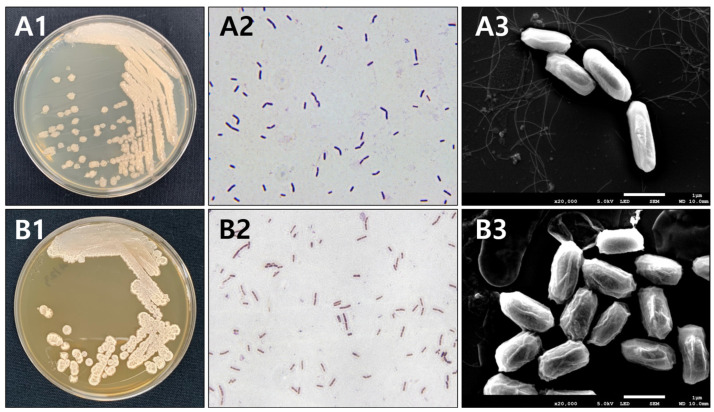
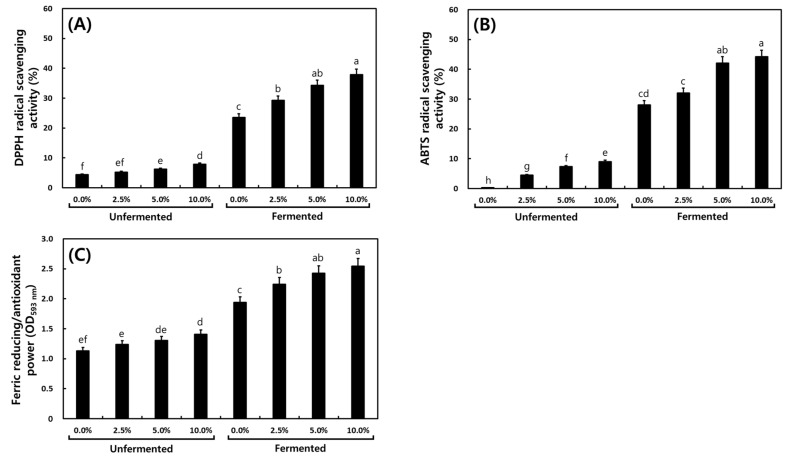
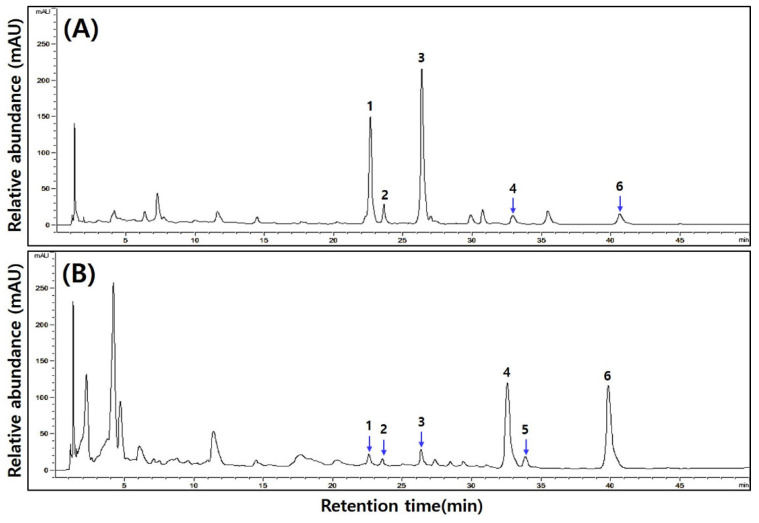
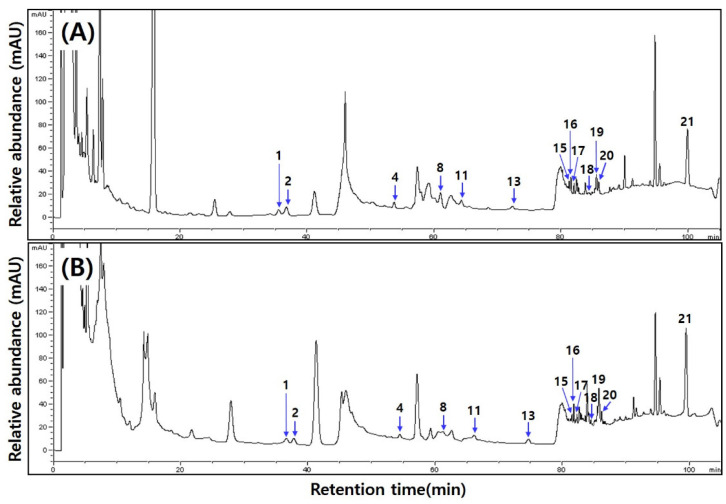
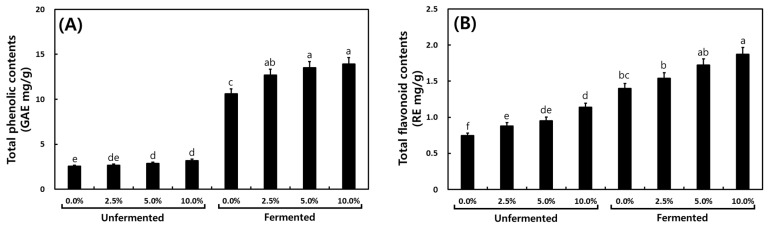
In this study, the nutrients, phytochemicals (including isoflavone and ginsenoside derivatives), and antioxidant activities of with different ratios (0%, 2.5%, 5%, and 10%) of mountain-cultivated ginseng (MCG) were compared and analyzed using microorganisms isolated from traditional . The IDCK 30 and IDCK 40 strains were confirmed as and , respectively, based on morphological, biological, biochemical, and molecular genetic identification, as well as cell wall fatty acid composition. The contents of amino acids and fatty acids showed no significant difference in relation to the ratio of MCG. After fermentation, isoflavone glycoside (such as daidzin, glycitin, and genistin) contents decreased, while aglycone (daidzein, glycitein, and genistein) contents increased. However, total ginsenoside contents were higher according to the ratio of MCG. After fermentation, ginsenoside Rg2, F2, and protopanaxadiol contents of decreased. Conversely, ginsenoside Rg3 (2.5%: 56.51 → 89.43 μg/g, 5.0%: 65.56 → 94.71 μg/g, and 10%: 96.05 → 166.90 μg/g) and compound K (2.5%: 28.54 → 69.43 μg/g, 5.0%: 41.63 → 150.72 μg/g, and 10%: 96.23 → 231.33 μg/g) increased. The total phenolic and total flavonoid contents were higher with increasing ratios of MCG and fermentation (fermented with 10% MCG: 13.60 GAE and 1.87 RE mg/g). Additionally, radical scavenging activities and ferric reducing/antioxidant power were significantly increased in fermented . This study demonstrates that the quality of improved, and with MCG as natural antioxidants may be useful in food and pharmaceutical applications.
在本研究中,使用从传统[具体来源未提及]分离出的微生物,对不同比例(0%、2.5%、5%和10%)山地栽培人参(MCG)的营养成分、植物化学物质(包括异黄酮和人参皂苷衍生物)及抗氧化活性进行了比较和分析。基于形态学、生物学、生物化学和分子遗传学鉴定以及细胞壁脂肪酸组成,IDCK 30和IDCK 40菌株分别被确认为[具体菌种1]和[具体菌种2]。氨基酸和脂肪酸含量与MCG比例无显著差异。发酵后,异黄酮糖苷(如大豆苷、染料木苷和葛根素)含量降低,而异黄酮苷元(大豆苷元、染料木素和金雀异黄素)含量增加。然而,总人参皂苷含量随MCG比例升高而增加。发酵后,[具体发酵物]的人参皂苷Rg2、F2和原人参二醇含量降低。相反,人参皂苷Rg3(2.5%:56.51→89.43μg/g,5.0%:65.56→94.71μg/g,10%:96.05→166.90μg/g)和化合物K(2.5%:28.54→69.43μg/g,5.0%:41.63→150.72μg/g,10%:96.23→231.33μg/g)增加。总酚和总黄酮含量随MCG比例增加和发酵而升高(10% MCG发酵的[具体发酵物]:13.60 GAE和1.87 RE mg/g)。此外,发酵[具体发酵物]的自由基清除活性和铁还原/抗氧化能力显著提高。本研究表明[具体发酵物]的品质得到改善,以MCG作为天然抗氧化剂的[具体发酵物]可能在食品和制药应用中有用。