Research Unit of Clinical Immunology and Vaccinology, Bambino Gesù Children's Hospital, IRCCS, Rome, Italy.
Precision Vaccines Program, Boston Children's Hospital, Boston, MA, USA.
Sci Rep. 2024 Oct 28;14(1):25792. doi: 10.1038/s41598-024-74066-4.
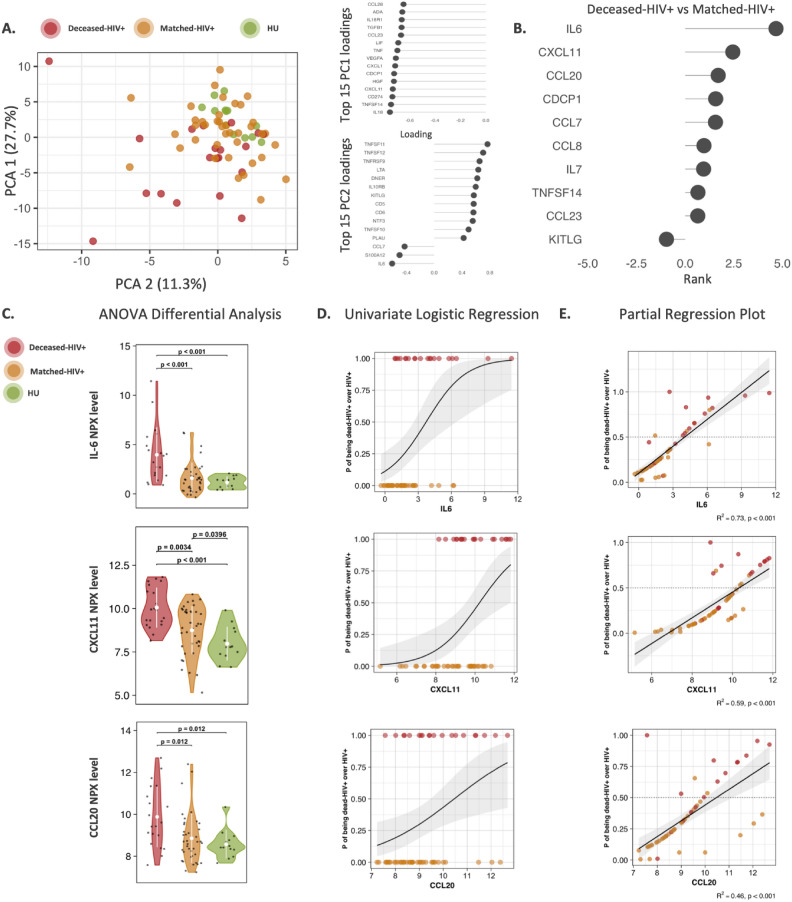
In this work our aim was to identify early biomarkers in plasma samples associated with mortality in children with perinatal HIV treated early in life, to potentially inform early intervention targeting this vulnerable group. 20/215 children (9.3%) with perinatal HIV, enrolled within 3 months of age died prematurely within the first year of the study, despite early ART initiation. Using a propensity score, we selected 40 alive study participants having similar clinical and virological records compared to the deceased group. 13 HIV unexposed (HU) healthy children were additionally used as controls. Baseline plasma samples were analyzed using a targeted proteomic approach, and to assess pathogen-associated and damage-associated molecular patterns (PAMPs, DAMPs) levels. Data from deceased participants were compared to both control groups, with multivariate logistic regression models used to evaluate the association between mortality and plasma proteins. We developed a machine learning model to predict mortality risk, finding that IL-6 and CXCL11 not only were higher in deceased children than Matched-children with HIV (p < 0.001 and p = 0.0034) but also predictive of mortality (accuracy of 77%); levels of PAMPs were higher in deceased children (p = 0.0016). Thus, measuring early inflammatory biomarkers, particularly IL-6, could help mortality risk prediction and potentially guide targeted interventions.
在这项工作中,我们的目的是鉴定与生命早期接受治疗的围生期 HIV 儿童死亡率相关的血浆样本中的早期生物标志物,以便为针对这一脆弱群体的早期干预提供信息。20/215 名(9.3%)患有围生期 HIV 的儿童,尽管早期开始 ART,但在研究的第一年过早夭折。通过倾向评分,我们选择了 40 名具有与死亡组相似的临床和病毒学记录的存活研究参与者。另外还使用了 13 名未感染 HIV(HU)的健康儿童作为对照。使用靶向蛋白质组学方法分析基线血浆样本,并评估病原体相关和损伤相关分子模式(PAMPs、DAMPs)的水平。将死亡参与者的数据与两组对照进行比较,使用多变量逻辑回归模型评估死亡率与血浆蛋白之间的关联。我们开发了一种机器学习模型来预测死亡风险,发现 IL-6 和 CXCL11 不仅在死亡儿童中高于 HIV 匹配儿童(p<0.001 和 p=0.0034),而且可以预测死亡(准确率为 77%);死亡儿童的 PAMPs 水平更高(p=0.0016)。因此,测量早期炎症生物标志物,特别是 IL-6,可能有助于预测死亡风险,并可能指导有针对性的干预措施。