Department of Proteomics and Signal Transduction; Max Planck Institute of Biochemistry, Martinsried, Germany.
Department of Dermatology, University Hospital Zurich, University of Zurich, Zurich, Switzerland.
Nature. 2024 Nov;635(8040):1001-1009. doi: 10.1038/s41586-024-08061-0. Epub 2024 Oct 16.
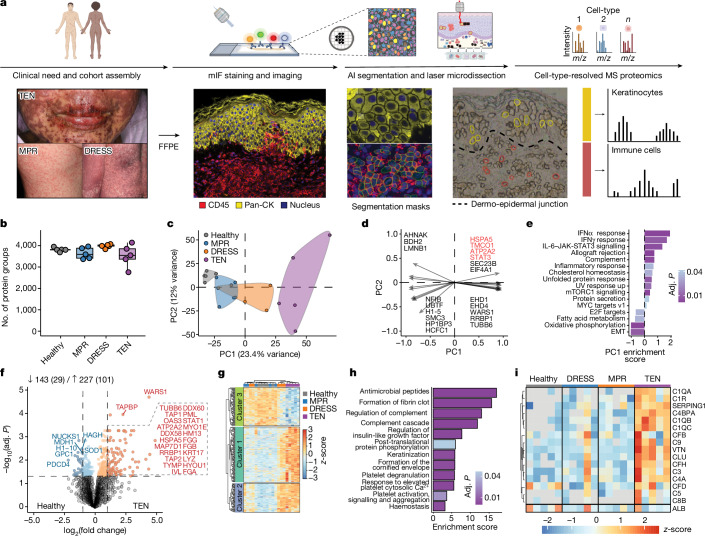
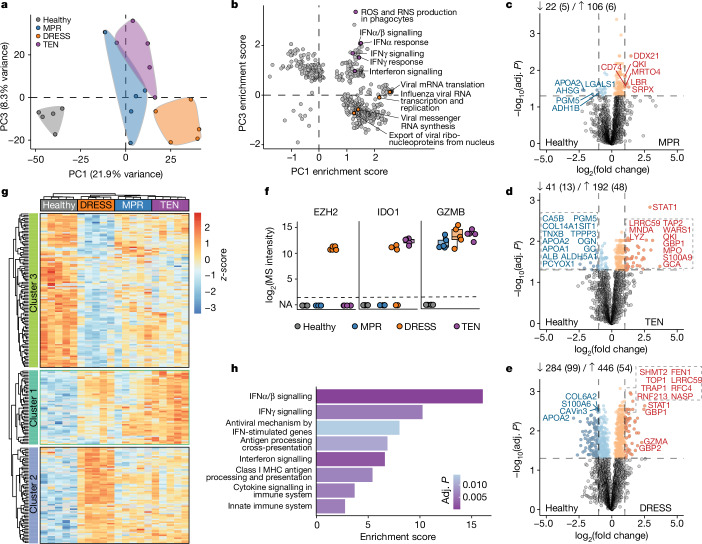
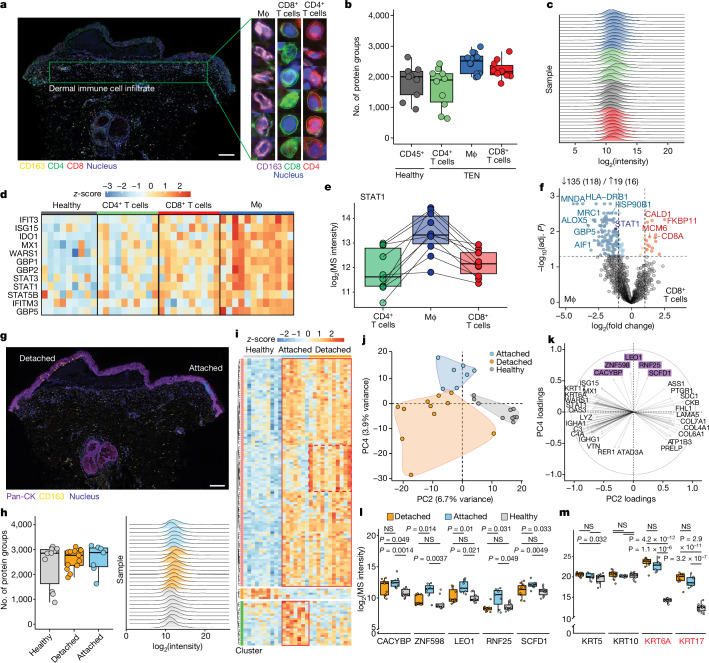
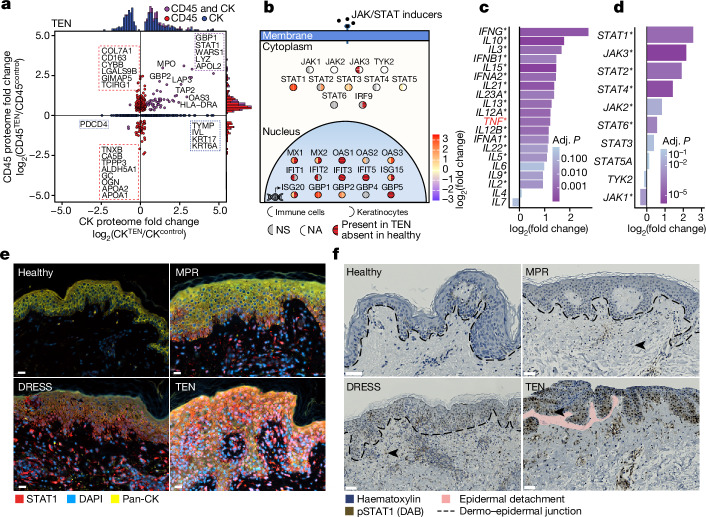
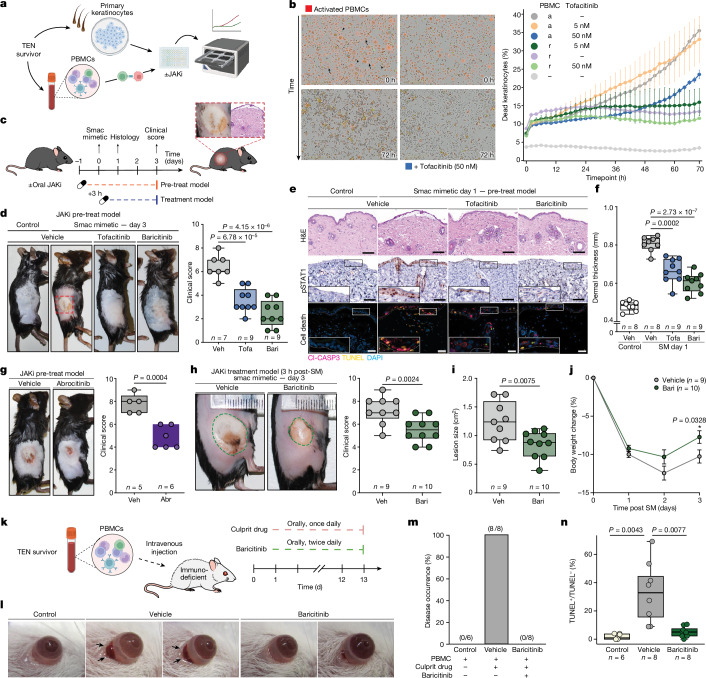
Toxic epidermal necrolysis (TEN) is a fatal drug-induced skin reaction triggered by common medications and is an emerging public health issue. Patients with TEN undergo severe and sudden epidermal detachment caused by keratinocyte cell death. Although molecular mechanisms that drive keratinocyte cell death have been proposed, the main drivers remain unknown, and there is no effective therapy for TEN. Here, to systematically map molecular changes that are associated with TEN and identify potential druggable targets, we utilized deep visual proteomics, which provides single-cell-based, cell-type-resolution proteomics. We analysed formalin-fixed, paraffin-embedded archived skin tissue biopsies of three types of cutaneous drug reactions with varying severity and quantified more than 5,000 proteins in keratinocytes and skin-infiltrating immune cells. This revealed a marked enrichment of type I and type II interferon signatures in the immune cell and keratinocyte compartment of patients with TEN, as well as phosphorylated STAT1 activation. Targeted inhibition with the pan-JAK inhibitor tofacitinib in vitro reduced keratinocyte-directed cytotoxicity. In vivo oral administration of tofacitinib, baricitinib or the JAK1-specific inhibitors abrocitinib or upadacitinib ameliorated clinical and histological disease severity in two distinct mouse models of TEN. Crucially, treatment with JAK inhibitors (JAKi) was safe and associated with rapid cutaneous re-epithelialization and recovery in seven patients with TEN. This study uncovers the JAK/STAT and interferon signalling pathways as key pathogenic drivers of TEN and demonstrates the potential of targeted JAKi as a curative therapy.
中毒性表皮坏死松解症(TEN)是一种由常见药物引发的致命性药物诱导皮肤反应,是一个新出现的公共卫生问题。患有 TEN 的患者会经历由角质形成细胞死亡引起的严重和突然的表皮脱落。尽管已经提出了驱动角质形成细胞死亡的分子机制,但主要驱动因素仍不清楚,并且 TEN 没有有效的治疗方法。在这里,为了系统地绘制与 TEN 相关的分子变化图并确定潜在的可用药靶标,我们利用了深度视觉蛋白质组学,该技术提供了基于单细胞的、细胞类型分辨率的蛋白质组学。我们分析了三种不同严重程度的皮肤药物反应的福尔马林固定、石蜡包埋存档皮肤组织活检,定量了角质形成细胞和皮肤浸润免疫细胞中超过 5000 种蛋白质。这揭示了 TEN 患者的免疫细胞和角质形成细胞区室中 I 型和 II 型干扰素特征明显富集,以及磷酸化 STAT1 激活。体外用 pan-JAK 抑制剂托法替尼靶向抑制减少了角质形成细胞定向细胞毒性。体内口服托法替尼、巴瑞替尼或 JAK1 特异性抑制剂阿布罗替尼或乌帕替尼在两种不同的 TEN 小鼠模型中改善了临床和组织学疾病严重程度。至关重要的是,JAK 抑制剂(JAKi)治疗在 7 名 TEN 患者中是安全的,并且与快速皮肤再上皮化和恢复相关。这项研究揭示了 JAK/STAT 和干扰素信号通路是 TEN 的关键致病驱动因素,并证明了靶向 JAKi 作为一种有前途的治疗方法的潜力。