National Institute of Gastroenterology, IRCCS "S. de Bellis" Research Hospital, Via Turi 27, Castellana Grotte, BA, 70013, Italy.
Division of General and Hepatobiliary Surgery, Department of Surgery, Dentistry, Gynecology and Pediatrics, University of Verona, G.B. Rossi University Hospital, P.le L.A. Scuro 10, Verona, 37134, Italy.
J Exp Clin Cancer Res. 2024 Oct 17;43(1):286. doi: 10.1186/s13046-024-03210-9.
Cancer-associated fibroblasts (CAFs), mainly responsible for the desmoplastic reaction hallmark of intrahepatic Cholangiocarcinoma (iCCA), likely have a role in tumor aggressiveness and resistance to therapy, although the molecular mechanisms involved are unknown. Aim of the study is to investigate how targeting hCAF/iCCA cross-talk with a Notch1 inhibitor, namely Crenigacestat, may affect cancer progression.
We used different in vitro models in 2D and established new 3D hetero-spheroids with iCCA cells and human (h)CAFs. The results were confirmed in a xenograft model, and explanted tumoral tissues underwent transcriptomic and bioinformatic analysis.
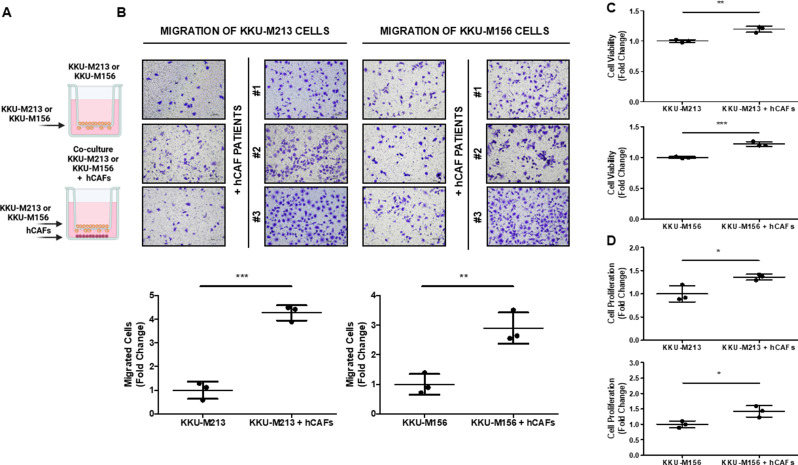
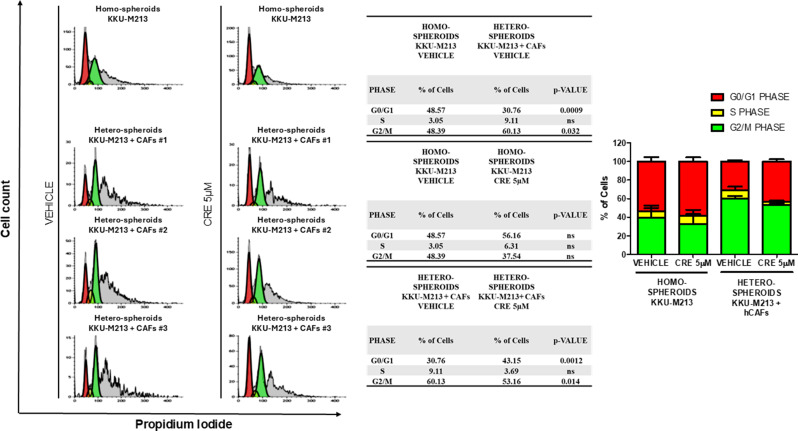
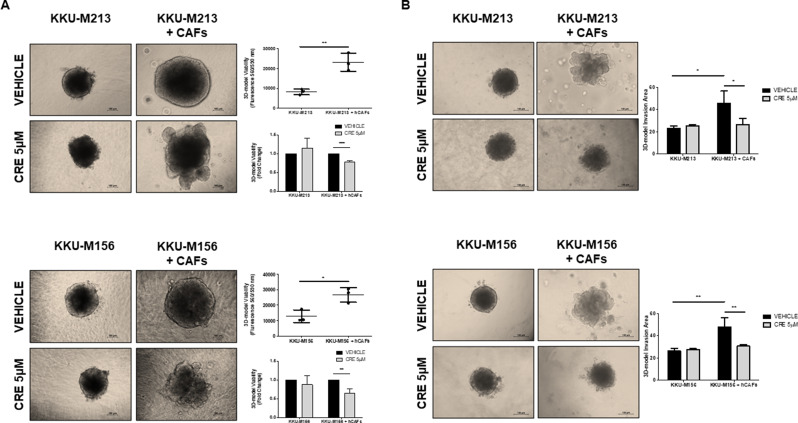
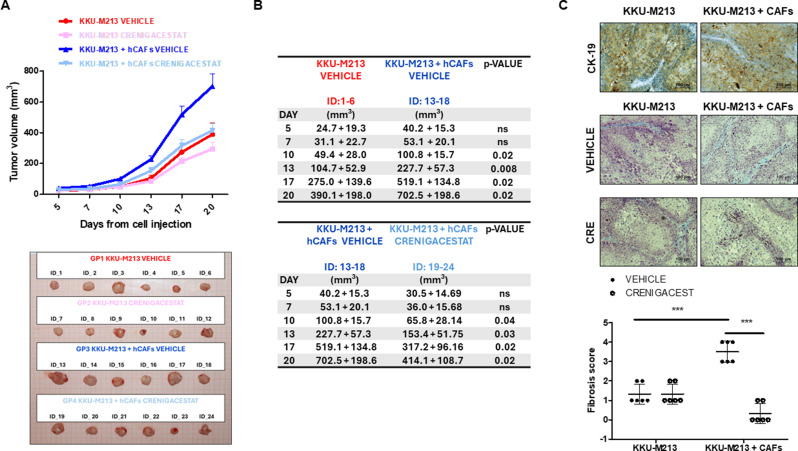
hCAFs/iCCA cross-talk sustains increased migration of both KKU-M213 and KKU-M156 cells, while Crenigacestat significantly inhibits only the cross-talk stimulated migration. Hetero-spheroids grew larger than homo-spheroids, formed by only iCCA cells. Crenigacestat significantly reduced the invasion and growth of hetero- but not of homo-spheroids. In xenograft models, hCAFs/KKU-M213 tumors grew significantly larger than KKU-M213 tumors, but were significantly reduced in volume by Crenigacestat treatment, which also significantly decreased the fibrotic reaction. Ingenuity pathway analysis revealed that genes of hCAFs/KKU-M213 but not of KKU-M213 tumors increased tumor lesions, and that Crenigacestat treatment inhibited the modulated canonical pathways. Cell cycle checkpoints were the most notably modulated pathway and Crenigacestat reduced CCNE2 gene expression, consequently inducing cell cycle arrest. In hetero-spheroids, the number of cells increased in the G2/M cell cycle phase, while Crenigacestat significantly decreased cell numbers in the G2/M phase in hetero but not in homo-spheroids.
The hCAFs/iCCA cross-talk is a new target for reducing cancer progression with drugs such as Crenigacestat.
癌症相关成纤维细胞(CAFs)主要负责肝内胆管癌(iCCA)的纤维反应特征,可能在肿瘤侵袭性和对治疗的耐药性方面发挥作用,尽管涉及的分子机制尚不清楚。本研究旨在探讨靶向 hCAF/iCCA 与 Notch1 抑制剂(即 Crenigacestat)相互作用如何影响癌症进展。
我们使用了不同的 2D 体外模型,并建立了具有 iCCA 细胞和人(h)CAFs 的新 3D 异质球体。结果在异种移植模型中得到了验证,并对离体肿瘤组织进行了转录组和生物信息学分析。
hCAF/iCCA 相互作用维持了 KKU-M213 和 KKU-M156 细胞迁移的增加,而 Crenigacestat 仅显著抑制了受刺激的细胞迁移。异质球体比仅由 iCCA 细胞形成的同质球体生长得更大。Crenigacestat 显著降低了异质球体的侵袭和生长,但对同质球体没有影响。在异种移植模型中,hCAFs/KKU-M213 肿瘤比 KKU-M213 肿瘤生长得大得多,但 Crenigacestat 治疗显著减小了肿瘤体积,同时也显著减少了纤维化反应。Ingenuity 通路分析显示,hCAFs/KKU-M213 肿瘤的基因而非 KKU-M213 肿瘤的基因增加了肿瘤病变,而 Crenigacestat 治疗抑制了调节的经典通路。细胞周期检查点是最显著调节的通路,Crenigacestat 降低了 CCNE2 基因的表达,从而诱导细胞周期停滞。在异质球体中,G2/M 细胞周期阶段的细胞数量增加,而 Crenigacestat 显著减少了异质球体而非同质球体中 G2/M 期的细胞数量。
hCAF/iCCA 相互作用是用 Crenigacestat 等药物减少癌症进展的新靶点。