Kiyota Sho, Yoshida Takashi, Nakamoto Takahiro, Jino Eri, Mishima Takao, Kinoshita Hidefumi
Department of Urology and Andrology Kansai Medical University Osaka Japan.
Department of Urology Osaka Saiseikai-Noe Hospital Osaka Japan.
BJUI Compass. 2024 Aug 15;5(10):957-960. doi: 10.1002/bco2.419. eCollection 2024 Oct.
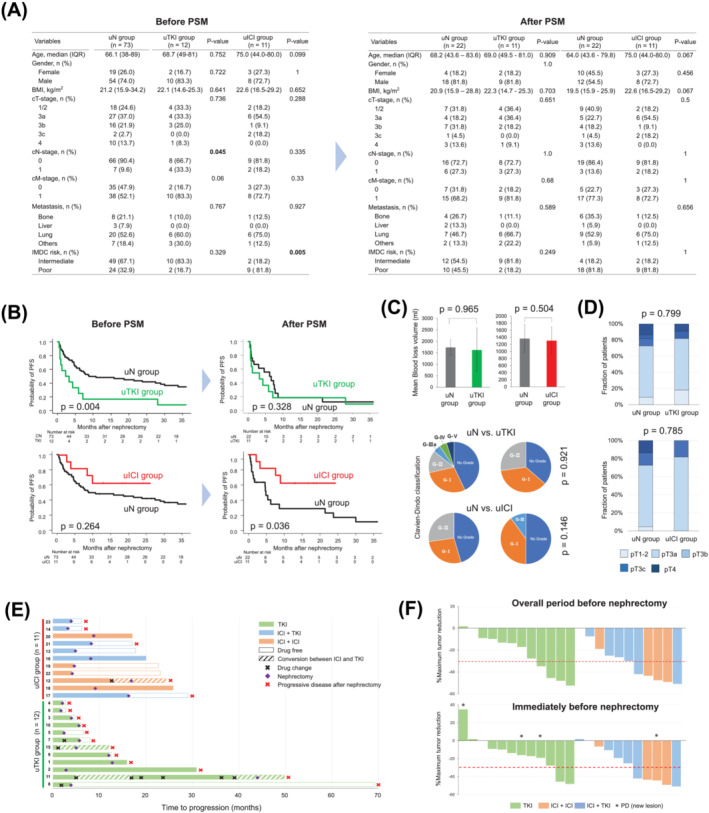
Renal cell carcinoma (RCC) affects 10%-20% of patients annually, often with metastases present. This study evaluated the impact of systemic therapy before nephrectomy in patients with unresectable or metastatic renal cell carcinoma (RCC). Patients receiving upfront immune checkpoint inhibitor (ICI) combination therapy showed significantly improved progression-free survival (PFS) compared to nephrectomy alone (2-year PFS: 62.3% vs. 17.4%; = 0.036), while upfront tyrosine kinase inhibitor (TKI) therapy did not (2-year PFS: 18.2% vs. 12.3%; = 0.545). Surgery-related outcomes did not differ significantly between groups. ICI therapy maintained tumour reduction rates better than TKI therapy. The study highlights the potential benefits of ICI combination therapy over TKI therapy in advanced RCC, suggesting further research is needed to confirm these findings.
每年有10%-20%的患者受肾细胞癌(RCC)影响,且常伴有转移。本研究评估了在不可切除或转移性肾细胞癌(RCC)患者中,肾切除术前全身治疗的影响。与单纯肾切除术相比,接受一线免疫检查点抑制剂(ICI)联合治疗的患者无进展生存期(PFS)显著改善(2年PFS:62.3%对17.4%;P = 0.036),而一线酪氨酸激酶抑制剂(TKI)治疗则不然(2年PFS:18.2%对12.3%;P = 0.545)。两组间手术相关结局无显著差异。ICI治疗比TKI治疗能更好地维持肿瘤缩小率。该研究突出了ICI联合治疗相对于TKI治疗在晚期RCC中的潜在益处,表明需要进一步研究来证实这些发现。