Oral Sciences Research Group, Special Needs Unit, Department of Surgery and Medical- Surgical Specialties, School of Medicine and Dentistry, Universidade de Santiago de Compostela, Fundación Instituto de Investigación Sanitaria de Santiago (FIDIS), Santiago de Compostela, A Coruña, Spain.
Centro Singular de Investigación en Tecnoloxías Intelixentes (CiTIUS) and Departamento de Electrónica e Computación, Universidade de Santiago de Compostela, Fundación Instituto de Investigación Sanitaria de Santiago (FIDIS), Santiago de Compostela, A Coruña, Spain.
BMC Oral Health. 2024 Oct 19;24(1):1247. doi: 10.1186/s12903-024-05042-7.
No clinical trials have evaluated the antimicrobial activity and substantivity of gel formulations containing chlorhexidine (CHX) and cymenol.
To compare the in situ antimicrobial effect and substantivity of a new 0.20% CHX + cymenol gel (test) with the current 0.20% CHX gel formulation (control) on salivary flora and dental plaque biofilm up to seven hours after a single application.
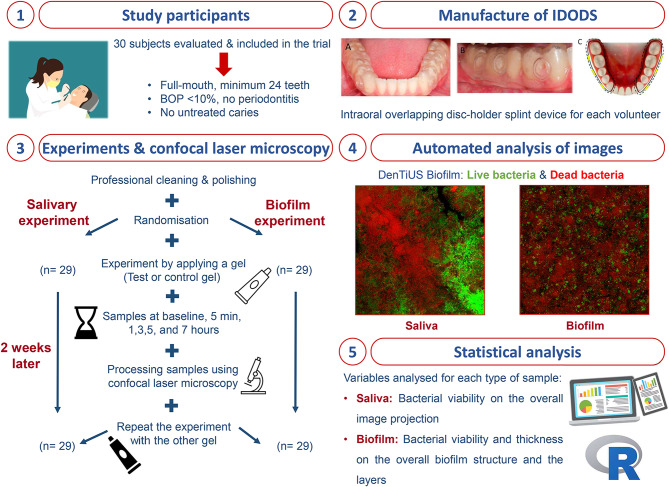
A randomised-crossover clinical trial was conducted with 29 orally healthy volunteers participating in the development of Experiments 1 (saliva) and 2 (dental plaque biofilm). All subjects participated in both experiments and were randomly assigned to receive either the test or control gels. Samples were collected at baseline and five minutes and one, three, five, and seven hours after a single application of the products. The specimens were processed using confocal laser scanning microscopy after staining with the LIVE/DEAD BacLight™ solution. Bacterial viability (BV) was quantified in the saliva and biofilm samples. The BV was calculated using the DenTiUS Biofilm software.
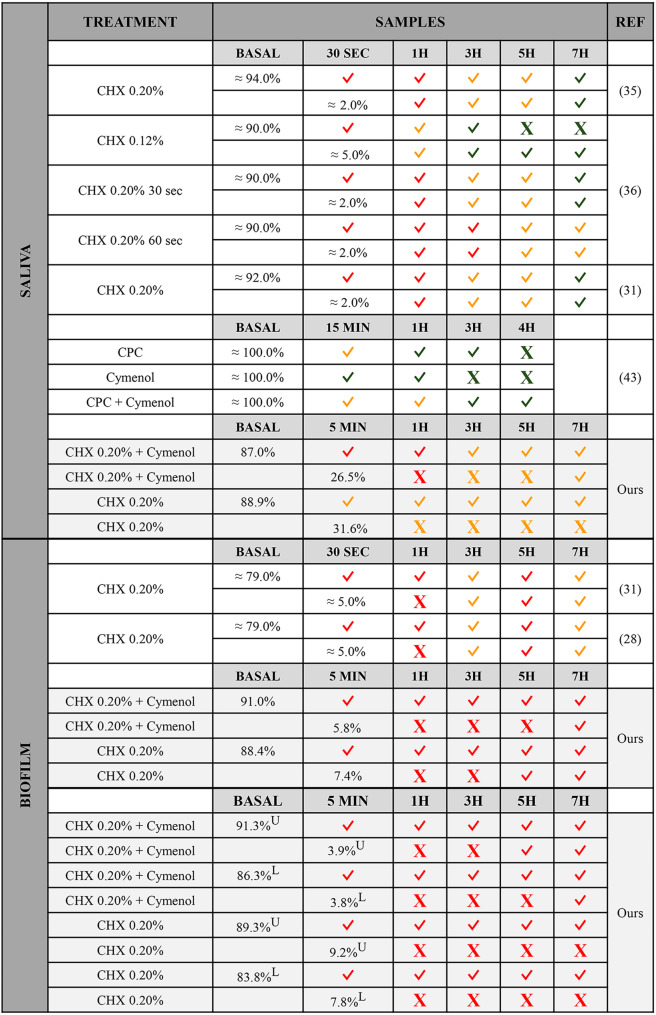
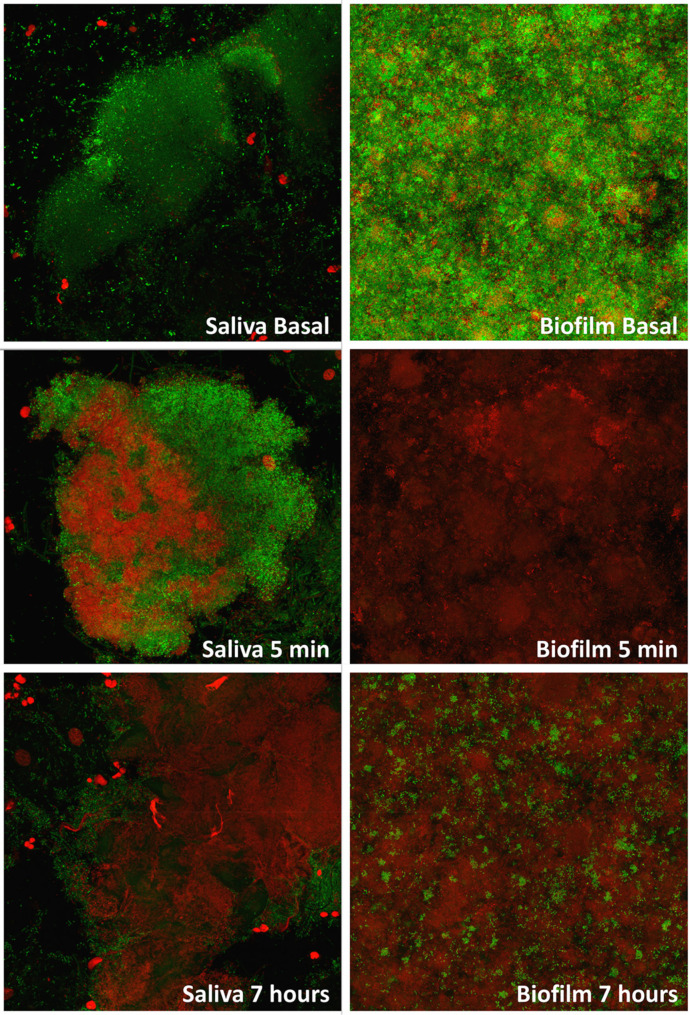
In Experiment 1, the mean baseline BV was significantly reduced five minutes after application in the test group (87.00% vs. 26.50%; p < 0.01). This effect was maintained throughout all sampling times and continued up to seven hours (40.40%, p < 0.01). The CHX control followed the same pattern. In Experiment 2, the mean baseline BV was also significantly lower five minutes after applying the test gel for: (1) the total thickness of biofilm (91.00% vs. 5.80%; p < 0.01); (2) the upper layer (91.29% vs. 3.94%; p < 0.01); and (3) the lower layer (86.29% vs. 3.83%; p < 0.01). The reduction of BV from baseline was observed for the full-thickness and by layers at all sampling moments and continued seven hours after application (21.30%, 24.13%, and 22.06%, respectively; p < 0.01). Again, the control group showed similar results. No significant differences between test and control gels were observed in either saliva or dental plaque biofilm at any sampling time.
A 0.20% CHX + cymenol gel application demonstrates potent and immediate antimicrobial activity on salivary flora and de novo biofilm. This effect is maintained seven hours after application. Similar effects are obtained with a 0.20% CHX-only gel.
尚无临床试验评估过含洗必泰(CHX)和按叶醇的凝胶制剂的抗菌活性和持续性。
比较新型 0.20% CHX+按叶醇凝胶(试验组)与当前 0.20% CHX 凝胶制剂(对照组)在单次应用后长达 7 小时时对唾液菌群和牙菌斑生物膜的原位抗菌效果和持续性。
进行了一项随机交叉临床试验,共有 29 名口腔健康志愿者参与了实验 1(唾液)和实验 2(牙菌斑生物膜)的开发。所有受试者均参与了这两项实验,并随机分配接受试验组或对照组凝胶。在产品单次应用后即刻、5 分钟以及 1、3、5 和 7 小时采集样本。使用 LIVE/DEAD BacLight™溶液染色后,通过共聚焦激光扫描显微镜处理样本。在唾液和生物膜样本中定量评估细菌活力(BV)。使用 DenTiUS Biofilm 软件计算 BV。
在实验 1 中,与基线相比,试验组在应用后 5 分钟时的平均基线 BV 显著降低(87.00%比 26.50%;p<0.01)。这种效果在所有采样时间内均持续存在,并持续至 7 小时(40.40%,p<0.01)。CHX 对照组也呈现相同的模式。在实验 2 中,在应用试验凝胶后 5 分钟,总生物膜厚度(91.00%比 5.80%;p<0.01)、上层(91.29%比 3.94%;p<0.01)和下层(86.29%比 3.83%;p<0.01)的平均基线 BV 也明显更低。在所有采样时间点,均观察到从基线开始的 BV 降低,并且在应用后 7 小时仍持续(分别为 21.30%、24.13%和 22.06%;p<0.01)。同样,对照组也显示出类似的结果。在任何采样时间点,唾液或牙菌斑生物膜中,试验组和对照组凝胶之间均未观察到显著差异。
应用 0.20% CHX+按叶醇凝胶可对唾液菌群和新生生物膜立即产生强大的抗菌作用。这种作用在应用后 7 小时仍能维持。应用 0.20% CHX 凝胶仅可获得类似效果。