Samanthapudi Aditya V, Wanjari Devyani, Sharma Radhika, Rajashekhar M, Kalantri Ashwini, Raut Abhishek V, Gupta Subodh S
Sushila Nayar School of Public Health (Incorporating Department of Community Medicine), Mahatma Gandhi Institute of Medical Sciences, Sevagram, Wardha, Maharashtra, India.
J Educ Health Promot. 2024 Aug 29;13:328. doi: 10.4103/jehp.jehp_202_24. eCollection 2024.
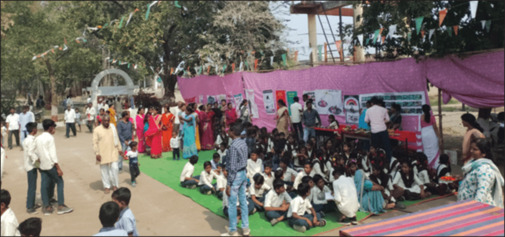
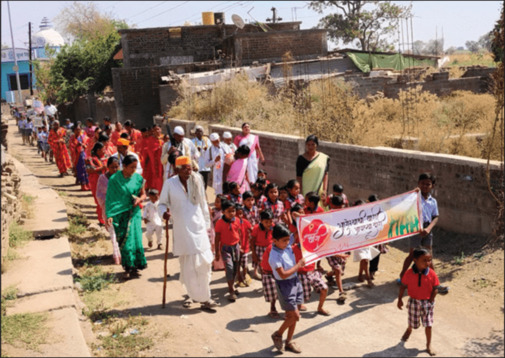
India faces a critical challenge with 5.8 million annual deaths from non-communicable diseases (NCDs). Maharashtra, where NCDs constitute 66% of the disease burden. The youth, lacking awareness, are vulnerable. Vitalizing communities against NCD risk factors (V-CaN) melawa, inspired by the "Pandharpur Wari" pilgrimage, aims to bridge implementation gaps and empower communities. "Arogya chi wari" integrates health practices with cultural events, offering a unique approach. Photo documentation from V-CaN melawa becomes a powerful tool for assessing community engagement qualitatively. The aim of the study was to qualitatively analyze photos from V-CaN melawas, exploring community engagement in health promotion against NCD risk factors.
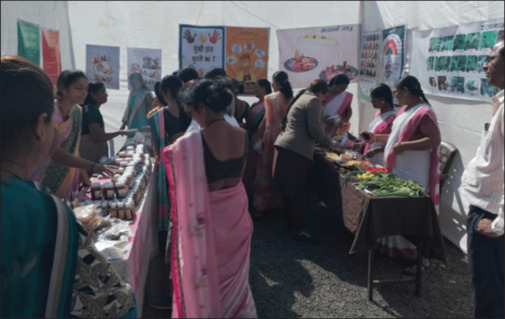
V-CaN melawas were organized in the field practice area of the department of community medicine. These melawas were part of the cluster randomized field trial named V-CaN, which is being implemented in a rural area of the Wardha district of Maharashtra. The V-CaN days, also known as melawas, were organized with the aim of facilitating behavioral change among participants. A qualitative study using photo content analysis was conducted, reviewing 2000 pictures from 59 V-CaN melawas. Thematic content analysis was employed, with researchers selecting 61 photos based on uniqueness.
Six major themes emerged: health promotion, health system involvement, intersectoral coordination, inclusiveness, community resource mobilization, and innovation. Examples include nutrition exhibitions, health screenings, and innovative games.
The analysis showcases diverse community participation in V-CaN melawas, emphasizing inclusivity, collaboration, and innovation. While qualitative, the study lays the foundation for future quantitative assessments of the intervention's impact on health outcomes and community attitudes.
印度面临着严峻挑战,每年有580万人死于非传染性疾病(NCDs)。在马哈拉施特拉邦,非传染性疾病占疾病负担的66%。缺乏意识的年轻人很容易受到影响。受“潘德尔布尔瓦里”朝圣之旅的启发,“抗击非传染性疾病风险因素的社区活力行动(V-CaN)梅拉瓦”旨在弥合实施差距并增强社区能力。“健康瓦里”将健康实践与文化活动相结合,提供了一种独特的方法。V-CaN梅拉瓦的照片记录成为定性评估社区参与度的有力工具。本研究的目的是对V-CaN梅拉瓦的照片进行定性分析,探索社区在针对非传染性疾病风险因素的健康促进中的参与情况。
V-CaN梅拉瓦在社区医学系的实地实践区域组织开展。这些梅拉瓦是名为V-CaN的整群随机实地试验的一部分,该试验正在马哈拉施特拉邦瓦尔达区的一个农村地区实施。组织V-CaN日活动(也称为梅拉瓦)的目的是促进参与者的行为改变。开展了一项使用照片内容分析的定性研究,审查了来自59次V-CaN梅拉瓦的2000张照片。采用了主题内容分析,研究人员根据独特性选择了61张照片。
出现了六个主要主题:健康促进、卫生系统参与、部门间协调、包容性、社区资源调动和创新。例子包括营养展览、健康筛查和创新游戏。
分析展示了社区在V-CaN梅拉瓦中的多样化参与,强调了包容性、协作和创新。虽然该研究是定性的,但为未来对该干预措施对健康结果和社区态度的影响进行定量评估奠定了基础。