Satoh Toru, Kobayashi Hidetoshi
Department of Cardiovascular Medicine, Kyorin University, Mitaka, Tokyo, Japan.
Softron Ltd. Suginami, Tokyo, Japan.
Nutr Metab Insights. 2024 Oct 17;17:11786388241285544. doi: 10.1177/11786388241285544. eCollection 2024.
The autonomic nervous system (ANS) is affected by several factors, including major nutrients. However, their effects on the ANS remains unclear. Most studies had several limitations. They focused on humans, therefore they had difficulties excluding factors other than the nutrients. Their observation periods were too short (<4 hours) to align with typical absorption times of carbohydrates versus fats. They assessed the effects compared with the pre-prandial state rather than comparisons between different nutrient types.
We aimed to investigate the effects of carbohydrates and fats on the ANS.
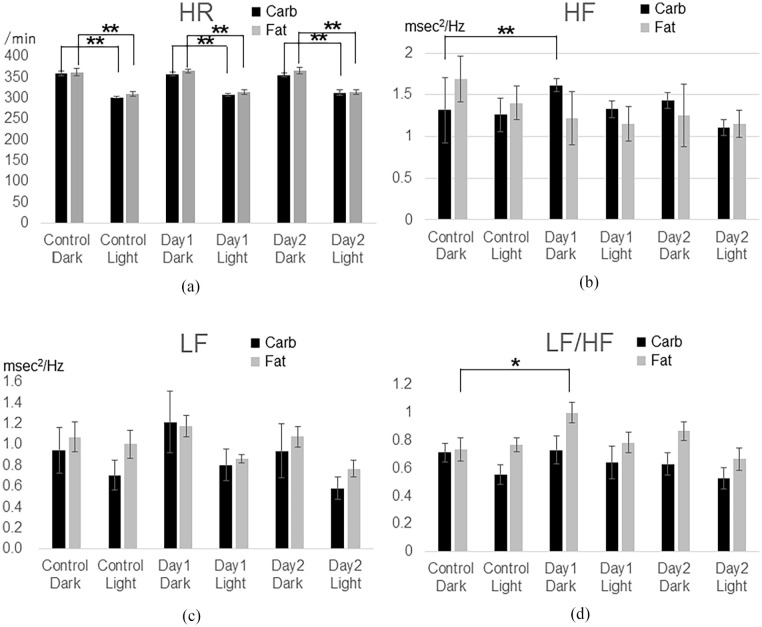
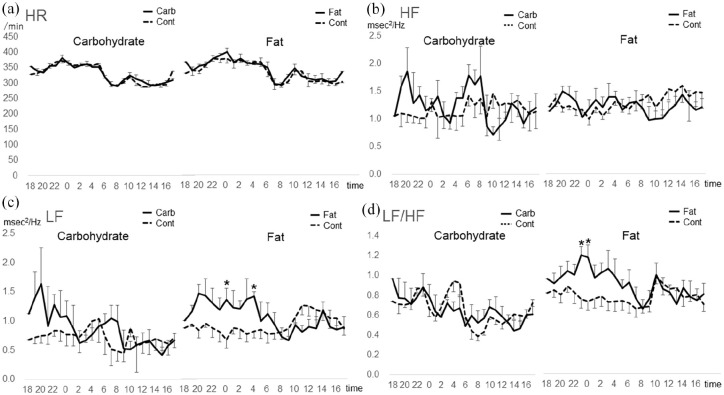
We employed a rat model to exclude the effects of external stimuli, used sufficient observation period, and compared the ANS parameters among animals fed 3 different diets. The rats were divided into carbohydrate-rich-diet (carb group) and fat-rich-diet (fat group) groups. We investigated the effects of carbohydrates and fats on the ANS by measuring heart rate variability parameters in rats. Electrodes and electrocardiography (ECG) transmitters were implanted in 14 Wistar rats maintained on a standard diet for 2 days followed by the experimental diets for 2 days. ECG readings were continuously recorded for 4 days. The R waves, function of the R-R interval, and time were calculated. A fast Fourier transform was used to obtain the power spectrum of the fluctuation (low frequency [LF: 0.2-0.75 Hz]; high frequency [HF: 0.75-3.0 Hz]; LF/HF ratio).
Compared with the standard-diet group, the carb group showed significantly increased HF activity, while the fat group showed a significantly increased LF/HF ratio.
The results reveal a link between macronutrients and ANS activity.
自主神经系统(ANS)受多种因素影响,包括主要营养素。然而,它们对自主神经系统的影响仍不清楚。大多数研究存在一些局限性。它们以人类为研究对象,因此难以排除营养素以外的因素。它们的观察期过短(<4小时),无法与碳水化合物和脂肪的典型吸收时间相匹配。它们评估的是与餐前状态相比的影响,而非不同营养素类型之间的比较。
我们旨在研究碳水化合物和脂肪对自主神经系统的影响。
我们采用大鼠模型以排除外部刺激的影响,使用足够长的观察期,并比较喂食三种不同饮食的动物的自主神经系统参数。将大鼠分为高碳水化合物饮食组(碳水化合物组)和高脂肪饮食组(脂肪组)。我们通过测量大鼠的心率变异性参数来研究碳水化合物和脂肪对自主神经系统的影响。将电极和心电图(ECG)发射器植入14只维持标准饮食2天,然后改为实验饮食2天的Wistar大鼠体内。连续记录4天的心电图读数。计算R波、R-R间期函数和时间。使用快速傅里叶变换获得波动的功率谱(低频[LF:0.2 - 0.75赫兹];高频[HF:0.75 - 3.0赫兹];LF/HF比值)。
与标准饮食组相比,碳水化合物组的高频活动显著增加,而脂肪组的LF/HF比值显著增加。
结果揭示了常量营养素与自主神经系统活动之间的联系。