The Molecular Foundry, Lawrence Berkeley National Laboratory, Berkeley, CA, 94720, USA.
Interdisciplinary Nanoscience Center (iNANO), Aarhus University, DK-8000, Aarhus, Denmark.
Nat Commun. 2024 Oct 21;15(1):9084. doi: 10.1038/s41467-024-52914-1.
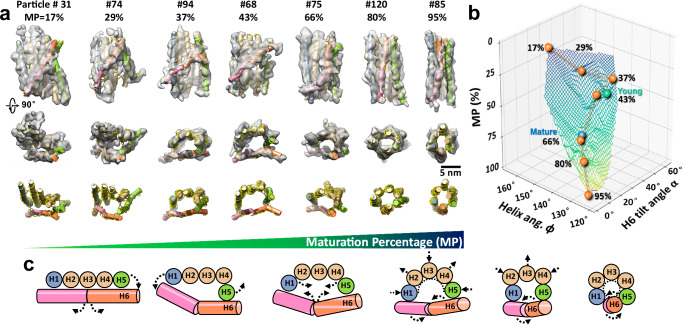
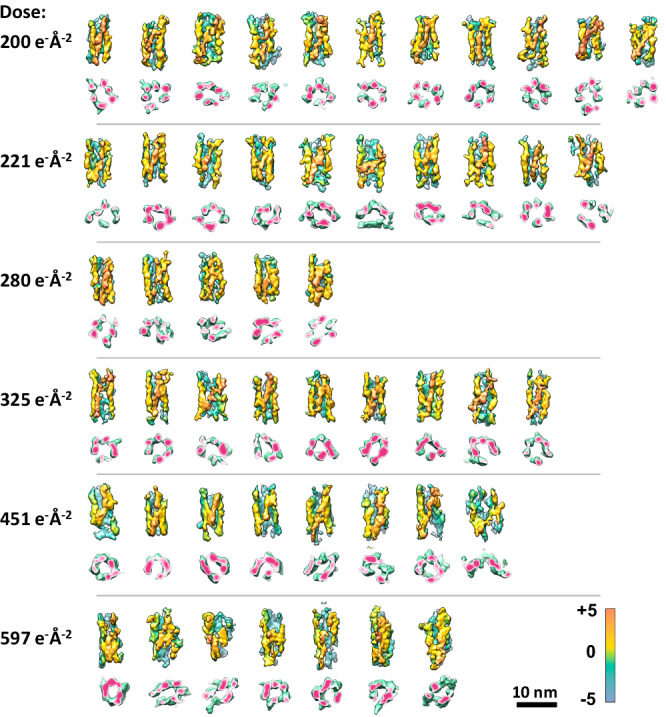
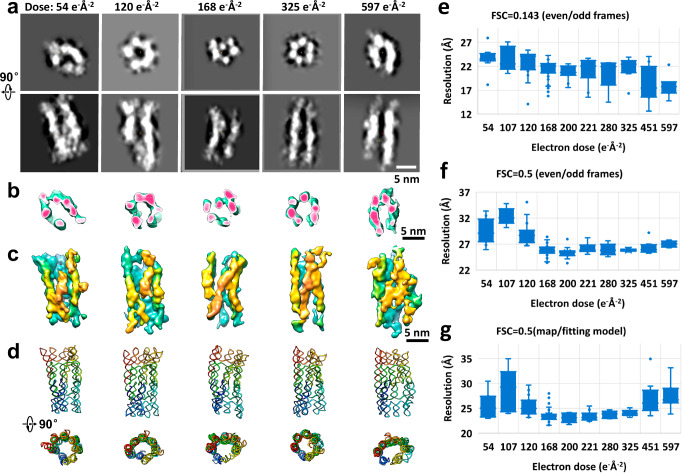
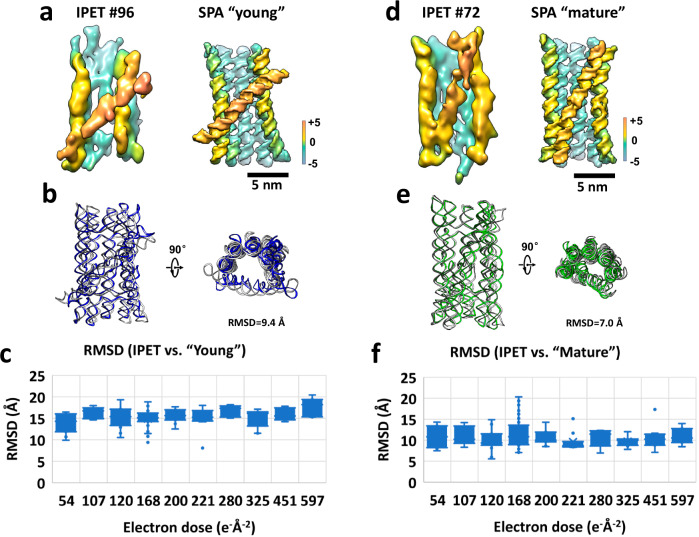
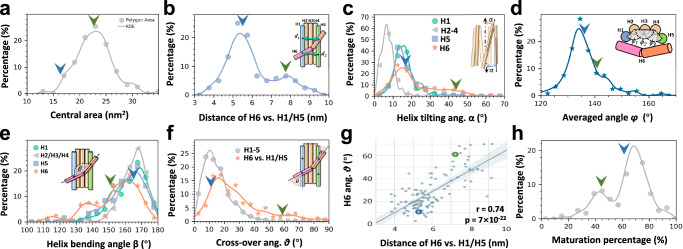
Large-scale and continuous conformational changes in the RNA self-folding process present significant challenges for structural studies, often requiring trade-offs between resolution and observational scope. Here, we utilize individual-particle cryo-electron tomography (IPET) to examine the post-transcriptional self-folding process of designed RNA origami 6-helix bundle with a clasp helix (6HBC). By avoiding selection, classification, averaging, or chemical fixation and optimizing cryo-ET data acquisition parameters, we reconstruct 120 three-dimensional (3D) density maps from 120 individual particles at an electron dose of no more than 168 eÅ, achieving averaged resolutions ranging from 23 to 35 Å, as estimated by Fourier shell correlation (FSC) at 0.5. Each map allows us to identify distinct RNA helices and determine a unique tertiary structure. Statistical analysis of these 120 structures confirms two reported conformations and reveals a range of kinetically trapped, intermediate, and highly compacted states, demonstrating a maturation folding landscape likely driven by helix-helix compaction interactions.
在 RNA 自我折叠过程中,大规模和连续的构象变化对结构研究提出了重大挑战,通常需要在分辨率和观测范围之间进行权衡。在这里,我们利用单颗粒 cryo-ET(IPET)来研究具有扣环螺旋(6HBC)的设计 RNA 折纸 6 螺旋束的转录后自我折叠过程。通过避免选择、分类、平均或化学固定,并优化 cryo-ET 数据采集参数,我们从 120 个个体粒子中重建了 120 个三维(3D)密度图,每个电子剂量不超过 168 eÅ,实现了平均分辨率在 23 到 35Å 之间,这是通过傅里叶壳相关(FSC)在 0.5 处估计的。每个图谱都允许我们识别出不同的 RNA 螺旋,并确定出独特的三级结构。对这 120 个结构的统计分析证实了两种报告的构象,并揭示了一系列动力学捕获的、中间的和高度紧凑的状态,表明成熟折叠景观可能由螺旋-螺旋紧缩相互作用驱动。