The Molecular Foundry, Lawrence Berkeley National Laboratory, Berkeley, CA, USA.
Applied Science and Technology Graduate Group, University of California, Berkeley, CA, USA.
Nat Commun. 2024 May 23;15(1):4395. doi: 10.1038/s41467-024-48305-1.
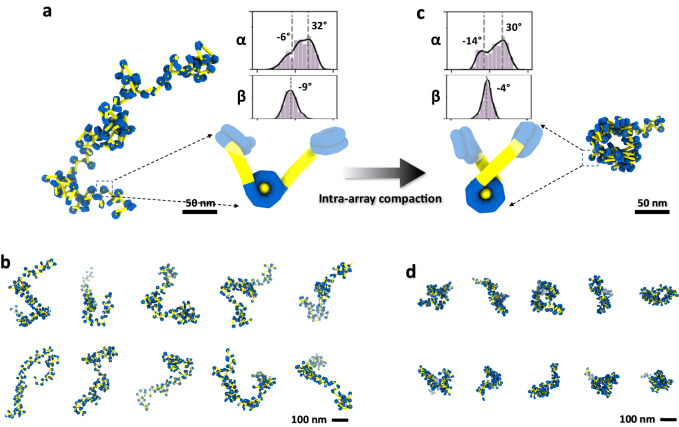
The conformational dynamics of nucleosome arrays generate a diverse spectrum of microscopic states, posing challenges to their structural determination. Leveraging cryogenic electron tomography (cryo-ET), we determine the three-dimensional (3D) structures of individual mononucleosomes and arrays comprising di-, tri-, and tetranucleosomes. By slowing the rate of condensation through a reduction in ionic strength, we probe the intra-array structural transitions that precede inter-array interactions and liquid droplet formation. Under these conditions, the arrays exhibite irregular zig-zag conformations with loose packing. Increasing the ionic strength promoted intra-array compaction, yet we do not observe the previously reported regular 30-nanometer fibers. Interestingly, the presence of H1 do not induce array compaction; instead, one-third of the arrays display nucleosomes invaded by foreign DNA, suggesting an alternative role for H1 in chromatin network construction. We also find that the crucial parameter determining the structure adopted by chromatin arrays is the angle between the entry and exit of the DNA and the corresponding tangents to the nucleosomal disc. Our results provide insights into the initial stages of intra-array compaction, a critical precursor to condensation in the regulation of chromatin organization.
核小体阵列的构象动力学产生了多样化的微观状态,这给它们的结构确定带来了挑战。利用低温电子断层扫描(cryo-ET),我们确定了单个单核小体和包含二、三、四核小体的阵列的三维(3D)结构。通过降低离子强度来减缓凝聚速度,我们探测了在阵列间相互作用和液滴形成之前的内部结构转变。在这些条件下,阵列表现出不规则的之字形构象,包装松散。增加离子强度促进了内部的压缩,但我们没有观察到以前报道的规则的 30 纳米纤维。有趣的是,H1 的存在并没有诱导阵列的压缩;相反,三分之一的阵列显示核小体被外来 DNA 入侵,这表明 H1 在染色质网络构建中具有替代作用。我们还发现,决定染色质阵列采用的结构的关键参数是 DNA 的进入和退出与核小体盘对应的切线之间的角度。我们的结果提供了对内部压缩初始阶段的深入了解,这是染色质组织调控中凝聚的关键前体。