Department of Mathematical, Physical and Computer Sciences, University of Parma, Parco Area delle Scienze 53/A, 43124, Parma, Italy.
Division of Mathematical Oncology and Computational Systems Biology Department of Computational and Quantitative Medicine, Beckman Research Institute City of Hope National Medical Center, 1500 E Duarte Rd., Duarte, 91010, CA, USA.
NPJ Syst Biol Appl. 2024 Oct 22;10(1):122. doi: 10.1038/s41540-024-00453-2.
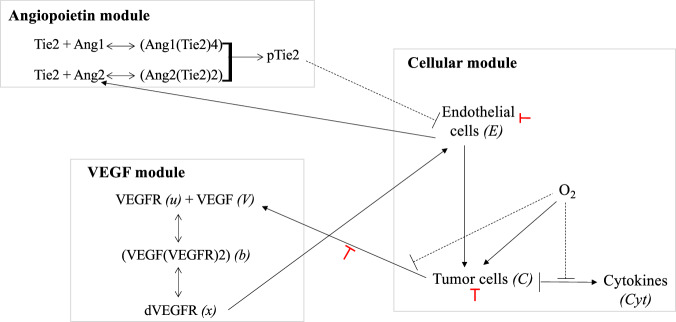
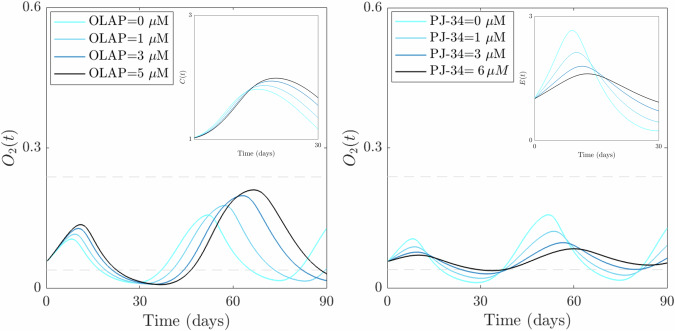
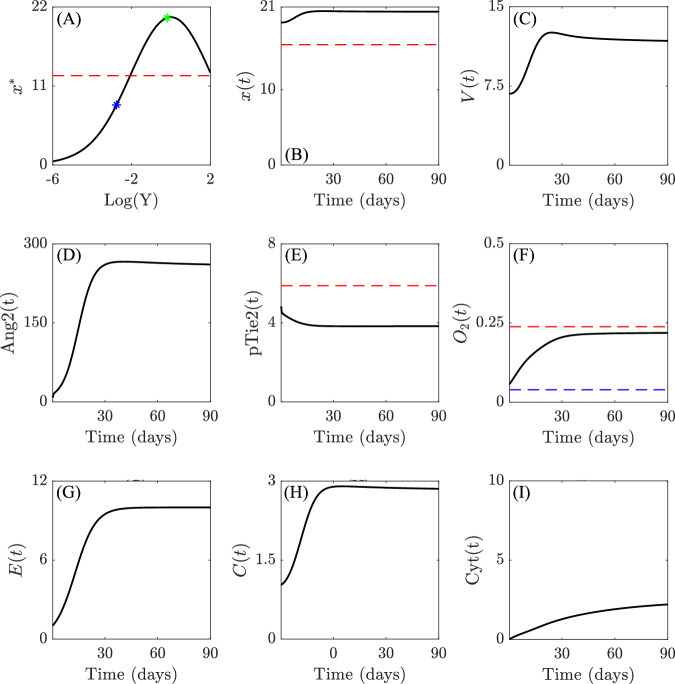
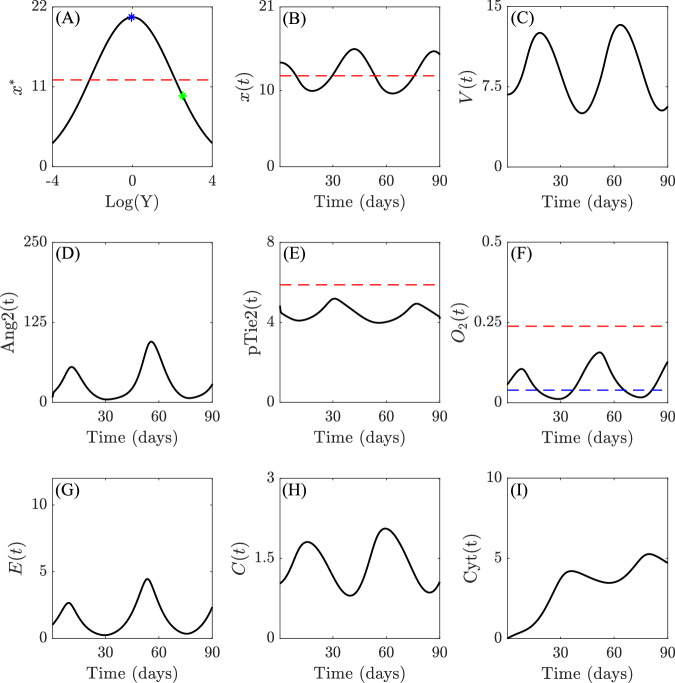
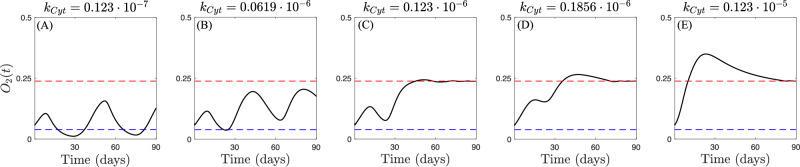
Tumor hypoxia is a dynamic phenomenon marked by fluctuations in oxygen levels across both rapid (seconds to minutes) and slow (hours to days) time scales. While short hypoxia cycles are relatively well understood, the mechanisms behind longer cycles remain largely unclear. In this paper, we present a novel mechanistic mathematical model that explains slow hypoxia cycles through feedback loops involving vascular expansion and regression, oxygen-regulated tumor growth, and toxic cytokine production. Our study reveals that, for the emergence of slow hypoxia cycles, endothelial cells must adapt by decreasing receptor activation as ligand concentration increases. Additionally, the interaction between tumor cells and toxic cytokines influences frequency and intensity of these cycles. By examining the effects of pharmacological interventions, specifically poly (ADP-ribose) polymerase inhibitors, we also demonstrate how targeting cell proliferation can help regulate oxygen levels. Our findings enhance the understanding of hypoxia regulation and suggest PARP proteins as promising therapeutic targets.
肿瘤缺氧是一种动态现象,其特征是氧水平在快速(秒到分钟)和缓慢(小时到天)时间尺度上波动。虽然短时间缺氧循环相对较好理解,但长时间缺氧循环背后的机制在很大程度上仍不清楚。在本文中,我们提出了一个新的机制数学模型,该模型通过涉及血管扩张和收缩、氧调节肿瘤生长和毒性细胞因子产生的反馈回路来解释缓慢缺氧循环。我们的研究表明,对于缓慢缺氧循环的出现,内皮细胞必须通过随着配体浓度的增加而减少受体激活来适应。此外,肿瘤细胞和毒性细胞因子之间的相互作用影响这些循环的频率和强度。通过检查药理学干预(特别是聚(ADP-核糖)聚合酶抑制剂)的效果,我们还证明了靶向细胞增殖如何有助于调节氧水平。我们的发现增强了对缺氧调节的理解,并表明 PARP 蛋白是有前途的治疗靶点。