Willms Jan F, Inauen Corinne, Bögli Stefan Yu, Muroi Carl, Boss Jens M, Keller Emanuela
Neurocritical Care Unit, Department of Neurosurgery and Institute of Intensive Care Medicine, Clinical Neuroscience Center, University Hospital Zurich and University of Zurich, 8091 Zurich, Switzerland.
Department of Neurology, Clinical Neuroscience Center, University Hospital Zurich and University of Zurich, 8091 Zurich, Switzerland.
Bioengineering (Basel). 2024 Sep 30;11(10):988. doi: 10.3390/bioengineering11100988.
Accurate longitudinal risk prediction for DCI (delayed cerebral ischemia) occurrence after subarachnoid hemorrhage (SAH) is essential for clinicians to administer appropriate and timely diagnostics, thereby improving treatment planning and outcome. This study aimed to develop an improved longitudinal DCI prediction model and evaluate its performance in predicting DCI between day 4 and 14 after aneurysm rupture.
Two DCI classification models were trained: (1) a static model based on routinely collected demographics and SAH grading scores and (2) a dynamic model based on results from laboratory and blood gas analysis anchored at the time of DCI. A combined model was derived from these two using a voting approach. Multiple classifiers, including Logistic Regression, Support Vector Machines, Random Forests, Histogram-based Gradient Boosting, and Extremely Randomized Trees, were evaluated through cross-validation using anchored data. A leave-one-out simulation was then performed on the best-performing models to evaluate their longitudinal performance using time-dependent Receiver Operating Characteristic (ROC) analysis.
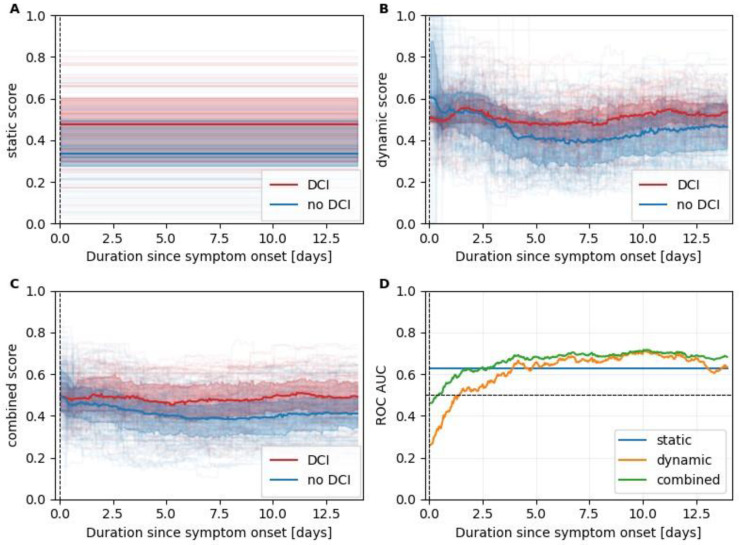
The training dataset included 218 patients, with 89 of them developing DCI (41%). In the anchored ROC analysis, the combined model achieved a ROC AUC of 0.73 ± 0.05 in predicting DCI onset, the static and the dynamic model achieved a ROC AUC of 0.69 ± 0.08 and 0.66 ± 0.08, respectively. In the leave-one-out simulation experiments, the dynamic and voting model showed a highly dynamic risk score (intra-patient score range was 0.25 [0.24, 0.49] and 0.17 [0.12, 0.25] for the dynamic and the voting model, respectively, for DCI occurrence over the course of disease. In the time-dependent ROC analysis, the dynamic model performed best until day 5.4, and afterwards the voting model showed the best performance.
A machine learning model for longitudinal DCI risk assessment was developed comprising a static and a dynamic sub-model. The longitudinal performance evaluation highlighted substantial time dependence in model performance, underscoring the need for a longitudinal assessment of prediction models in intensive care settings. Moreover, clinicians need to be aware of these performance variations when performing a risk assessment and weight the different model outputs correspondingly.
准确纵向预测蛛网膜下腔出血(SAH)后迟发性脑缺血(DCI)的发生,对于临床医生进行恰当且及时的诊断至关重要,从而有助于改善治疗方案规划及治疗结果。本研究旨在开发一种改进的纵向DCI预测模型,并评估其在预测动脉瘤破裂后第4天至第14天发生DCI的性能。
训练了两种DCI分类模型:(1)基于常规收集的人口统计学数据和SAH分级评分的静态模型;(2)基于DCI发生时实验室检查和血气分析结果的动态模型。使用投票方法从这两种模型中得出一个组合模型。通过使用锚定数据的交叉验证,对包括逻辑回归、支持向量机、随机森林、基于直方图的梯度提升和极端随机树在内的多个分类器进行了评估。然后对表现最佳的模型进行留一法模拟,使用时间依赖的受试者操作特征(ROC)分析来评估其纵向性能。
训练数据集包括218例患者,其中89例发生了DCI(41%)。在锚定ROC分析中,组合模型在预测DCI发作时的ROC曲线下面积(AUC)为0.73±0.05,静态模型和动态模型的ROC AUC分别为0.69±0.08和0.66±0.08。在留一法模拟实验中,动态模型和投票模型显示出高度动态的风险评分(在疾病过程中,动态模型和投票模型预测DCI发生时患者内部评分范围分别为0.25[0.24,0.49]和0.17[0.12,0.25])。在时间依赖的ROC分析中,动态模型在第5.4天之前表现最佳,之后投票模型表现最佳。
开发了一种用于纵向DCI风险评估的机器学习模型,该模型包括一个静态子模型和一个动态子模型。纵向性能评估突出了模型性能中显著的时间依赖性,强调了在重症监护环境中对预测模型进行纵向评估的必要性。此外,临床医生在进行风险评估时需要意识到这些性能差异,并相应地权衡不同模型的输出结果。