Ene Cosmin-Victor, Geavlete Bogdan, Mares Cristian, Nicolae Ilinca, Ene Corina Daniela
Department of Urology, 'Carol Davila' University of Medicine and Pharmacy, 050474 Bucharest, Romania.
Department of Urology, "Saint John" Clinical Emergency Hospital, 042122 Bucharest, Romania.
J Pers Med. 2024 Sep 28;14(10):1037. doi: 10.3390/jpm14101037.
Prostate tumors, if prostate cancer or adenoma, represent a major public health challenge. Progress in research on inflammation has revealed a connection between inflammation, immunity, and cancer. In this context, this study aimed to find IL-6 signaling systemic abnormalities in the inflammatory tumor microenvironment.
This study was case-controlled, multicentered, and included 86 patients, 43 diagnosed with BPH and 43 diagnosed with PCa, between January 2019 and January 2020. The study group was homogenous and the studied parameters were IL-6 complex (IL-6, soluble receptor IL-6R, soluble glycoprotein gp130), acute phase proteins (C reactive protein-CRP, acid alpha1 glycoprotein-AGPA, ferritin, albumin, transferrin), and oxidative stress-associated variables (malondialdehyde-MDA, carbonylated protein-PCO, 8-hydroxy-deoxy guanosine-8-OHdG, total antioxidant status-bTAS).
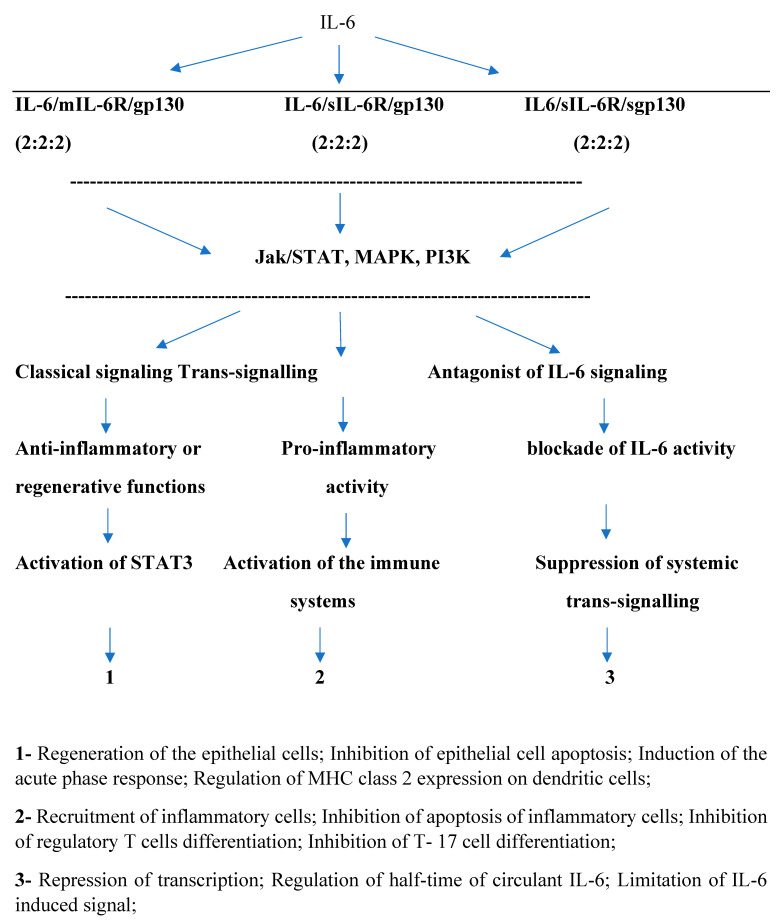
The inflammatory microenvironment determined IL-6 signaling alterations (over-regulation of sIL-6R and suppression of sgp130 in PCa versus BPH), changes in acute phase reaction markers (increased serum levels of CRP, AGPA, ferritin, and decreased serum levels of albumin, transferrin) that were much more evident in PCa compared to BPH, an imbalance between macromolecular oxidative damage (MDA, PCO, 8-OHdG) and endogenous antioxidants (TAS) that was more accentuated in PCa compared with BPH, and a representative association between the sIL-6R/sgp130 ratio and inflammatory/oxidative stress-related factors only in PCa patients.
Our study reconfirms the anterior concept that IL-6 promotes prostatic tumorigenesis. In this study, we first demonstrated that a high sIL-6R/sgp130 ratio facilitates prostate malignancy.
前列腺肿瘤,无论是前列腺癌还是腺瘤,都是一项重大的公共卫生挑战。炎症研究的进展揭示了炎症、免疫和癌症之间的联系。在此背景下,本研究旨在发现炎症性肿瘤微环境中白细胞介素-6(IL-6)信号通路的全身异常情况。
本研究为病例对照、多中心研究,在2019年1月至2020年1月期间纳入了86例患者,其中43例诊断为良性前列腺增生(BPH),43例诊断为前列腺癌(PCa)。研究组具有同质性,所研究的参数包括IL-6复合物(IL-6、可溶性受体IL-6R、可溶性糖蛋白gp130)、急性期蛋白(C反应蛋白-CRP、酸性α1糖蛋白-AGPA、铁蛋白、白蛋白、转铁蛋白)以及氧化应激相关变量(丙二醛-MDA、羰基化蛋白-PCO、8-羟基脱氧鸟苷-8-OHdG、总抗氧化状态-bTAS)。
炎症微环境导致IL-6信号通路改变(与BPH相比,PCa中sIL-6R上调且sgp130受到抑制),急性期反应标志物发生变化(PCa患者血清中CRP、AGPA、铁蛋白水平升高,白蛋白、转铁蛋白水平降低,且与BPH相比在PCa中更为明显),大分子氧化损伤(MDA、PCO、8-OHdG)与内源性抗氧化剂(TAS)之间的失衡在PCa中比BPH更为突出,并且仅在PCa患者中sIL-6R/sgp130比值与炎症/氧化应激相关因素之间存在显著关联。
我们的研究再次证实了IL-6促进前列腺肿瘤发生这一先前的概念。在本研究中,我们首次证明高sIL-6R/sgp130比值促进前列腺恶性肿瘤的发生。