Mulinari Jéssica, Rigo Diane, Demaman Oro Carolina Elisa, Meneses Alessandra Cristina de, Zin Guilherme, Eleutério Rafael Vidal, Tres Marcus Vinícius, Dallago Rogério Marcos
TransferTech Gestão de Inovação, Erechim 99700-420, Brazil.
Department of Food and Chemical Engineering, Universidade Regional Integrada do Alto Uruguai e das Missões (URI), 1621 Sete de Setembro Av., Centro, Erechim 99709-910, Brazil.
Membranes (Basel). 2024 Sep 27;14(10):208. doi: 10.3390/membranes14100208.
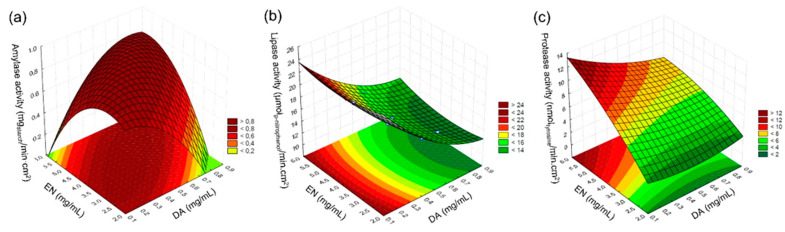
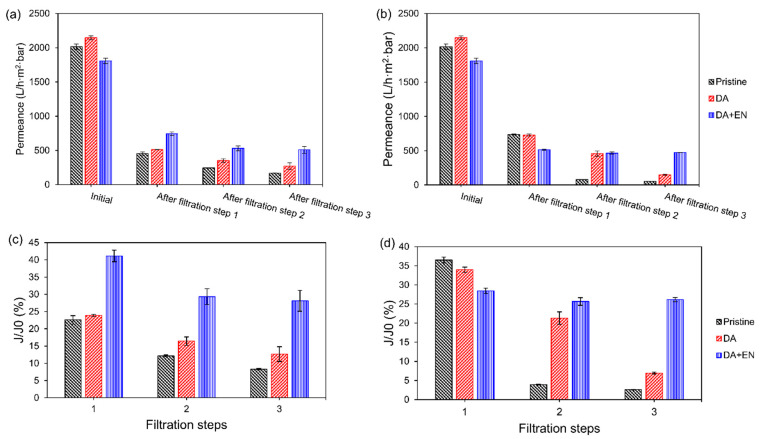
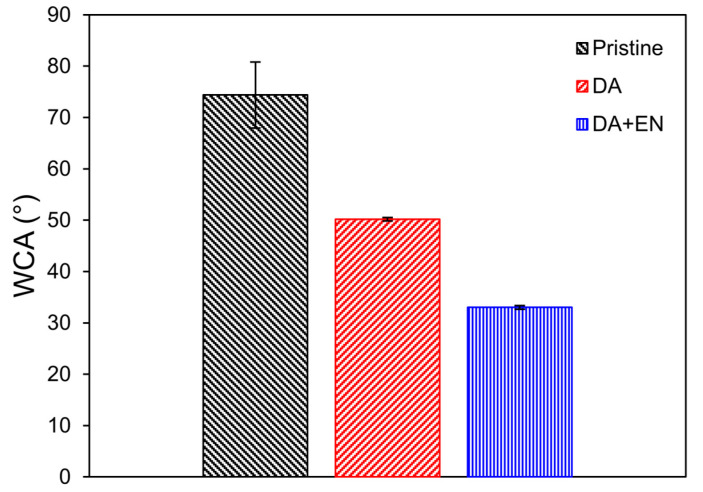
Immobilizing different enzymes on membranes can result in biocatalytic active membranes with a self-cleaning capacity toward a complex mixture of foulants. The membrane modification can reduce fouling and enhance filtration performance. Protease, lipase, and amylase were immobilized on poly(vinylidene fluoride) (PVDF) microfiltration membranes using a polydopamine coating in a one-step method. The concentrations of polydopamine precursor and enzymes were optimized during the immobilization. The higher hydrolytic activities were obtained using 0.2 mg/mL of dopamine hydrochloride and 4 mg/mL of enzymes: 0.90 mg/min·cm for amylase, 10.16 nmol/min·cm for protease, and 20.48 µmol/min·cm for lipase. Filtration tests using a protein, lipid, and carbohydrate mixture showed that the modified membrane retained 41%, 29%, and 28% of its initial water permeance (1808 ± 39 L/m·h·bar) after three consecutive filtration cycles, respectively. In contrast, the pristine membrane (initial water permeance of 2016 ± 40 L/m·h·bar) retained only 23%, 12%, and 8%. Filtrations of milk powder solution were also performed to simulate dairy industry wastewater: the modified membrane maintained 28%, 26%, and 26% of its initial water permeance after three consecutive filtration cycles, respectively, and the pristine membrane retained 34%, 21%, and 7%. The modified membrane showed increased fouling resistance against a mixture of foulants and presented a similar water permeance after three cycles of simulated dairy wastewater filtration. Membrane fouling is reduced by the immobilized enzymes through two mechanisms: increased membrane hydrophilicity (evidenced by the reduced water contact angle after modification) and the enzymatic hydrolysis of foulants as they accumulate on the membrane surface.
将不同的酶固定在膜上可得到具有对复杂污染物混合物自清洁能力的生物催化活性膜。膜修饰可减少污染并提高过滤性能。使用聚多巴胺涂层通过一步法将蛋白酶、脂肪酶和淀粉酶固定在聚偏氟乙烯(PVDF)微滤膜上。在固定过程中对聚多巴胺前体和酶的浓度进行了优化。使用0.2mg/mL的盐酸多巴胺和4mg/mL的酶可获得较高的水解活性:淀粉酶为0.90mg/min·cm,蛋白酶为10.16nmol/min·cm,脂肪酶为20.48µmol/min·cm。使用蛋白质、脂质和碳水化合物混合物进行的过滤测试表明,经过三个连续过滤循环后,改性膜分别保留了其初始水通量(1808±39L/m·h·bar)的41%、29%和28%。相比之下,原始膜(初始水通量为2016±40L/m·h·bar)仅保留了23%、12%和8%。还进行了奶粉溶液过滤以模拟乳制品工业废水:经过三个连续过滤循环后,改性膜分别保留了其初始水通量的28%、26%和26%,而原始膜保留了34%、21%和7%。改性膜对污染物混合物表现出更高的抗污染性,并且在模拟乳制品废水过滤三个循环后呈现出相似的水通量。固定化酶通过两种机制减少膜污染:增加膜的亲水性(改性后水接触角减小证明)以及污染物在膜表面积累时的酶促水解。