Division of Sleep and Circadian Disorders, Brigham and Women's Hospital, Boston, MA 02115, USA.
Division of Sleep Medicine, Harvard Medical School, Boston, MA 02115, USA.
Sensors (Basel). 2024 Oct 10;24(20):6532. doi: 10.3390/s24206532.
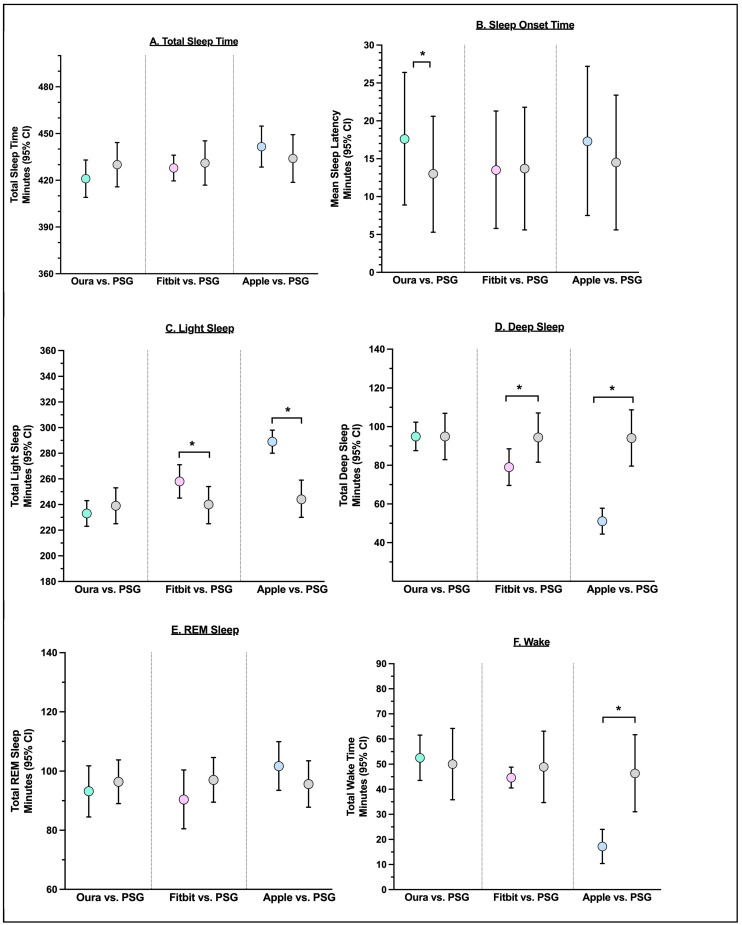
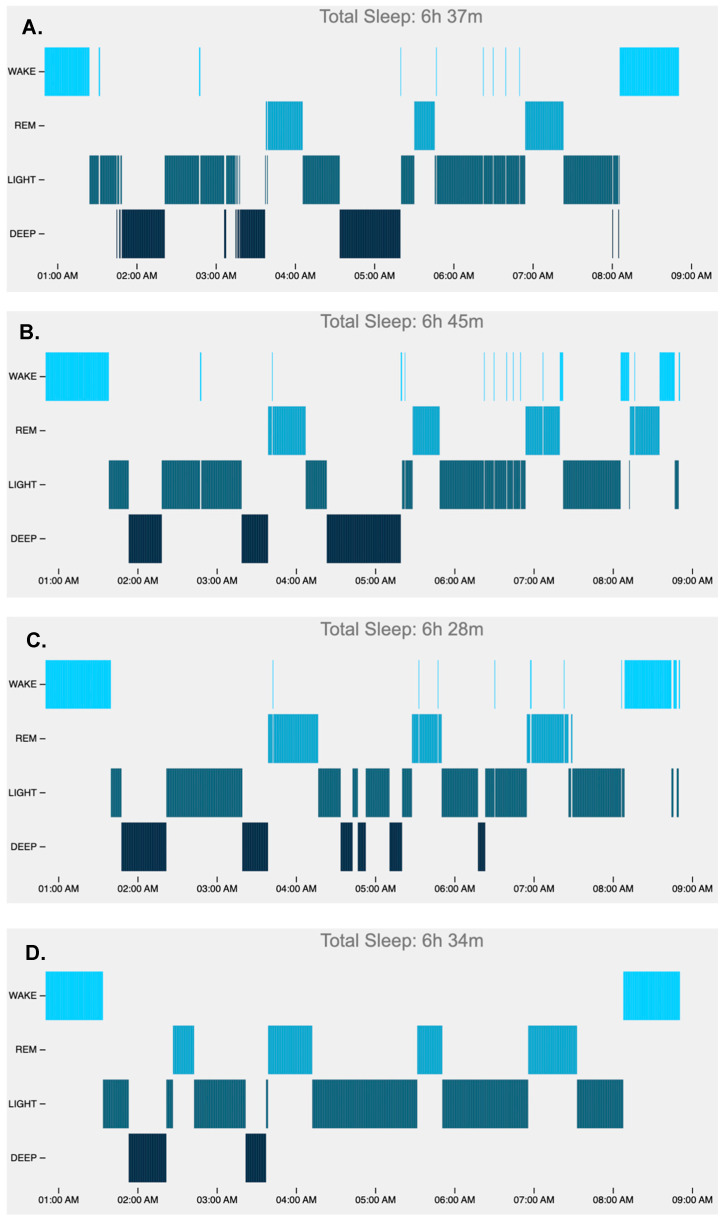
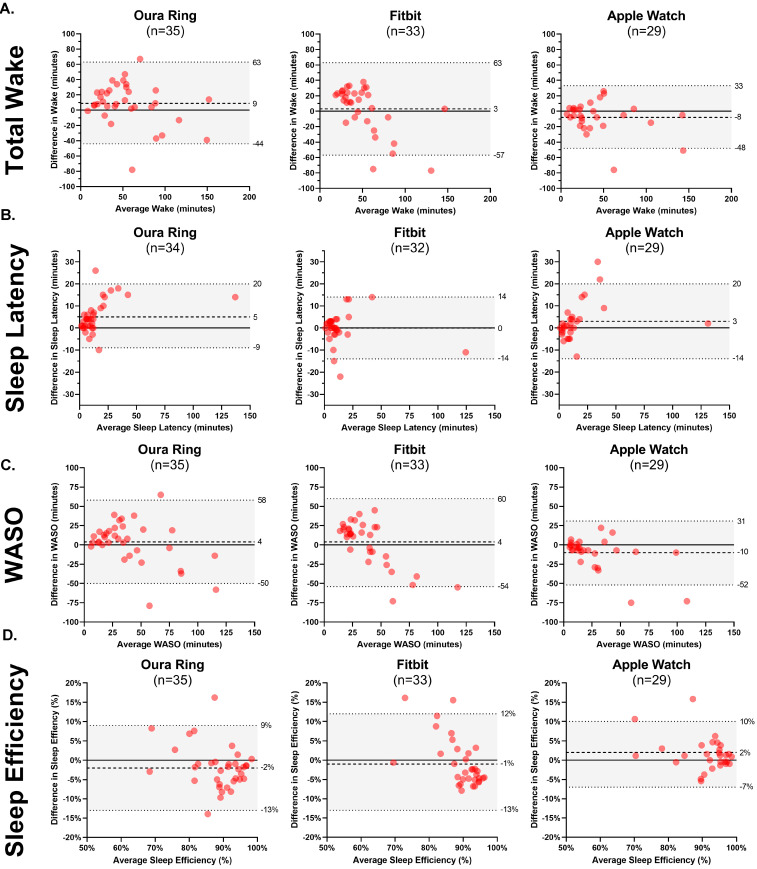
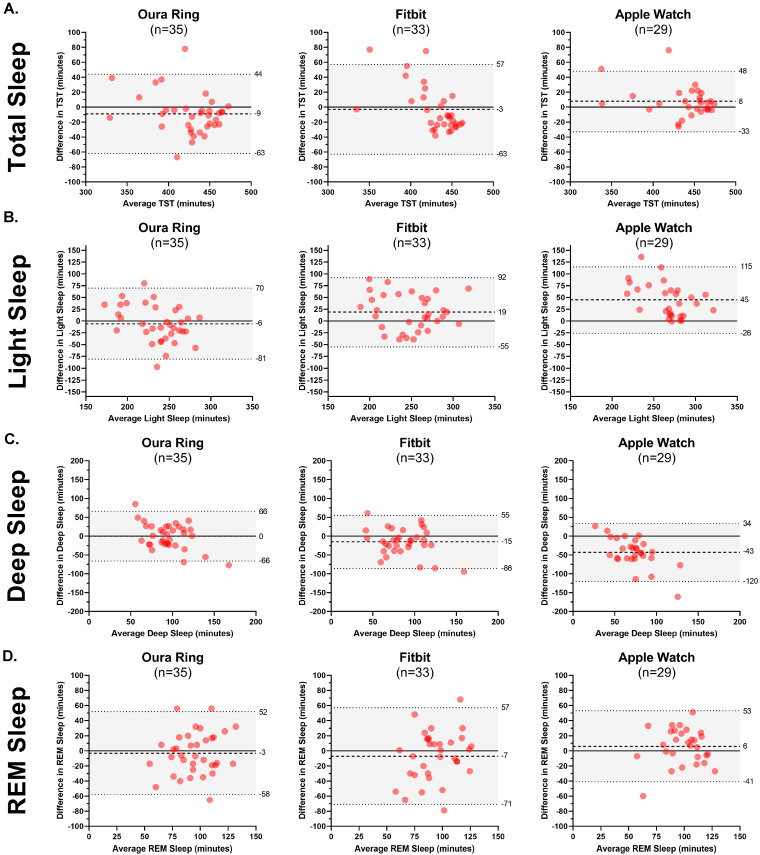
Sleep tracking by consumers is becoming increasingly prevalent; yet, few studies have evaluated the accuracy of such devices. We sought to evaluate the accuracy of three devices (Oura Ring Gen3, Fitbit Sense 2, and Apple Watch Series 8) compared to the gold standard sleep assessment (polysomnography (PSG)). Thirty-five participants (aged 20-50 years) without a sleep disorder were enrolled in a single-night inpatient study, during which they wore the Oura Ring, Fitbit, and Apple Watch, and were monitored with PSG. For detecting sleep vs. wake, the sensitivity was ≥95% for all devices. For discriminating between sleep stages, the sensitivity ranged from 50 to 86%, as follows: Oura ring sensitivity 76.0-79.5% and precision 77.0-79.5%; Fitbit sensitivity 61.7-78.0% and precision 72.8-73.2%; and Apple sensitivity 50.5-86.1% and precision 72.7-87.8%. The Oura ring was not different from PSG in terms of wake, light sleep, deep sleep, or REM sleep estimation. The Fitbit overestimated light (18 min; < 0.001) sleep and underestimated deep (15 min; < 0.001) sleep. The Apple underestimated the duration of wake (7 min; < 0.01) and deep (43 min; < 0.001) sleep and overestimated light (45 min; < 0.001) sleep. In adults with healthy sleep, all the devices were similar to PSG in the estimation of sleep duration, with the devices also showing moderate to substantial agreement with PSG-derived sleep stages.
消费者的睡眠追踪正变得越来越流行;然而,很少有研究评估这些设备的准确性。我们旨在评估三款设备(Oura Ring Gen3、Fitbit Sense 2 和 Apple Watch Series 8)与金标准睡眠评估(多导睡眠图(PSG))相比的准确性。35 名年龄在 20-50 岁之间、无睡眠障碍的参与者参加了一项单夜住院研究,在此期间,他们佩戴了 Oura Ring、Fitbit 和 Apple Watch,并接受了 PSG 监测。在检测睡眠与清醒方面,所有设备的敏感性均≥95%。在区分睡眠阶段方面,敏感性范围为 50%至 86%,如下所示:Oura Ring 的敏感性为 76.0-79.5%和精确性为 77.0-79.5%;Fitbit 的敏感性为 61.7-78.0%和精确性为 72.8-73.2%;Apple 的敏感性为 50.5-86.1%和精确性为 72.7-87.8%。Oura Ring 在估计清醒、浅睡、深睡和 REM 睡眠方面与 PSG 无差异。Fitbit 高估了浅睡(18 分钟;<0.001),低估了深睡(15 分钟;<0.001)。Apple 低估了清醒(7 分钟;<0.01)和深睡(43 分钟;<0.001)的持续时间,高估了浅睡(45 分钟;<0.001)的持续时间。在健康睡眠的成年人中,所有设备在估计睡眠时间方面与 PSG 相似,这些设备与 PSG 衍生的睡眠阶段也具有中度至高度一致性。