School of Biomedical Sciences & Pharmacy, University of Newcastle, Callaghan, NSW, Australia.
Food and Nutrition Research Program, Hunter Medical Research Institute, New Lambton Heights, NSW, Australia.
Lipids Health Dis. 2024 Oct 26;23(1):348. doi: 10.1186/s12944-024-02340-5.
Vegan and vegetarian dietary patterns are known to beneficially modulate risk factors for cardiovascular disease; however, the current literature does not differentiate between various plant-based diets. This study aimed to examine the association between various plant-based diets and plasma lipids and glycaemic indices compared to a regular meat-eating diet.
A cross-sectional study of Australian adults (n = 230) aged 30-75yrs habitually consuming the following were recruited: vegan, lacto-vegetarian, pesco-vegetarian, semi-vegetarian, or regular meat-eater. Multivariable regression analysis was used to adjust for covariates.
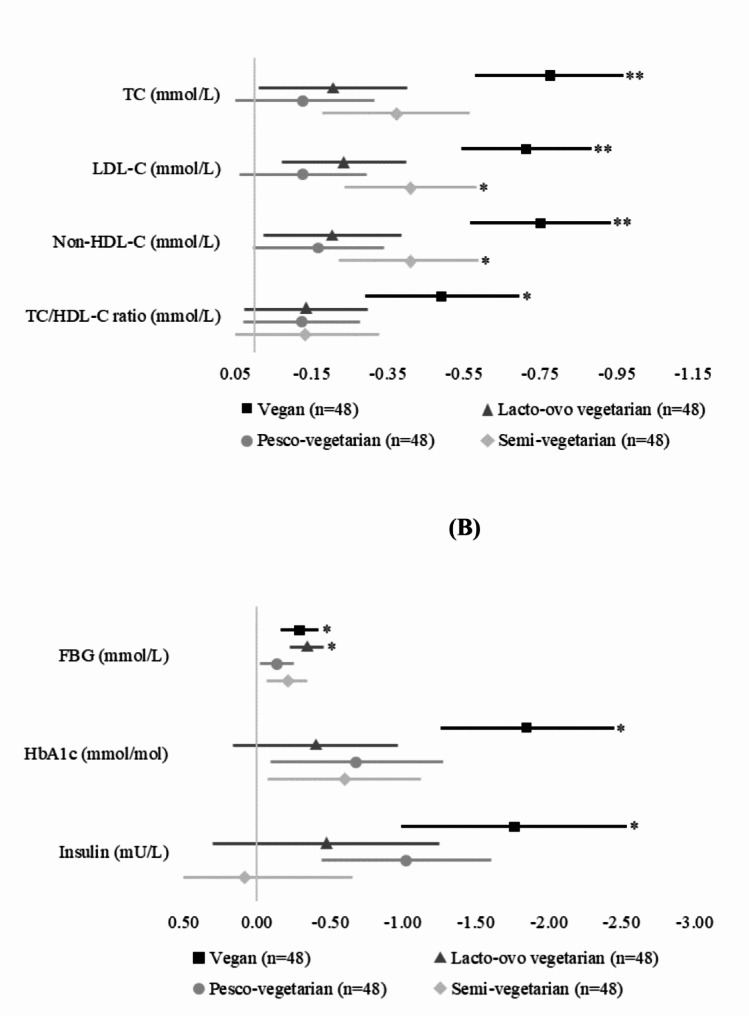
Compared to regular meat-eaters, vegans had significantly lower total cholesterol (-0.77mmol/L,95% CI -1.15, -0.39, P < 0.001), low-density lipoprotein cholesterol (LDL-C, -0.71mmol/L, 95% CI -1.05, -0.38, P < 0.001), non-high-density lipoprotein cholesterol (non-HDL-C, -0.75mmol/L, 95% CI -1.11, -0.39, P < 0.001), total cholesterol/HDL-C-ratio (-0.49mmol/L, 95% CI -0.87, -0.11, P = 0.012), fasting blood glucose (FBG, -0.29mmol/L, 95% CI -0.53, -0.06, P = 0.014), haemoglobin A1C (-1.85mmol/mol, 95% CI -3.00, -0.71, P = 0.002) and insulin (-1.76mU/L, 95% CI -3.26, -0.26, P = 0.021) concentrations. Semi-vegetarians had significantly lower LDL-C (-0.41mmol/L, 95% CI -0.74, -0.08, P = 0.041) and non-HDL-C (-0.40mmol/L, 95% CI -0.76, -0.05, P = 0.026) and lacto-ovo vegetarians had significantly lower FBG (-0.34mmol/L, 95% CI -0.56, -0.11, P = 0.003) compared to regular meat-eaters. There were no differences in HDL-C and triglycerides between plant-based and regular-meat diets.
Plasma lipaemic and glycaemic measures as a collective were more favourable among vegans, whereas among lacto-ovo vegetarians and semi-vegetarians, only some measures were favourable.
ACTRN12621000743864. Date 6/11/2021.
众所周知,素食和纯素饮食模式可以有益地调节心血管疾病的风险因素;然而,目前的文献并没有区分各种植物性饮食。本研究旨在比较各种植物性饮食与常规肉食饮食相比,对血浆脂质和血糖指数的关联。
本研究招募了 230 名年龄在 30-75 岁之间、习惯性食用以下食物的澳大利亚成年人:严格素食者、乳素食者、鱼素食者、半素食者或常规肉食者。使用多变量回归分析调整协变量。
与常规肉食者相比,严格素食者的总胆固醇(-0.77mmol/L,95%CI -1.15,-0.39,P < 0.001)、低密度脂蛋白胆固醇(LDL-C,-0.71mmol/L,95%CI -1.05,-0.38,P < 0.001)、非高密度脂蛋白胆固醇(非-HDL-C,-0.75mmol/L,95%CI -1.11,-0.39,P < 0.001)、总胆固醇/高密度脂蛋白胆固醇比值(-0.49mmol/L,95%CI -0.87,-0.11,P = 0.012)、空腹血糖(FBG,-0.29mmol/L,95%CI -0.53,-0.06,P = 0.014)、糖化血红蛋白 A1C(-1.85mmol/mol,95%CI -3.00,-0.71,P = 0.002)和胰岛素(-1.76mU/L,95%CI -3.26,-0.26,P = 0.021)浓度均较低。半素食者的 LDL-C(-0.41mmol/L,95%CI -0.74,-0.08,P = 0.041)和非-HDL-C(-0.40mmol/L,95%CI -0.76,-0.05,P = 0.026)较低,乳素食者的 FBG(-0.34mmol/L,95%CI -0.56,-0.11,P = 0.003)较低。植物性饮食和常规肉食饮食之间的高密度脂蛋白胆固醇和甘油三酯没有差异。
与常规肉食者相比,血浆脂质和血糖指标更为有利,而乳素食者和半素食者仅部分指标更为有利。
ACTRN12621000743864。日期:2021 年 11 月 6 日。