Pertzikovitz Alon, Vidal Sergi, de Valk Helga A G
Netherlands Interdisciplinary Demographic Institute (NIDI-KNAW), University of Groningen, Lange Houtstraat 19, The Hague, 2511CV, Netherlands.
Department of Sociology, Universitat Autònoma de Barcelona, Carrer de Ca N'Altayó, Edifici E2, 08193, Bellaterra/Barcelona, Spain.
Eur J Popul. 2024 Oct 28;40(1):30. doi: 10.1007/s10680-024-09717-3.
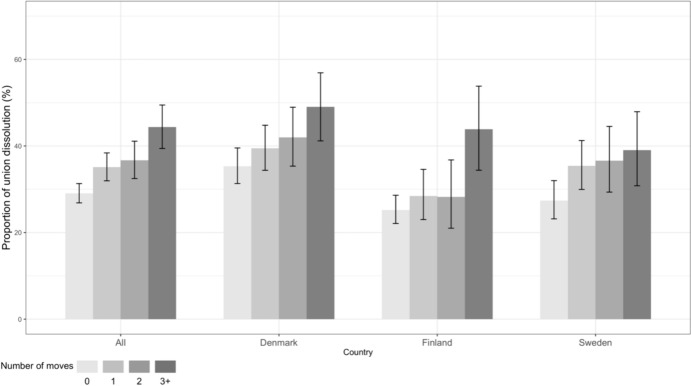
The limited existing literature studying the effects of childhood residential mobility suggests that it influences a range of life outcomes, at least in young adulthood. Little is known about how the frequency of moving in childhood is related to later-life demographic behaviour in Europe. Drawing on residential and partnership histories from the Survey of Health, Ageing and Retirement in Europe (SHARE), this paper examines whether moving in childhood relates to union dissolution in adulthood. It empirically addresses two theoretical explanations underlying the potential association: First, according to the confounding hypothesis, effects of childhood residential mobility differ by family background and resources. Second, the family stress model suggests that the accumulated stress and conflicts associated with frequent residential mobility disrupt the family and child's social ties, resulting in worse relationship skills in later life (mediation hypothesis). Applying discrete-time event history analysis to individuals born between 1945 and 1965 in Sweden, Denmark, and Finland, we find a significant association between childhood moves (prior to age 17) and adult union dissolution. The effect's strength varies based on the number of childhood moves, demonstrating a clear gradient. Notably, adults with three or more childhood moves exhibit a 55% higher likelihood of union dissolution compared to non-movers. These associations persist even after accounting for childhood background factors, while family stress mediates the link partially. Our findings shed light on the role of spatial mobility in shaping demographic outcomes and underscore its potential contribution to the accumulation and reproduction of life disadvantages.
现有研究童年时期居住流动性影响的文献有限,表明其至少在青年期会影响一系列生活结果。关于童年时期搬家频率与欧洲后期人口行为之间的关系,我们知之甚少。本文利用欧洲健康、老龄化与退休调查(SHARE)中的居住和伴侣关系历史数据,研究童年时期搬家是否与成年后的婚姻解体有关。它通过实证研究了潜在关联背后的两种理论解释:第一,根据混杂假设,童年时期居住流动性的影响因家庭背景和资源而异。第二,家庭压力模型表明,频繁居住流动带来的累积压力和冲突会破坏家庭和孩子的社会关系,导致后期生活中的人际关系技能更差(中介假设)。对瑞典、丹麦和芬兰1945年至1965年出生的个体应用离散时间事件史分析,我们发现童年时期搬家(17岁之前)与成年后的婚姻解体之间存在显著关联。这种影响的强度因童年时期搬家的次数而异,呈现出明显的梯度。值得注意的是,与童年时期未搬家的成年人相比,童年时期搬家三次或更多次的成年人婚姻解体的可能性高出55%。即使在考虑了童年背景因素之后,这些关联仍然存在,而家庭压力部分地介导了这种联系。我们的研究结果揭示了空间流动性在塑造人口结果中的作用,并强调了其对生活劣势的积累和再生产的潜在贡献。