School for Environment and Sustainability, University of Michigan, Ann Arbor, MI 19350.
Aquatic Ecology Laboratory, Department of Evolution, Ecology, and Organismal Biology, The Ohio State University, Columbus, OH 43212.
Proc Natl Acad Sci U S A. 2024 Nov 5;121(45):e2322595121. doi: 10.1073/pnas.2322595121. Epub 2024 Oct 28.
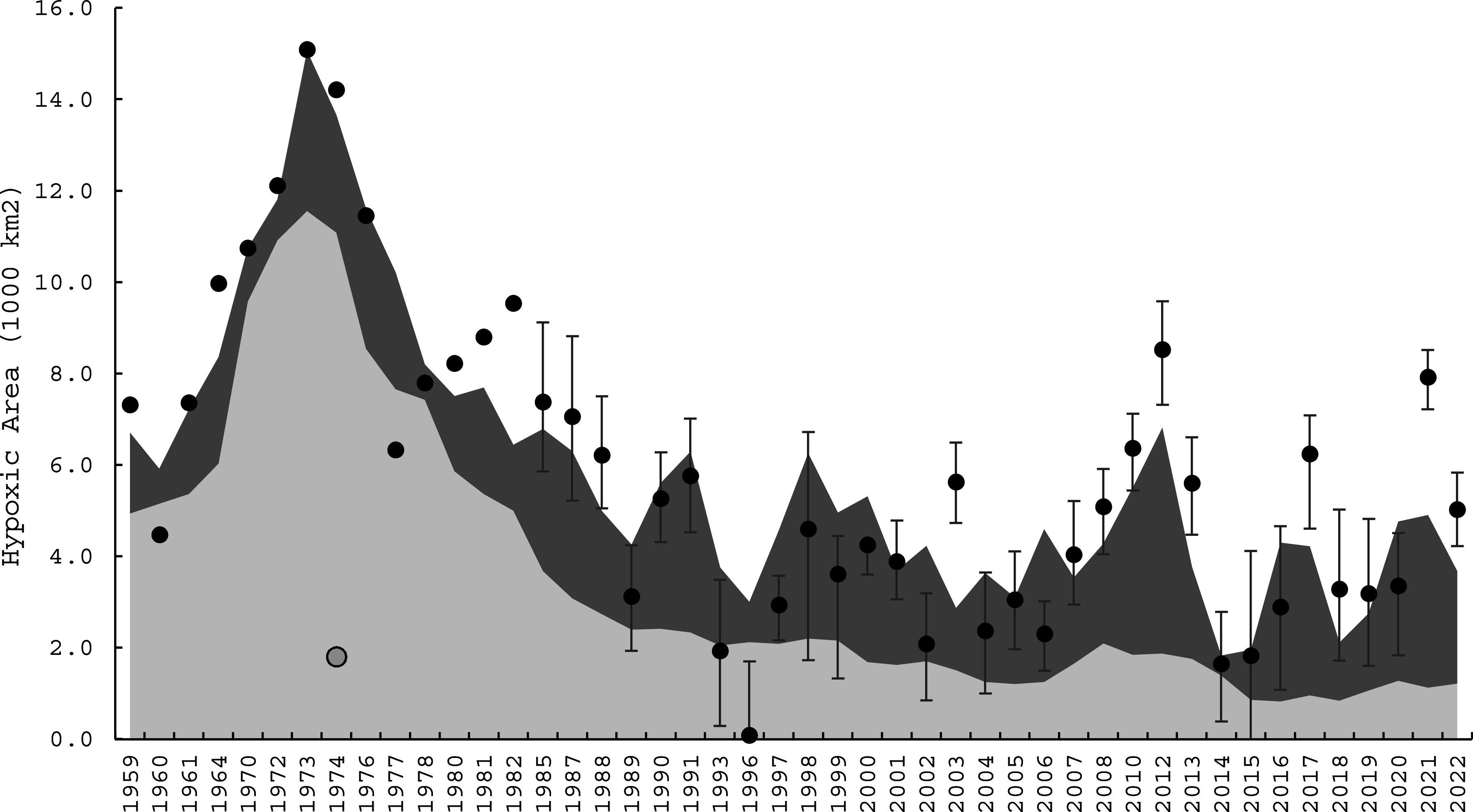
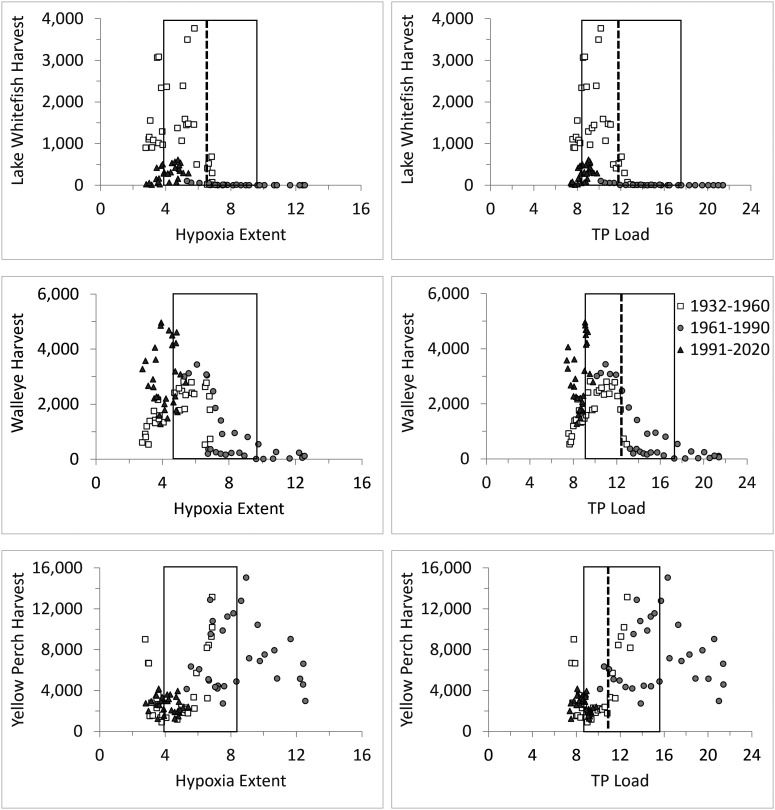
Changes driven by both unanticipated human activities and management actions are creating wicked management landscapes in freshwater and marine ecosystems that require new approaches to support decision-making. By linking a predictive model of nutrient- and temperature-driven bottom hypoxia with observed commercial fishery harvest data from Lake Erie (United States-Canada) over the past century (1928-2022) and climate projections (2030-2099), we show how simple, yet robust models and routine monitoring data can be used to identify tradeoffs associated with nutrient management and guide decision-making in even the largest of aquatic ecosystems now and in the future. Our approach enabled us to assess planned nutrient load reduction targets designed to mitigate nutrient-driven hypoxia and show why they appear overly restrictive based on current fishery needs, indicating tradeoffs between water quality and fisheries management goals. At the same time, our temperature results show that projected climate change impacts on hypoxic extent will require more stringent nutrient regulations in the future. Beyond providing a rare example of bottom hypoxia driving changes in fishery harvests at an ecosystem scale, our study illustrates the need for adaptive ecosystem-based management, which can be informed by simple predictive models that can be readily applied over long time periods, account for tradeoffs across multiple management sectors (e.g., water quality, fisheries), and address ecosystem nonstationarity (e.g., climate change impacts on management targets). Such approaches will be critical for maintaining valued ecosystem services in the many aquatic systems worldwide that are vulnerable to multiple drivers of environmental change.
人为活动和管理措施带来的变化正在淡水和海洋生态系统中形成复杂的管理局面,这需要新的方法来支持决策。我们通过将一个预测模型与过去一个世纪(1928-2022 年)在伊利湖(美加共有)观察到的商业渔业捕捞数据和气候预测(2030-2099 年)联系起来,展示了简单而强大的模型和常规监测数据如何用于确定与营养管理相关的权衡,并指导即使是最大的水生生态系统现在和未来的决策。我们的方法使我们能够评估旨在减轻营养驱动型缺氧的计划营养负荷减少目标,并展示为什么根据当前渔业需求,这些目标似乎过于严格,表明水质和渔业管理目标之间存在权衡。与此同时,我们的温度结果表明,预计气候变化对缺氧范围的影响将要求未来更严格的营养法规。除了在生态系统尺度上罕见地证明底栖缺氧会导致渔业捕捞量变化外,我们的研究还说明了需要进行适应性的基于生态系统的管理,这可以通过简单的预测模型来提供信息,这些模型可以在很长一段时间内轻松应用,考虑到多个管理部门(例如水质、渔业)之间的权衡,并解决生态系统非平稳性(例如,气候变化对管理目标的影响)。这些方法对于维持全球许多易受环境变化多种驱动因素影响的水生系统的有价值的生态系统服务至关重要。