Wong Ka Po, Zhang Bohan, Lai Cynthia Yuen Yi, Xie Yao Jie, Li Yan, Li Chen, Qin Jing
Department of Applied Social Sciences, The Hong Kong Polytechnic University, Hong Kong, China (Hong Kong).
Centre for Smart Health, School of Nursing, The Hong Kong Polytechnic University, Hong Kong, China (Hong Kong).
JMIR Serious Games. 2024 Oct 28;12:e58963. doi: 10.2196/58963.
Attention-deficit/hyperactivity disorder (ADHD) usually begins in childhood and is often accompanied by impairments in social functioning. Virtual reality (VR) has emerged as an adjunctive tool to embed in social skills training to enhance the social skills of children with ADHD, but its effectiveness requires further investigation.
This study aims to enhance the social skills of children with ADHD by examining the feasibility and effectiveness of VR-based training in comparison to traditional social skills training.
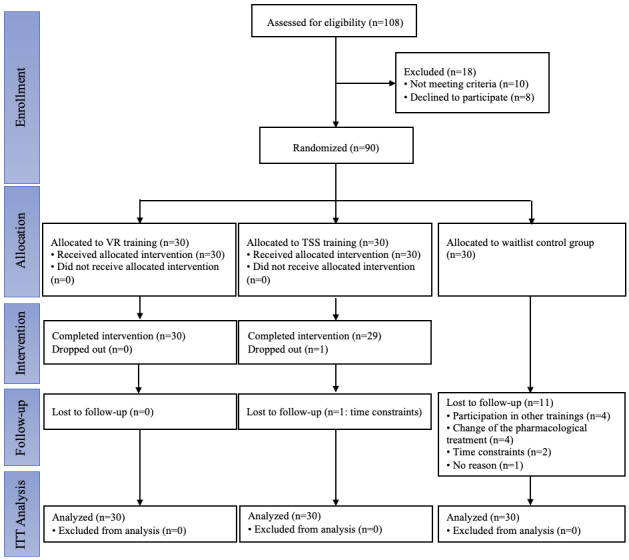
A 3-arm randomized controlled trial was conducted with 90 children with ADHD aged 6-12 years. Participants were randomly assigned to 3 weeks of 12-session VR-based social skills training, traditional social skills training, or a waitlist control group of equivalent duration. Outcome measures included assessments by a clinical psychologist who was blinded to group assignments, the Social Skills Improvement System Rating Scale, the Behavior Rating Inventory of Executive Function, and the Simulator Sickness Questionnaire, conducted at baseline and after the intervention.
The preliminary results support the feasibility and acceptability of VR training for children with ADHD aged 6-12 years. Analysis showed that the VR and traditional social skills training groups experienced a statistically significant improvement in the clinical psychologist assessment of social skills and parent-rated self-control, initiative, and emotional control after the intervention compared with baseline. The VR group performed significantly better than the traditional social skills group on social skills assessed by clinical psychologists (F=76.77; P<.001) and on parent-rated self-control (F=18.77; P<.001), initiative (F=11.93; P<.001), and emotional control (F=17.27; P<.001). No significant between-group differences were found for parent-rated cooperation and inhibition (all P>.05).
The findings provide preliminary evidence supporting the feasibility and superior effectiveness of VR-based social skills training compared to traditional approaches for enhancing social skills and related executive functions in children with ADHD. These results suggest that VR may be a valuable tool to embed within social skills interventions for this population. Further research is warranted to explore the long-term impacts and generalizability of these benefits.
ClinicalTrials.gov NCT05778526; https://clinicaltrials.gov/study/NCT05778526.
INTERNATIONAL REGISTERED REPORT IDENTIFIER (IRRID): RR2-10.2196/48208.
注意力缺陷多动障碍(ADHD)通常始于童年,常伴有社交功能障碍。虚拟现实(VR)已成为一种辅助工具,可融入社交技能训练中,以提高多动症儿童的社交技能,但其有效性仍需进一步研究。
本研究旨在通过比较基于VR的训练与传统社交技能训练的可行性和有效性,提高多动症儿童的社交技能。
对90名6至12岁的多动症儿童进行了一项三臂随机对照试验。参与者被随机分配到为期3周、共12节的基于VR的社交技能训练组、传统社交技能训练组或同等时长的等待名单对照组。结果测量包括由对分组不知情的临床心理学家进行的评估、社交技能改进系统评定量表、执行功能行为评定量表和模拟器晕动病问卷,在基线和干预后进行。
初步结果支持了对6至12岁多动症儿童进行VR训练的可行性和可接受性。分析表明,与基线相比,VR组和传统社交技能训练组在干预后,临床心理学家对社交技能的评估以及家长评定的自我控制、主动性和情绪控制方面有统计学显著改善。在临床心理学家评估的社交技能方面(F=76.77;P<.001)以及家长评定的自我控制方面(F=18.77;P<.001)、主动性方面(F=11.93;P<.001)和情绪控制方面(F=17.27;P<.001),VR组的表现明显优于传统社交技能组。在家长评定的合作和抑制方面,未发现组间显著差异(所有P>.05)。
研究结果提供了初步证据,支持与传统方法相比,基于VR的社交技能训练在提高多动症儿童社交技能和相关执行功能方面的可行性和卓越有效性。这些结果表明,VR可能是针对该人群融入社交技能干预的一种有价值的工具。有必要进一步研究以探索这些益处的长期影响和普遍性。
ClinicalTrials.gov NCT05778526;https://clinicaltrials.gov/study/NCT05778526。
国际注册报告识别码(IRRID):RR2-10.2196/48208。