Corrigan Niamh, Păsărelu Costina-Ruxandra, Voinescu Alexandra
Department of Psychology, University of Bath, Claverton Down, Bath, BA2 7AY UK.
Department of Clinical Psychology and Psychotherapy, The International Institute for the Advanced Studies of Psychotherapy and Applied Mental Health, Babe-Bolyai University, No.37, Republicii Street, 400015 Cluj-Napoca, Romania.
Virtual Real. 2023 Feb 18:1-20. doi: 10.1007/s10055-023-00768-1.
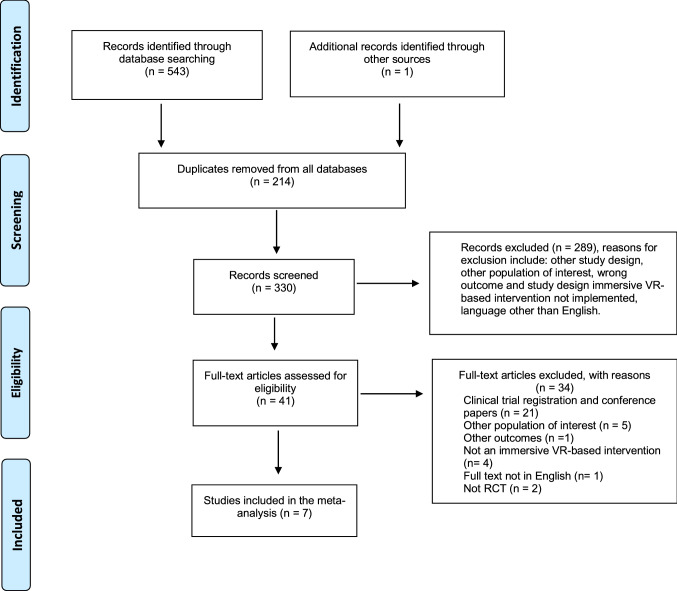
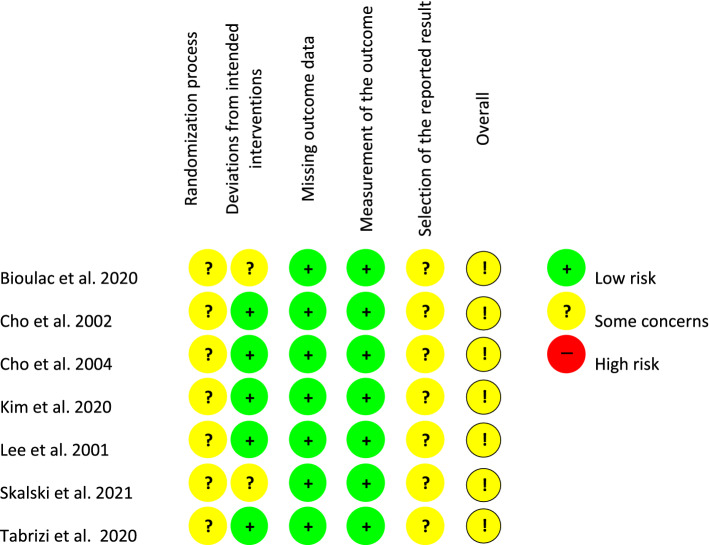
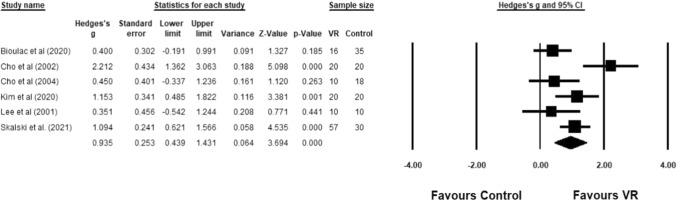
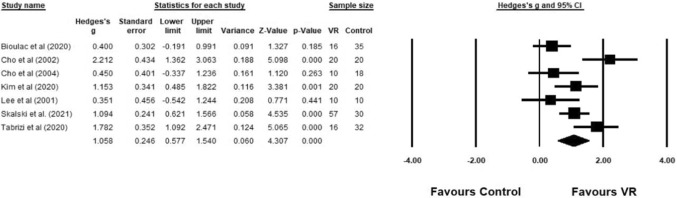
Virtual reality (VR) shows great potential in treating and managing various mental health conditions. This includes using VR for training or rehabilitation purposes. For example, VR is being used to improve cognitive functioning (e.g. attention) among children with attention/deficit-hyperactivity disorder (ADHD). The aim of the current review and meta-analysis is to evaluate the effectiveness of immersive VR-based interventions for improving cognitive deficits in children with ADHD, to investigate potential moderators of the effect size and assess treatment adherence and safety. The meta-analysis included seven randomised controlled trials (RCTs) of children with ADHD comparing immersive VR-based interventions with controls (e.g. waiting list, medication, psychotherapy, cognitive training, neurofeedback and hemoencephalographic biofeedback) on measures of cognition. Results indicated large effect sizes in favour of VR-based interventions on outcomes of global cognitive functioning, attention, and memory. Neither intervention length nor participant age moderated the effect size of global cognitive functioning. Control group type (active vs passive control group), ADHD diagnostic status (formal vs. informal) and novelty of VR technology were not significant moderators of the effect size of global cognitive functioning. Treatment adherence was similar across groups and there were no adverse effects. Results should be cautiously interpreted given the poor quality of included studies and small sample.
虚拟现实(VR)在治疗和管理各种心理健康状况方面显示出巨大潜力。这包括将VR用于训练或康复目的。例如,VR正被用于改善注意力缺陷多动障碍(ADHD)儿童的认知功能(如注意力)。当前综述和荟萃分析的目的是评估沉浸式VR干预对改善ADHD儿童认知缺陷的有效性,调查效应量的潜在调节因素,并评估治疗依从性和安全性。荟萃分析纳入了七项针对ADHD儿童的随机对照试验(RCT),比较了沉浸式VR干预与对照组(如等待名单、药物治疗、心理治疗、认知训练、神经反馈和脑电生物反馈)在认知测量方面的效果。结果表明,基于VR的干预在全球认知功能、注意力和记忆结果方面有较大的效应量。干预时长和参与者年龄均未调节全球认知功能的效应量。对照组类型(主动与被动对照组)、ADHD诊断状态(正式与非正式)和VR技术的新颖性均不是全球认知功能效应量的显著调节因素。各组的治疗依从性相似,且无不良反应。鉴于纳入研究质量较差且样本量较小,应对结果进行谨慎解读。