Department of Neurology, Second Faculty of Medicine, Charles University and Motol University Hospital Motol, Prague, Czech Republic.
Department of Clinical Biochemistry, Hematology and Immunology, Na Homolce Hospital, Prague, Czech Republic.
Medicine (Baltimore). 2024 Oct 25;103(43):e40165. doi: 10.1097/MD.0000000000040165.
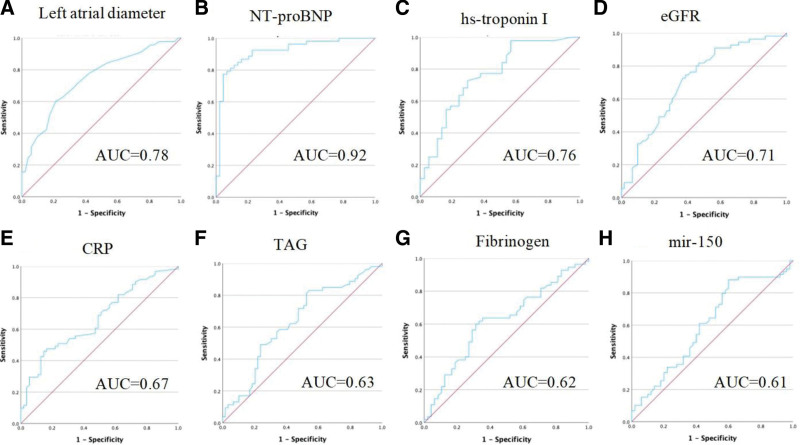
This study aimed to evaluate the ability of selected microRNAs as biomarkers of atrial fibrillation (AF) in ischemic stroke patients in comparison with other established biochemical biomarkers. A prospective case-control study of consecutive ischemic stroke patients with AF admitted to a comprehensive stroke center was conducted. The control group consisted of patients with ischemic stroke with no AF detected on prolonged (at least 3 weeks) Holter ECG monitoring. As potential biomarkers of AF, we analyzed the plasma levels of microRNAs (miR-21, miR-29b, miR-133b, miR-142-5p, miR-150, miR-499, and miR-223-3p) and 13 biochemical biomarkers at admission. The predictive accuracy of biomarkers was assessed by calculating the area under the receiver operating characteristic curve. The data of 117 patients were analyzed (61 with AF, 56 with no AF, 46% men, median age 73 years, median National Institutes of Health Stroke Scale 6). Biochemical biomarkers (N-terminal pro-B-type natriuretic peptide [NT-proBNP], high-sensitivity cardiac troponin I, fibrinogen, C-reactive protein, eGFR, and total triglycerides) were significantly associated with AF. NT-proBNP had the best diagnostic performance for AF with area under the receiver operating characteristic curve 0.92 (95%, CI 0.86-0.98); a cutoff value of >528 ng/L had a sensitivity of 79% and a specificity of 97%. None of the other biomarkers, including microRNAs, was associated with AF. Conventional biochemical biomarkers (NT-proBNP, high-sensitivity cardiac troponin I, fibrinogen, C-reactive protein, eGFR, and triglycerides), but not microRNAs (miR-21, miR-29b, miR-133b, miR-142-5p, miR-150, miR-499, and miR-223-3p) were significantly associated with AF in our ischemic stroke cohort.
本研究旨在评估选定 microRNAs 作为伴有房颤(AF)的缺血性脑卒中患者生物标志物的能力,并与其他已建立的生化生物标志物进行比较。这是一项连续缺血性脑卒中伴有 AF 患者的前瞻性病例对照研究,这些患者在综合卒中中心接受了至少 3 周的长时间(Holter)心电图监测。我们分析了入院时血浆 microRNAs(miR-21、miR-29b、miR-133b、miR-142-5p、miR-150、miR-499 和 miR-223-3p)和 13 种生化生物标志物的水平,作为 AF 的潜在生物标志物。通过计算受试者工作特征曲线下面积来评估生物标志物的预测准确性。共分析了 117 例患者的数据(61 例伴有 AF,56 例无 AF,46%为男性,中位年龄 73 岁,中位国立卫生研究院卒中量表评分 6 分)。生化标志物(N 末端脑利钠肽前体[NT-proBNP]、高敏心肌肌钙蛋白 I、纤维蛋白原、C 反应蛋白、肾小球滤过率和总甘油三酯)与 AF 显著相关。NT-proBNP 对 AF 的诊断性能最佳,受试者工作特征曲线下面积为 0.92(95%CI,0.86-0.98);截断值>528ng/L 时,灵敏度为 79%,特异性为 97%。其他生物标志物,包括 microRNAs,均与 AF 无相关性。在我们的缺血性脑卒中队列中,常规生化生物标志物(NT-proBNP、高敏心肌肌钙蛋白 I、纤维蛋白原、C 反应蛋白、肾小球滤过率和甘油三酯),而不是 microRNAs(miR-21、miR-29b、miR-133b、miR-142-5p、miR-150、miR-499 和 miR-223-3p)与 AF 显著相关。