Department of Gastroenterology, Key Laboratory of Gut Microbiota Translational Medicine Research, Peking Union Medical College Hospital, Peking Union Medical College & Chinese Academy of Medical Science, Beijing, China; Eight-year Medical Doctor Program, Peking Union Medical College & Chinese Academy of Medical Science, Beijing, China.
Department of Gastroenterology, Key Laboratory of Gut Microbiota Translational Medicine Research, Peking Union Medical College Hospital, Peking Union Medical College & Chinese Academy of Medical Science, Beijing, China.
EBioMedicine. 2024 Nov;109:105427. doi: 10.1016/j.ebiom.2024.105427. Epub 2024 Oct 30.
The influence of the gut microbiota on long-term immune checkpoint inhibitor (ICI) efficacy and immune-related adverse events (irAEs) is poorly understood, as are the underlying mechanisms.
We performed gut metagenome and metabolome sequencing of gut microbiotas from patients with lung cancer initially treated with anti-PD-1/PD-L1 therapy and explored the underlying mechanisms mediating long-term (median follow-up 1167 days) ICI responses and immune-related adverse events (irAEs). Results were validated in external, publicly-available datasets (Routy, Lee, and McCulloch cohorts).
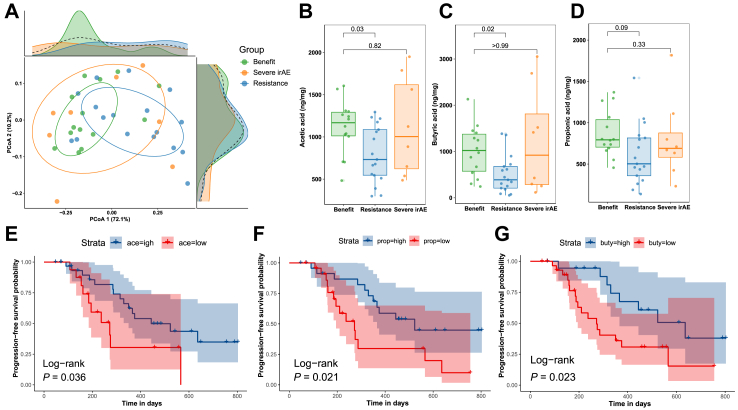
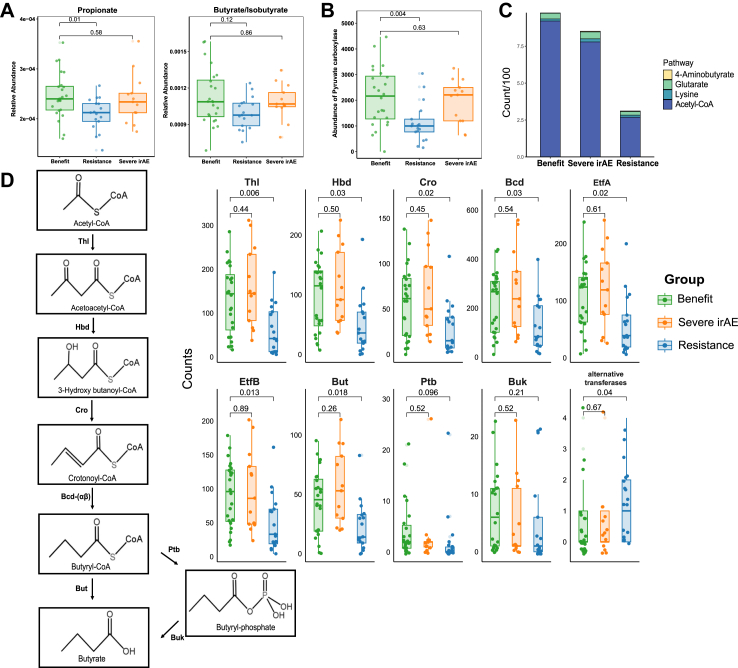
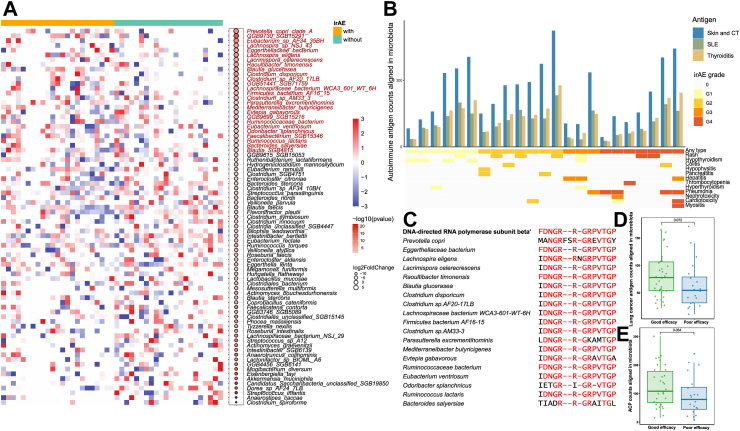
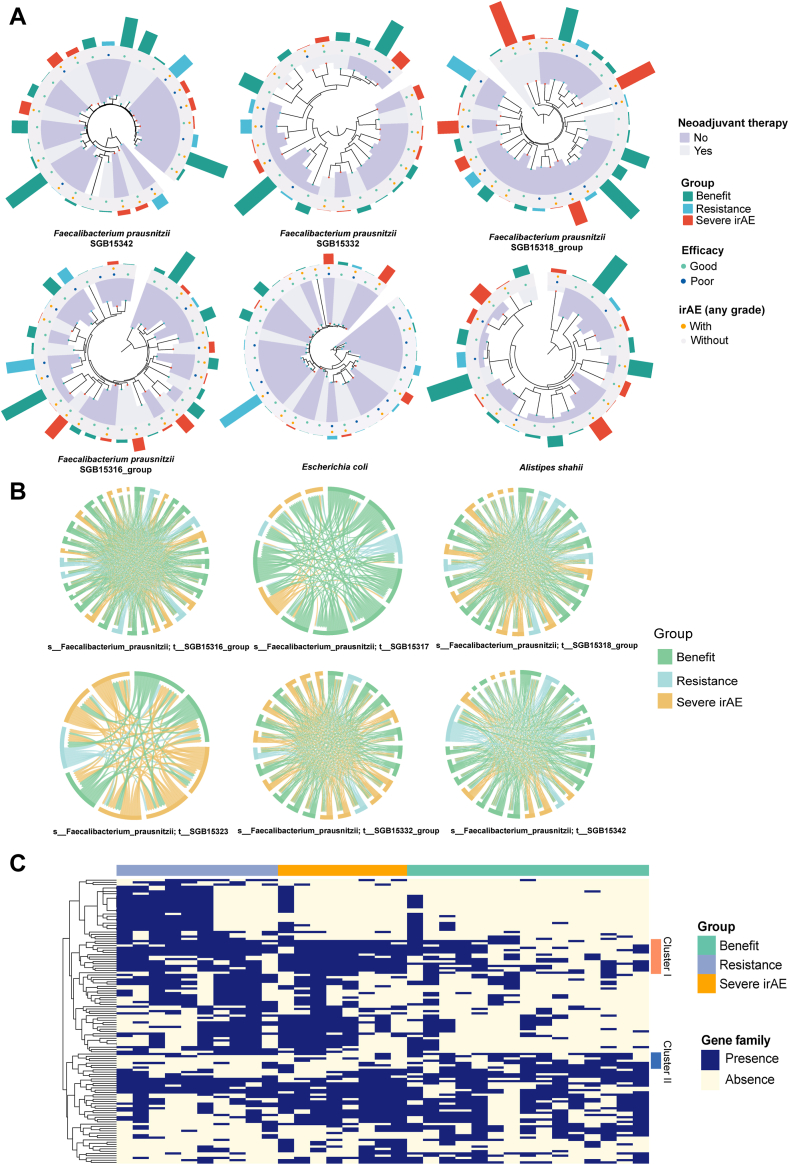
The ICI benefit group was enriched for propionate (P = 0.01) and butyrate/isobutyrate (P = 0.12) compared with the resistance group, which was validated in the McCulloch cohort (propionate P < 0.001, butyrate/isobutyrate P = 0.002). The acetyl-CoA pathway (P = 0.02) in beneficial species mainly mediated butyrate production. Microbiota sequences from irAE patients aligned with antigenic epitopes found in autoimmune diseases. Microbiotas of responsive patients contained more lung cancer-related antigens (P = 0.07), which was validated in the Routy cohort (P = 0.02). Escherichia coli and SGB15342 of Faecalibacterium prausnitzii showed strain-level variations corresponding to clinical phenotypes. Metabolome validation reviewed more abundant acetic acid (P = 0.03), propionic acid (P = 0.09), and butyric acid (P = 0.02) in the benefit group than the resistance group, and patients with higher acetic, propionic, and butyric acid levels had a longer progression-free survival and lower risk of tumor progression after adjusting for histopathological subtype and stage (P < 0.05).
Long-term ICI survivors have coevolved a compact microbial community with high butyrate production, and molecular mimicry of autoimmune and tumor antigens by microbiota contribute to outcomes. These results not only characterize the gut microbiotas of patients who benefit long term from ICIs but pave the way for "smart" fecal microbiota transplantation. Registered in the Chinese Clinical Trial Registry (ChiCTR2000032088).
This work was supported by Beijing Natural Science Foundation (7232110), National High Level Hospital Clinical Research Funding (2022-PUMCH-A-072, 2023-PUMCH-C-054), CAMS Innovation Fund for Medical Sciences (CIFMS) (2022-I2M-C&T-B-010).
肠道微生物群对长期免疫检查点抑制剂(ICI)疗效和免疫相关不良事件(irAEs)的影响尚不清楚,其潜在机制也是如此。
我们对最初接受抗 PD-1/PD-L1 治疗的肺癌患者的肠道微生物群进行了肠道宏基因组和代谢组测序,并探索了介导长期(中位随访 1167 天)ICI 反应和免疫相关不良事件(irAEs)的潜在机制。结果在外部公开可用的数据集(Routy、Lee 和 McCulloch 队列)中得到了验证。
与耐药组相比,ICI 获益组富含丙酸盐(P=0.01)和丁酸盐/异丁酸盐(P=0.12),这在 McCulloch 队列中得到了验证(丙酸盐 P<0.001,丁酸盐/异丁酸盐 P=0.002)。有益物种中的乙酰辅酶 A 途径(P=0.02)主要介导丁酸盐的产生。irAE 患者的微生物组序列与自身免疫性疾病中的抗原表位相吻合。反应性患者的微生物组含有更多与肺癌相关的抗原(P=0.07),这在 Routy 队列中得到了验证(P=0.02)。大肠杆菌和 Faecalibacterium prausnitzii 的 SGB15342 显示出与临床表型相对应的菌株水平变化。代谢组验证表明,在获益组中,乙酸(P=0.03)、丙酸(P=0.09)和丁酸(P=0.02)的含量高于耐药组,并且在调整组织病理学亚型和分期后,具有较高的乙酸、丙酸和丁酸水平的患者具有更长的无进展生存期和更低的肿瘤进展风险(P<0.05)。
长期接受 ICI 治疗的幸存者与丁酸产量较高的紧密共生微生物群落共同进化,而微生物群对自身免疫和肿瘤抗原的分子模拟有助于产生结果。这些结果不仅描绘了长期从 ICI 中获益的患者的肠道微生物群,还为“智能”粪便微生物群移植铺平了道路。在中国临床试验注册中心(ChiCTR2000032088)注册。
本工作得到北京市自然科学基金(7232110)、国家高水平医院临床研究基金(2022-PUMCH-A-072,2023-PUMCH-C-054)、中国医学科学院医学与健康科技创新工程(CIFMS)(2022-I2M-C&T-B-010)的资助。