Ciernikova Sona, Sevcikova Aneta, Novisedlakova Maria, Mego Michal
Department of Genetics, Cancer Research Institute, Biomedical Research Center of the Slovak Academy of Sciences, Dubravska Cesta 9, 845 05 Bratislava, Slovakia.
Department of Oncology, Hospital Bory, Ivana Bukovčana 6118, 841 08 Bratislava, Slovakia.
Cancers (Basel). 2024 Dec 23;16(24):4271. doi: 10.3390/cancers16244271.
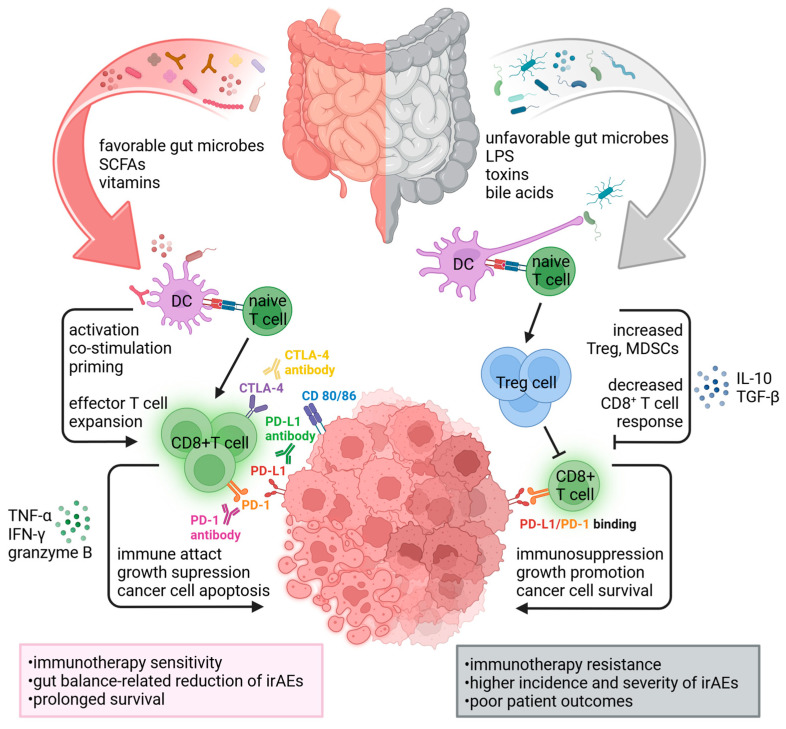
Immunotherapy with immune checkpoint inhibitors represents a revolutionary approach to the treatment of solid tumors, including malignant melanoma, lung cancer, and gastrointestinal malignancies. Anti-CTLA-4 and anti-PD-1/PDL-1 therapies provide prolonged survival for cancer patients, but their efficacy and safety are highly variable. This review focuses on the crucial role of the gut microbiome in modulating the efficacy and toxicity of immune checkpoint blockade. Studies suggest that the composition of the gut microbiome may influence the response to immunotherapy, with specific bacterial strains able to promote an anti-tumor immune response. On the other hand, dysbiosis may increase the risk of adverse effects, such as immune-mediated colitis. Interventions aimed at modulating the microbiome, including the use of probiotics, prebiotics, fecal microbial transplantation, or dietary modifications, represent promising strategies to increase treatment efficacy and reduce toxicity. The combination of immunotherapy with the microbiome-based strategy opens up new possibilities for personalized treatment. In addition, factors such as physical activity and nutritional supplementation may indirectly influence the gut ecosystem and consequently improve treatment outcomes in refractory patients, leading to enhanced patient responses and prolonged survival.
使用免疫检查点抑制剂进行免疫治疗是治疗实体瘤(包括恶性黑色素瘤、肺癌和胃肠道恶性肿瘤)的一种革命性方法。抗CTLA-4和抗PD-1/PDL-1疗法可延长癌症患者的生存期,但其疗效和安全性差异很大。本综述重点关注肠道微生物群在调节免疫检查点阻断的疗效和毒性方面的关键作用。研究表明,肠道微生物群的组成可能会影响对免疫治疗的反应,特定的细菌菌株能够促进抗肿瘤免疫反应。另一方面,生态失调可能会增加不良反应的风险,如免疫介导的结肠炎。旨在调节微生物群的干预措施,包括使用益生菌、益生元、粪便微生物移植或饮食调整,是提高治疗效果和降低毒性的有前景的策略。免疫治疗与基于微生物群的策略相结合为个性化治疗开辟了新的可能性。此外,体育活动和营养补充等因素可能会间接影响肠道生态系统,从而改善难治性患者的治疗结果,提高患者反应并延长生存期。