Hu Hai-Tao, Jiang Yu-Juan, Shao Xin-Xin, Lu Yi-Ming, Tian Yan-Tao, Xu Quan
Department of Pancreatic and Gastric Surgery, National Cancer Center/National Clinical Research Center for Cancer/Cancer Hospital, Chinese Academy of Medical Sciences and Peking Union Medical College, Beijing 100021, China.
World J Clin Oncol. 2024 Oct 24;15(10):1269-1279. doi: 10.5306/wjco.v15.i10.1269.
Cancer presents a significant public health challenge in China, necessitating broad collaboration across society. The Chinese government has articulated a goal to increase the overall five-year survival rate for cancer by 15% by 2030. Achieving this objective requires not only advances in medical technology, but also an improvement in the dissemination of knowledge pertaining to cancer prevention and treatment.
To provide a comprehensive understanding of the status of cancer prevention and level of popularization in China in 2023.
From January 2023 to May 2023, online questionnaires were distributed to 3000 participants, including medical personnel, patients with cancer, their families, and the general public. There were 2711 valid responses, covering the entire nation.
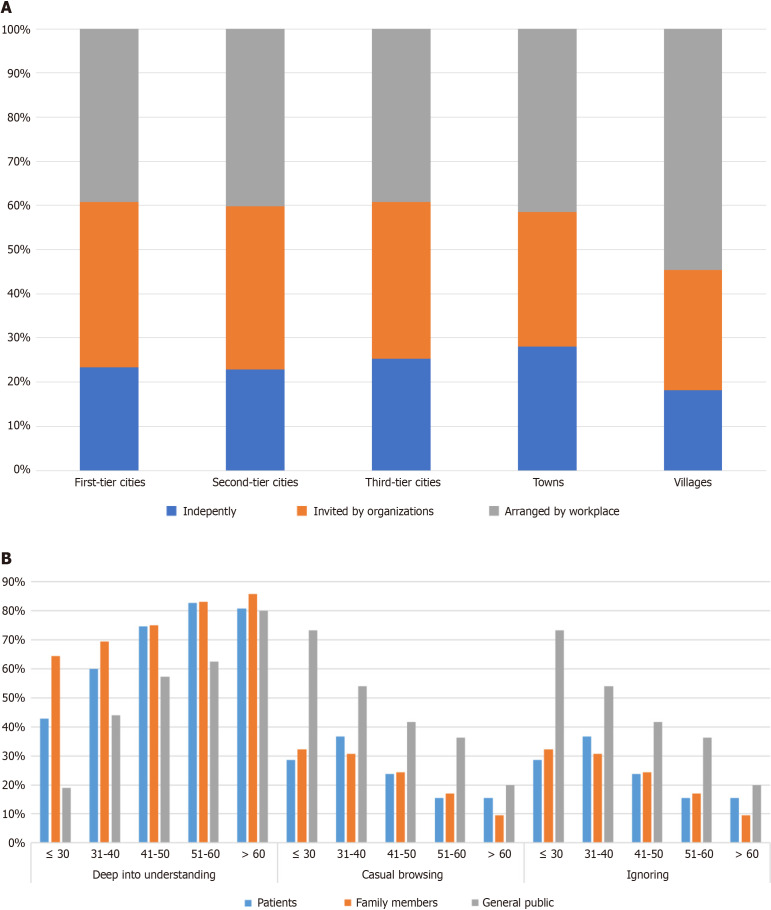
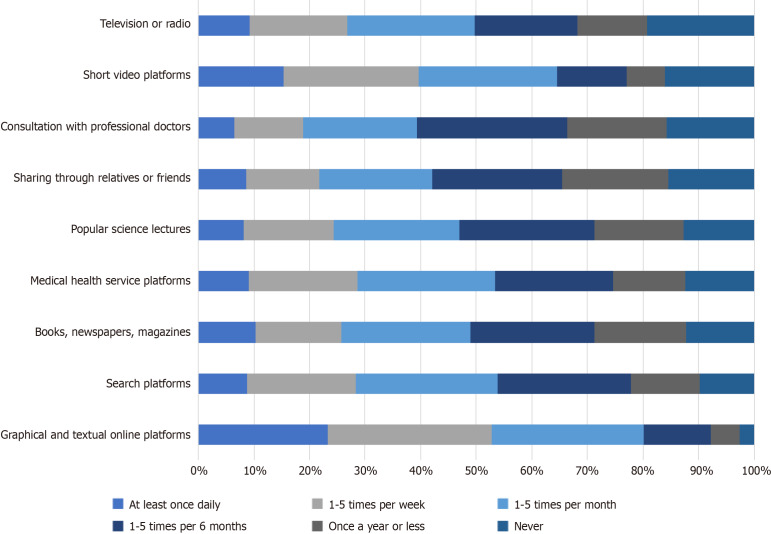
A total of 1020 medical personnel and 1691 patients with cancer, their family members, and the general public participated in the survey. Among medical personnel, 93.2% had popularized cancer health. Commonly addressed topics included cancer prevention (85.9%) and cancer screening (77.8%). Primary challenges included time constraints (73.9%), insufficient personnel and material support (66.7%), and uncertainty as to where to begin (49.3%). Among patients with cancer, their family members, and the general public, 93.4% reported reading or watching cancer science popularization materials and 56.9% expressed a desire for deeper understanding. The most sought-after topics in cancer science popularization included cancer screening (80.2%) and cancer prevention (75.8%). The greatest challenge encountered in accessing cancer health popularization was an abundance of misinformation (67.5%).
Most clinical doctors, patients, family, and the general public wish to participate in cancer education. However, improvement in the quality of content in cancer prevention and treatment education is required.
癌症给中国的公共卫生带来了重大挑战,需要全社会广泛合作。中国政府已明确提出目标,到2030年将癌症总体五年生存率提高15%。实现这一目标不仅需要医学技术的进步,还需要改善癌症预防和治疗相关知识的传播。
全面了解2023年中国癌症预防现状及普及程度。
2023年1月至2023年5月,向3000名参与者发放在线问卷,包括医务人员、癌症患者及其家属以及普通公众。共收到2711份有效回复,覆盖全国。
共有1020名医务人员以及1691名癌症患者、其家属和普通公众参与了调查。在医务人员中,93.2%的人进行过癌症健康知识普及。常见的普及主题包括癌症预防(85.9%)和癌症筛查(77.8%)。主要挑战包括时间限制(73.9%)、人员和物资支持不足(66.7%)以及不知从何处入手(49.3%)。在癌症患者、其家属和普通公众中,93.4%的人表示阅读或观看过癌症科普资料,56.9%的人表示希望深入了解。癌症科普中最受关注的主题包括癌症筛查(80.2%)和癌症预防(75.8%)。获取癌症健康知识普及面临的最大挑战是错误信息过多(67.5%)。
大多数临床医生、患者、家属和普通公众都希望参与癌症教育。然而,需要提高癌症防治教育内容的质量。