Wang Weiyi, Pang Xinlong, Dong Mengzhen, Li Rui, Liu Ziyan, Liang Yubo, Liu Hui, Ni Nengyi, Chen Dawei, Sun Xiao
School of Chemistry and Pharmaceutical Engineering, Medical Science and Technology Innovation Center, Shandong First Medical University and Shandong Academy of Medical Sciences, Jinan 250000, China.
Department of Chemical and Biomolecular Engineering, National University of Singapore, Singapore 117585, Singapore.
Environ Health (Wash). 2023 Nov 9;1(6):367-382. doi: 10.1021/envhealth.3c00132. eCollection 2023 Dec 15.
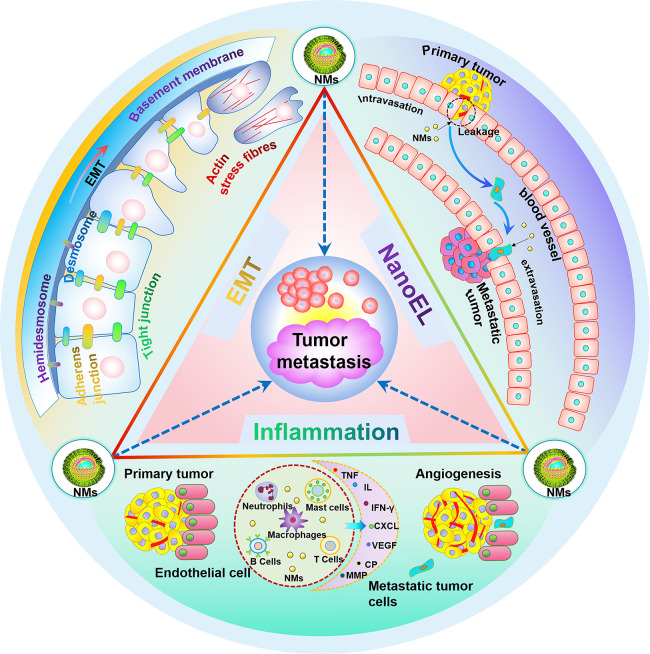
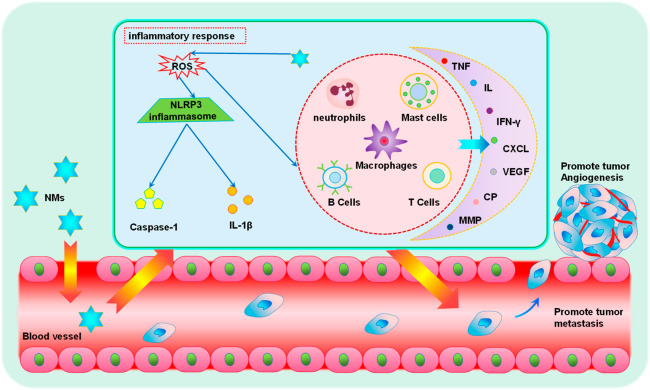
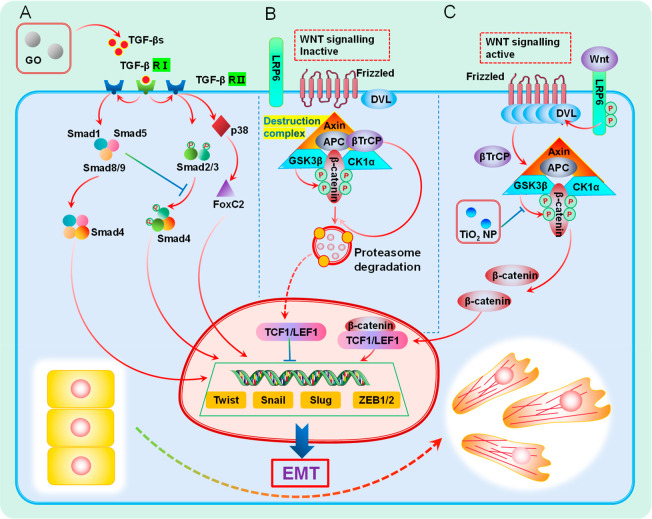
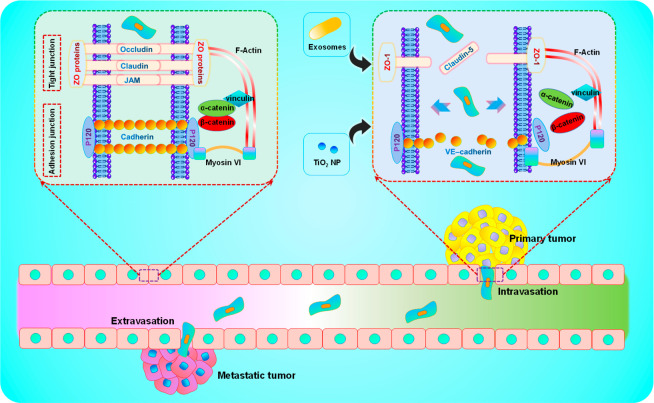
Tumor metastasis is one of the most significant biological characteristics of malignant tumors. Advances in nanotechnology provide a new direction for tackling malignant tumors. Unlike previous studies that focused on the use of nanomaterials to eliminate tumors and avoid metastasis, this work focuses on summarizing the mechanisms by which some nanomaterials promote tumor metastasis in some cases. In this Review, we summarized recent research about various nanomaterials promoting tumor metastasis. The mechanisms of nanomaterials in this process have been highlighted, including the induction of epithelial-mesenchymal transition in tumor cells by nanomaterials, the interaction of nanomaterials with the vasculature, and the induction of inflammation by nanomaterials. Elucidating the mechanism of nanomaterials promoting tumor metastasis is beneficial to guide the development and application of safe and efficient nanomaterials, which can effectively reduce the incidence of tumor metastasis in the future.
肿瘤转移是恶性肿瘤最重要的生物学特征之一。纳米技术的进步为攻克恶性肿瘤提供了新方向。与以往专注于使用纳米材料消除肿瘤并避免转移的研究不同,这项工作着重总结了某些纳米材料在某些情况下促进肿瘤转移的机制。在本综述中,我们总结了近期关于各种纳米材料促进肿瘤转移的研究。突出了纳米材料在此过程中的机制,包括纳米材料诱导肿瘤细胞上皮-间质转化、纳米材料与脉管系统的相互作用以及纳米材料诱导炎症。阐明纳米材料促进肿瘤转移的机制有利于指导安全高效纳米材料的开发与应用,从而在未来有效降低肿瘤转移的发生率。