Faculty of Medicine, Sabaragamuwa University of Sri Lanka, Ratnapura, Sri Lanka.
Faculty of Medical Sciences, University of Sri Jayewardenepura, Nugegoda, Sri Lanka.
BMC Palliat Care. 2024 Nov 1;23(1):253. doi: 10.1186/s12904-024-01579-0.
Spiritual support for patients and caregivers of critically ill patients is associated with improved quality of life. This aspect, however, is not incorporated into the current care pathways in Sri Lanka. The Spiritual Needs Assessment for Patients (SNAP) questionnaire, comprised of 3 domains: psychosocial, spiritual and religious, gives a platform for clinicians to assess the spiritual needs of those patients. This study presents the results of validation of the Sinhala version of the SNAP (S-SNAP) questionnaire.
The SNAP was translated from English to Sinhala using the standard forward and backward translation process. After verifying the content validity, unambiguity and clarity of items in a focused group discussion, and a pilot study, the pre-final version was tested among 267 volunteers with cancer selected from three state-run cancer care institutions. Data were analysed for internal consistency and item-total correlations. Factor analysis was done using Varimax rotation with Kaiser normalization. A Scree plot was also made to determine the number of factors.
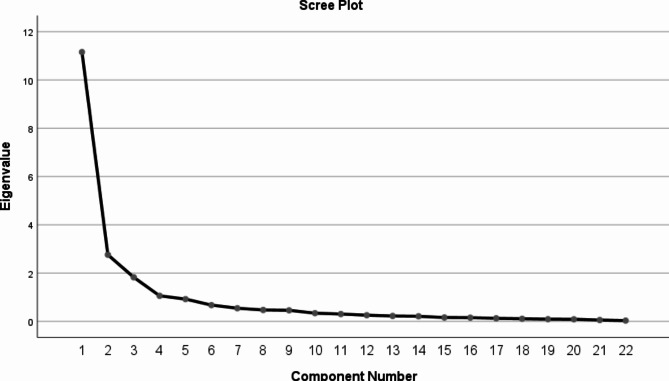
The mean (SD) age of subjects was 63.2 (11.4) years. The total S-SNAP score ranged from 22 to 88 (maximum 88). The overall Cronbach's alpha was 0.94 while item-total correlations varied from 0.26 to 0.87. Total SNAP score showed inverse correlations with age, Charleson Comorbidity index and Barthel index while a positive correlation was seen with the Karnofsky performance status scale (p < 0.05). Kaiser-Meyer-Olkein value of 0.92 (P = < 0.001) for Bartlett's test indicated adequate sampling and non-linearity of factors. The scree plot showed a four-factor structure explaining 76% variation. Meaning of life and relationship with a supernatural being and religious rituals are loaded as 2 different factors. Worries, fears and forgiveness are grouped as the third factor while relaxation, coping and sharing feelings are loaded separately.
The S-SNAP is a reliable and valid tool to assess spiritual suffering among patients with cancers conversant in the Sinhala language.
为危重症患者及其照护者提供精神支持与生活质量的改善相关。然而,这一方面并未纳入斯里兰卡目前的护理路径。精神需求评估量表(SNAP)包含 3 个领域:心理社会、精神和宗教,为临床医生评估这些患者的精神需求提供了平台。本研究呈现了 SNAP 斯里兰卡语版(S-SNAP)问卷的验证结果。
采用标准的正向和反向翻译过程,将 SNAP 从英文翻译为僧伽罗语。在焦点小组讨论和预试验中验证了内容效度、项目的无歧义性和清晰度后,对来自三家国立癌症护理机构的 267 名癌症志愿者进行了预终版测试。对内部一致性和项目总分相关性进行了分析。采用 Kaiser 标准化的 Varimax 旋转进行因子分析。还绘制了碎石图以确定因子的数量。
受试者的平均(SD)年龄为 63.2(11.4)岁。S-SNAP 总分范围为 22 至 88(最高 88)。总体 Cronbach's alpha 为 0.94,而项目总分相关性范围为 0.26 至 0.87。SNAP 总分与年龄、Charlson 合并症指数和巴氏指数呈负相关,与 Karnofsky 表现状态量表呈正相关(p<0.05)。Kaiser-Meyer-Olkein 值为 0.92(P<0.001),Bartlett 检验表明适当的抽样和因子的非线性。碎石图显示出具有 76%变异性的四因子结构。生活意义和与超自然存在的关系以及宗教仪式被加载为 2 个不同的因子。担忧、恐惧和宽恕被归为第三个因子,而放松、应对和分享感受则分别被加载。
S-SNAP 是一种可靠且有效的工具,可用于评估斯里兰卡语熟练的癌症患者的精神痛苦。