Ishikawa Ryotaro
Clinical Psychology, Taisho University, Tokyo, JPN.
Cureus. 2024 Sep 30;16(9):e70584. doi: 10.7759/cureus.70584. eCollection 2024 Sep.
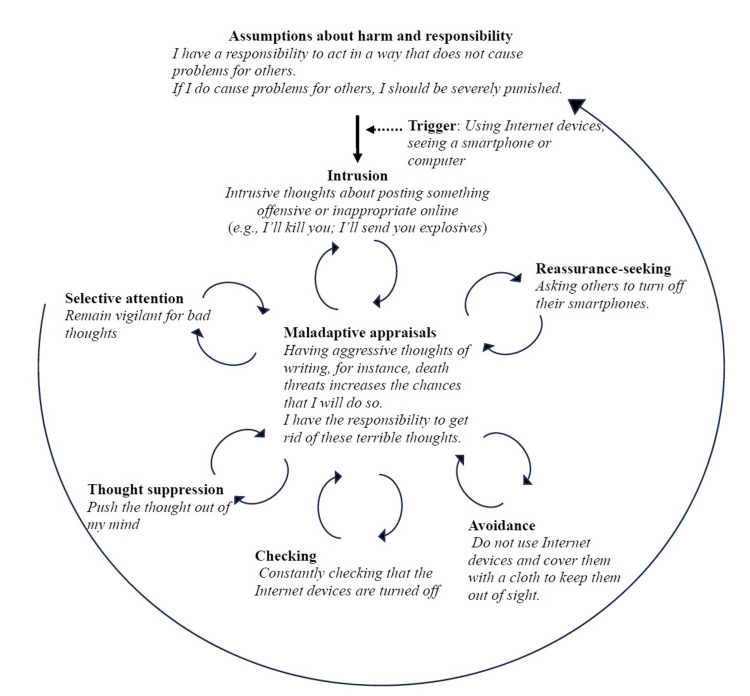
Obsessive-compulsive disorder's (OCD's) symptomatology appears to evolve with modern developments, with recent reports highlighting the influence of modern technologies (e.g., the Internet); for instance, some OCD cases are characterised by an excessive fear of Internet use. Meanwhile, cognitive behavioural therapy (CBT) is a form of psychotherapy that focuses on modifying dysfunctional thoughts, behaviours, and emotions, and has proven effective for various psychological issues, including OCD; however, research on OCD related to the fear of Internet use and its treatment remains limited. The present study presents a case of a patient who had been suffering from severe OCD for approximately one year, exhibiting a fear of using the Internet due to intrusive urges to send offensive messages (e.g., death threats) when near computers. This fear led to avoidance of Internet use and compulsive checking to ensure that Internet-connected devices were turned off. The treatment involved a combination of CBT and medication (fluvoxamine). The case formulation focused on identifying thought-action-fusion-misinterpretations that exacerbate and maintain OCD (maladaptive appraisals about an increase in the probability of an unpleasant event by merely thinking about it); it also addressed cognitive and behavioural factors, including safety behaviours such as reassurance-seeking and thought suppression. To address and alter maladaptive interpretations and behaviours, CBT was implemented using various techniques, including behavioural experiments, which included the 'on duty versus off duty' tactic to relieve the patient from the responsibility of controlling aggressive thoughts, refraining from covering his computer or smartphone, intentionally looking at them frequently, and browsing various Internet forums and review sites. Through these experiments, the patient realised that his negative predictions were unfounded and that avoiding Internet use was unnecessary. The patient's self-reported OCD symptoms, measured using the Japanese versions of the Yale-Brown Obsessive-Compulsive Scale and the Obsessive-Compulsive Inventory, decreased over the course of 10 sessions. This case study demonstrates that empirically supported CBT can effectively treat OCD related to aggressive obsessions and the fear of Internet use. Its limitations included that the patient was receiving both fluvoxamine and CBT (thus making it difficult to attribute the improvement solely to CBT) and that this study focused on a single patient setting (thereby making it difficult to generalize its findings).
强迫症(OCD)的症状表现似乎随着现代社会的发展而演变,近期报告突出了现代技术(如互联网)的影响;例如,一些强迫症病例的特征是对使用互联网过度恐惧。同时,认知行为疗法(CBT)是一种心理治疗形式,专注于改变功能失调的思维、行为和情绪,已被证明对包括强迫症在内的各种心理问题有效;然而,与对互联网使用的恐惧及其治疗相关的强迫症研究仍然有限。本研究呈现了一个病例,该患者患有严重强迫症约一年,由于在靠近电脑时会产生发送攻击性信息(如死亡威胁)的侵入性冲动而表现出对使用互联网的恐惧。这种恐惧导致其避免使用互联网,并进行强迫性检查以确保联网设备已关闭。治疗采用了认知行为疗法和药物(氟伏沙明)相结合的方式。病例分析着重于识别加剧并维持强迫症的思维 - 行动融合性误解(即仅仅通过思考就对不愉快事件发生概率增加的适应不良评估);它还涉及认知和行为因素,包括寻求安慰和思维抑制等安全行为。为了应对和改变适应不良的解释与行为,采用了包括行为实验在内的各种技术实施认知行为疗法(CBT),行为实验包括“值班与下班”策略,以减轻患者控制攻击性思维的责任,不再遮盖他的电脑或智能手机,有意频繁查看它们,并浏览各种互联网论坛和评论网站。通过这些实验,患者意识到他的负面预测毫无根据,避免使用互联网是不必要的。使用日语版的耶鲁 - 布朗强迫症量表和强迫症问卷对患者自我报告的强迫症症状进行测量,结果显示在10次治疗过程中症状有所减轻。本案例研究表明,经验证有效的认知行为疗法(CBT)可以有效治疗与攻击性强迫观念及对互联网使用恐惧相关的强迫症。其局限性在于患者同时接受氟伏沙明治疗和认知行为疗法(因此难以将改善完全归因于认知行为疗法),并且本研究聚焦于单一患者情况(从而难以推广其研究结果)。