• 文献检索
  • 文档翻译
  • 深度研究
  • 学术资讯
  • Suppr Zotero 插件Zotero 插件
  • 邀请有礼
  • 套餐&价格
  • 历史记录
应用&插件
Suppr Zotero 插件Zotero 插件浏览器插件Mac 客户端Windows 客户端微信小程序
定价
高级版会员购买积分包购买API积分包
服务
文献检索文档翻译深度研究API 文档MCP 服务
关于我们
关于 Suppr公司介绍联系我们用户协议隐私条款
关注我们

Suppr 超能文献

核心技术专利:CN118964589B侵权必究
粤ICP备2023148730 号-1Suppr @ 2026

文献检索

告别复杂PubMed语法,用中文像聊天一样搜索,搜遍4000万医学文献。AI智能推荐,让科研检索更轻松。

立即免费搜索

文件翻译

保留排版,准确专业,支持PDF/Word/PPT等文件格式,支持 12+语言互译。

免费翻译文档

深度研究

AI帮你快速写综述,25分钟生成高质量综述,智能提取关键信息,辅助科研写作。

立即免费体验

强迫症(OCD)类型与社交媒体:社交媒体对强迫症患者重要且有影响吗?

Obsessive-Compulsive Disorder (OCD) Types and Social Media: Are Social Media Important and Impactful for OCD People?

作者信息

Guazzini Andrea, Gursesli Mustafa Can, Serritella Elena, Tani Margherita, Duradoni Mirko

机构信息

Department of Education, Literatures, Intercultural Studies, Languages and Psychology, University of Florence, 50135 Florence, Italy.

Centre for the Study of Complex Dynamics, University of Florence, 50019 Sesto Fiorentino, Italy.

出版信息

Eur J Investig Health Psychol Educ. 2022 Aug 15;12(8):1108-1120. doi: 10.3390/ejihpe12080078.

DOI:10.3390/ejihpe12080078
PMID:36005227
原文链接:https://pmc.ncbi.nlm.nih.gov/articles/PMC9407245/
Abstract

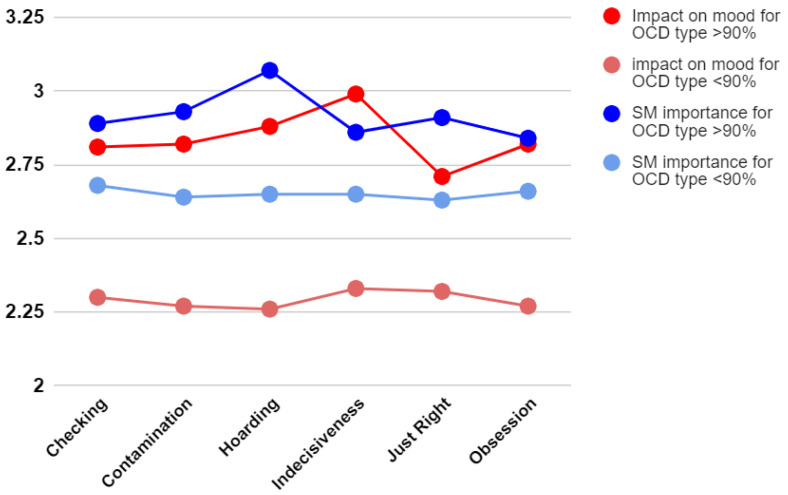
Social media (SM) are the new standard for social interaction and people with OCD use such platforms like everyone else. However, the research on these individuals provides limited, sporadic, and difficult-to-generalize data outside of social-media evidence for one specific context concerning how SM is experienced by people with OCD. Our cross-sectional study involved 660 participants (71.4% females, 28.6% males) with 22% of the sample surpassing the 90° percentile threshold to be identified as high-level OCD-symptomatic individuals. Our work highlighted that roughly all OCD types are affected by social media in terms of mood and that these individuals appeared to give SM more importance than non-OCD individuals. The evidence presented, although very narrow, can be conceived as the first building blocks to encourage future research considering how individuals with OCD experience social media, since they appear to be affected more by them compared to non-OCD individuals.

摘要

社交媒体(SM)是社交互动的新标准,患有强迫症(OCD)的人与其他人一样使用此类平台。然而,关于这些个体的研究提供的数据有限、零散且难以推广,除了关于强迫症患者如何体验社交媒体的一个特定背景下的社交媒体证据之外。我们的横断面研究涉及660名参与者(71.4%为女性,28.6%为男性),其中22%的样本超过90°百分位数阈值,被确定为高症状水平的强迫症个体。我们的研究突出表明,大致所有类型的强迫症在情绪方面都会受到社交媒体的影响,而且这些个体似乎比非强迫症个体更重视社交媒体。所呈现的证据虽然非常有限,但可以被视为鼓励未来研究的第一个基石,该研究考虑强迫症患者如何体验社交媒体,因为与非强迫症个体相比,他们似乎受社交媒体的影响更大。
https://cdn.ncbi.nlm.nih.gov/pmc/blobs/6527/9407245/8a4a241973d9/ejihpe-12-00078-g001.jpg

相似文献

1
Obsessive-Compulsive Disorder (OCD) Types and Social Media: Are Social Media Important and Impactful for OCD People?强迫症(OCD)类型与社交媒体:社交媒体对强迫症患者重要且有影响吗?
Eur J Investig Health Psychol Educ. 2022 Aug 15;12(8):1108-1120. doi: 10.3390/ejihpe12080078.
2
[Obsessive-compulsive disorder as seen by those who are confronted with it: A survey of patients, relatives and clinicians].[强迫症患者、家属及临床医生眼中的强迫症:一项针对患者、家属及临床医生的调查]
Encephale. 2017 Dec;43(6):528-539. doi: 10.1016/j.encep.2016.07.004. Epub 2016 Oct 4.
3
[Validation of a scale for responsibility (Salkovskis Responsibility Scale)].[责任量表(索尔科夫斯基责任量表)的验证]
Encephale. 2001 May-Jun;27(3):229-37.
4
Sensitivity to being betrayed and betraying others in obsessive compulsive disorder and depression.强迫症和抑郁症患者对被背叛和背叛他人的敏感性。
Br J Clin Psychol. 2022 Mar;61(1):58-75. doi: 10.1111/bjc.12319. Epub 2021 Jul 15.
5
Empathy, compassion, and theory of mind in obsessive-compulsive disorder.强迫症患者的同理心、同情心和心理理论。
Psychol Psychother. 2022 Mar;95(1):1-17. doi: 10.1111/papt.12358. Epub 2021 Jul 31.
6
The Impact of COVID-19 Pandemic on Individuals With Pre-existing Obsessive-Compulsive Disorder in the State of Qatar: An Exploratory Cross-Sectional Study.COVID-19大流行对卡塔尔国患有强迫症的个体的影响:一项探索性横断面研究。
Front Psychiatry. 2022 Apr 12;13:833394. doi: 10.3389/fpsyt.2022.833394. eCollection 2022.
7
Seeking help for obsessive compulsive disorder (OCD): a qualitative study of the enablers and barriers conducted by a researcher with personal experience of OCD.为强迫症寻求帮助:一项由有强迫症亲身经历的研究人员开展的关于促成因素和障碍的定性研究。
Psychol Psychother. 2017 Jun;90(2):193-211. doi: 10.1111/papt.12090. Epub 2017 Apr 10.
8
Social losses predict a faster onset and greater severity of obsessive-compulsive disorder.社会损失预示着强迫症发病更快且病情更严重。
J Psychiatr Res. 2020 Nov;130:187-193. doi: 10.1016/j.jpsychires.2020.07.027. Epub 2020 Aug 2.
9
The Brown Longitudinal Obsessive Compulsive Study: clinical features and symptoms of the sample at intake.布朗纵向强迫症研究:入组时样本的临床特征与症状
J Clin Psychiatry. 2006 May;67(5):703-11. doi: 10.4088/jcp.v67n0503.
10
Prevalence and correlates of obsessive-compulsive disorder and subthreshold obsessive-compulsive disorder among college students in Kerala, India.印度喀拉拉邦大学生中强迫症及亚阈值强迫症的患病率及其相关因素
Indian J Psychiatry. 2017 Jan-Mar;59(1):56-62. doi: 10.4103/0019-5545.204438.

引用本文的文献

1
Problematic online behaviors and their early patterns of co-occurrence in young adults: insights from directed and undirected networks.年轻人中有问题的网络行为及其早期共现模式:来自有向和无向网络的见解
Front Psychiatry. 2025 Feb 24;16:1446338. doi: 10.3389/fpsyt.2025.1446338. eCollection 2025.
2
Cognitive Behavioural Therapy for Obsessive-Compulsive Disorder Related to the Fear of Internet Use: A Case Study.针对与互联网使用恐惧相关的强迫症的认知行为疗法:一项案例研究。
Cureus. 2024 Sep 30;16(9):e70584. doi: 10.7759/cureus.70584. eCollection 2024 Sep.
3
From Clicks to Calm: Investigating the Link Between Mindfulness and Digital Hoarding Behavior Among Chinese Youth.

本文引用的文献

1
Associations Between Social Media, Bedtime Technology Use Rules, and Daytime Sleepiness Among Adolescents: Cross-sectional Findings From a Nationally Representative Sample.社交媒体、睡前科技使用规则与青少年日间嗜睡之间的关联:来自全国代表性样本的横断面研究结果
JMIR Ment Health. 2021 Sep 15;8(9):e26273. doi: 10.2196/26273.
2
Social media use and self-injurious thoughts and behaviors: A systematic review and meta-analysis.社交媒体使用与自伤意念和行为:系统评价和荟萃分析。
Clin Psychol Rev. 2021 Jul;87:102038. doi: 10.1016/j.cpr.2021.102038. Epub 2021 May 8.
3
What Will Be the Impact of the Covid-19 Quarantine on Psychological Distress? Considerations Based on a Systematic Review of Pandemic Outbreaks.
从点击到平静:探究中国青少年正念与数字囤积行为之间的联系
Psychol Res Behav Manag. 2024 Sep 24;17:3283-3297. doi: 10.2147/PRBM.S473523. eCollection 2024.
4
Insight into the Association between Slitrk Protein and Neurodevelopmental and Neuropsychiatric Conditions.解析 Slitrk 蛋白与神经发育和神经精神疾病之间关联的研究进展。
Biomolecules. 2024 Aug 26;14(9):1060. doi: 10.3390/biom14091060.
5
The effect of event impact on fear of missing out: the chain mediation effect of coping styles and anxiety.事件影响对错失恐惧的作用:应对方式与焦虑的链式中介作用
Front Psychol. 2024 Apr 18;15:1382440. doi: 10.3389/fpsyg.2024.1382440. eCollection 2024.
6
Exploration of vulnerability factors of digital hoarding behavior among university students and the moderating role of maladaptive perfectionism.大学生数字囤积行为的脆弱性因素探究及适应不良完美主义的调节作用
Digit Health. 2024 Jan 30;10:20552076241226962. doi: 10.1177/20552076241226962. eCollection 2024 Jan-Dec.
7
Storing, Not Reading: Investigating the Link Between Upward Social Comparison via Social Media and Digital Hoarding Behavior in Chinese Youth.存储而非阅读:探究中国青少年通过社交媒体进行向上社会比较与数字囤积行为之间的联系。
Psychol Res Behav Manag. 2023 Dec 23;16:5209-5224. doi: 10.2147/PRBM.S441859. eCollection 2023.
8
The Relationship between Orthorexia Nervosa and Obsessive Compulsive Disorder.正食症与强迫症之间的关系。
Eur J Investig Health Psychol Educ. 2023 May 17;13(5):861-869. doi: 10.3390/ejihpe13050065.
9
Development and Validation of the Digital Life Balance (DLB) Scale: A Brand-New Measure for Both Harmonic and Disharmonic Use of ICTs.数字生活平衡(DLB)量表的开发与验证:一种用于信息通信技术和谐与不和谐使用的全新测量方法。
Behav Sci (Basel). 2022 Dec 1;12(12):489. doi: 10.3390/bs12120489.
10
The Long-COVID Experience Changed People's Vaccine Hesitancy but Not Their Vaccination Fear.长新冠经历改变了人们对接种疫苗的犹豫态度,但没有改变他们对接种疫苗的恐惧。
Int J Environ Res Public Health. 2022 Nov 5;19(21):14550. doi: 10.3390/ijerph192114550.
新冠疫情隔离措施对心理困扰会产生怎样的影响?基于对大流行疫情的系统综述的思考
Healthcare (Basel). 2021 Jan 19;9(1):101. doi: 10.3390/healthcare9010101.
4
Social Media and Depression Symptoms: a Meta-Analysis.社交媒体与抑郁症状:一项元分析。
Res Child Adolesc Psychopathol. 2021 Feb;49(2):241-253. doi: 10.1007/s10802-020-00715-7. Epub 2021 Jan 6.
5
Social Media Insights Into US Mental Health During the COVID-19 Pandemic: Longitudinal Analysis of Twitter Data.社交媒体洞察美国在 COVID-19 大流行期间的心理健康状况:对 Twitter 数据的纵向分析。
J Med Internet Res. 2020 Dec 14;22(12):e21418. doi: 10.2196/21418.
6
"Is compulsive social media use amid COVID-19 pandemic addictive behavior or coping mechanism?在新冠疫情期间,强迫性使用社交媒体是成瘾行为还是应对机制?
Asian J Psychiatr. 2020 Dec;54:102290. doi: 10.1016/j.ajp.2020.102290. Epub 2020 Jul 7.
7
The other side of COVID-19: Impact on obsessive compulsive disorder (OCD) and hoarding.新冠疫情的另一面:对强迫症(OCD)和囤积症的影响。
Psychiatry Res. 2020 Jun;288:112966. doi: 10.1016/j.psychres.2020.112966. Epub 2020 Apr 11.
8
Social Media Use During Social Distancing.社交距离期间的社交媒体使用
Cyberpsychol Behav Soc Netw. 2020 May;23(5):275-276. doi: 10.1089/cyber.2020.29181.bkw. Epub 2020 Apr 7.
9
Why check? A meta-analysis of checking in obsessive-compulsive disorder: Threat vs. distrust of senses.为何检查?强迫症中检查行为的元分析:对感官的威胁与不信任。
Clin Psychol Rev. 2020 Feb;75:101807. doi: 10.1016/j.cpr.2019.101807. Epub 2019 Dec 12.
10
Active and Passive Social Media Use and Symptoms of Anxiety and Depressed Mood Among Icelandic Adolescents.冰岛青少年的主动和被动社交媒体使用与焦虑和抑郁情绪症状。
Cyberpsychol Behav Soc Netw. 2019 Aug;22(8):535-542. doi: 10.1089/cyber.2019.0079. Epub 2019 Jul 30.