Liu Xinyu, Choi Jaehoon, Xu Zhen, Grey Clare P, Fleischmann Simon, Forse Alexander C
Yusuf Hamied Department of Chemistry, University of Cambridge, Cambridge CB2 1EW, U.K.
Helmholtz Institute Ulm (HIU), 89081 Ulm, Germany.
J Am Chem Soc. 2024 Nov 13;146(45):30748-30752. doi: 10.1021/jacs.4c10214. Epub 2024 Nov 1.
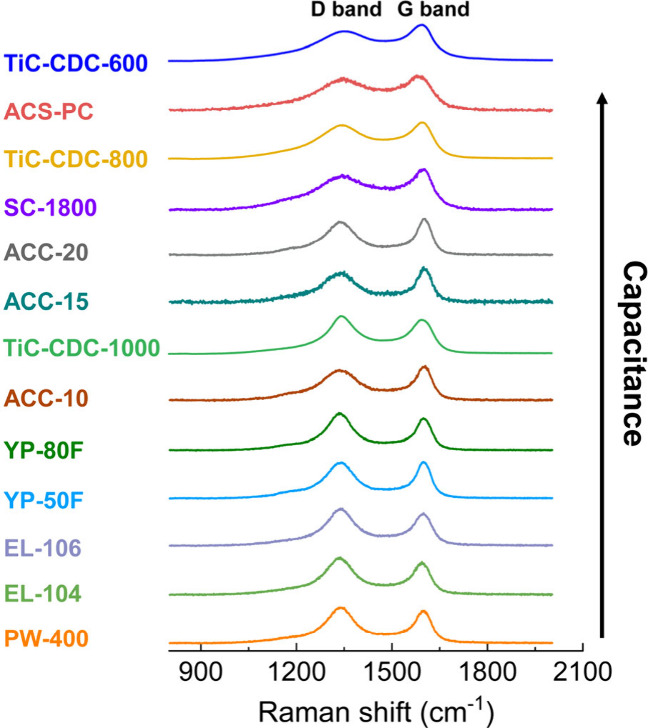
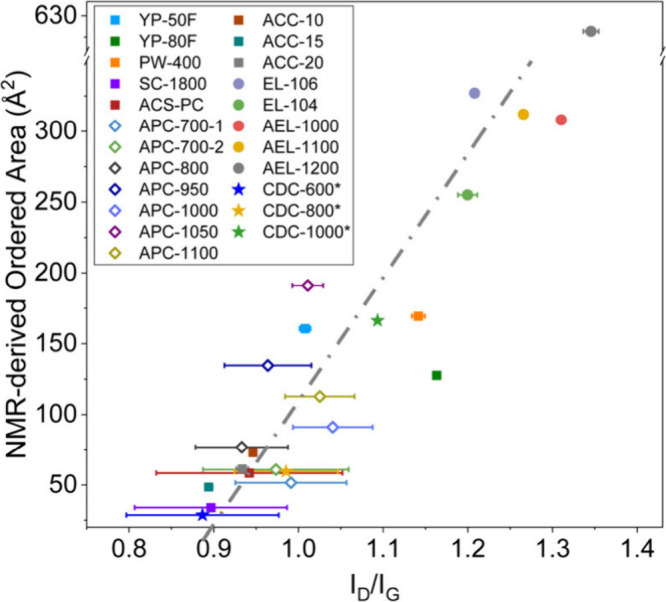
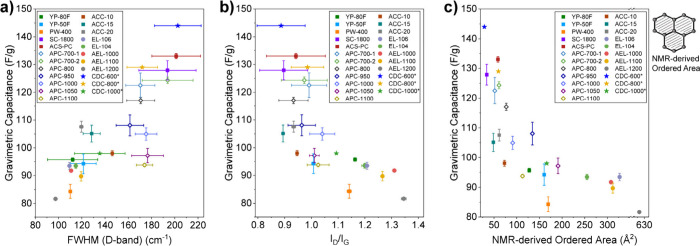
Our recent study of 20 nanoporous activated carbons showed that a more disordered local carbon structure leads to enhanced capacitive performance in electrochemical double layer capacitors. Specifically, NMR spectroscopy measurements and simulations of electrolyte-soaked carbons evidenced that nanoporous carbons with smaller graphene-like domains have larger capacitances. In this study, we use Raman spectroscopy, a common probe of local structural disorder in nanoporous carbons, to test the disorder-driven capacitance theory. It is found that nanoporous carbons with broader D bands and smaller I/I intensity ratios exhibit higher capacitance. Most notably, the I/I intensity ratio probes the in-plane sizes of graphene-like domains and supports the findings from NMR that smaller graphene-like domains correlate with larger capacitances. This study supports our finding that disorder is a key metric for high capacitance in nanoporous carbons and shows that Raman spectroscopy is a powerful technique that allows rapid screening to identify nanoporous carbons with superior performance in supercapacitors.