Department of Radiation Oncology, Inselspital, Bern University Hospital, University of Bern, Bern, Switzerland.
Department for BioMedical Research, Inselspital, Bern University Hospital, University of Bern, Bern, Switzerland.
Nat Commun. 2024 Nov 2;15(1):9467. doi: 10.1038/s41467-024-53711-6.
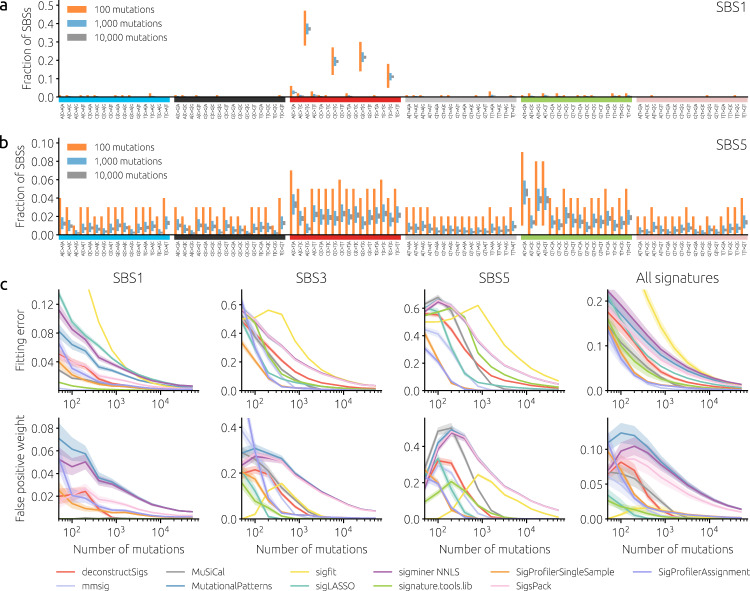
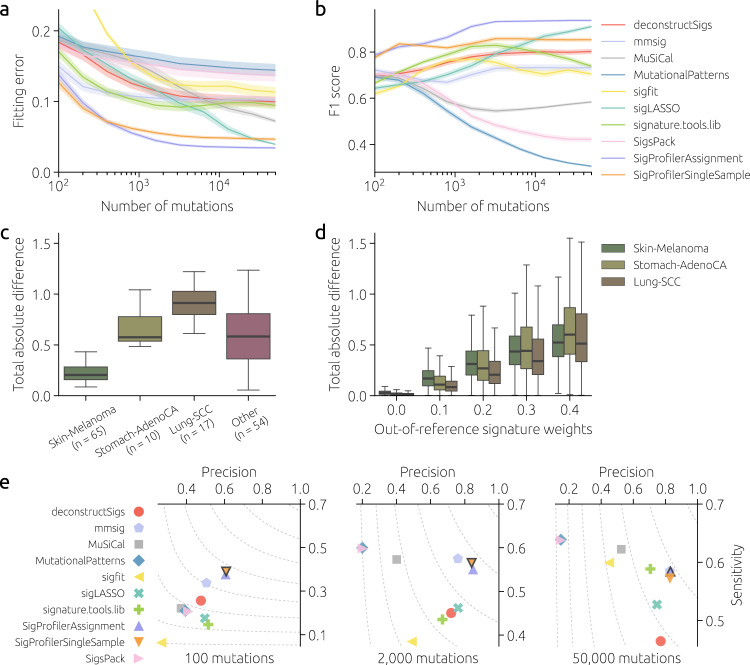
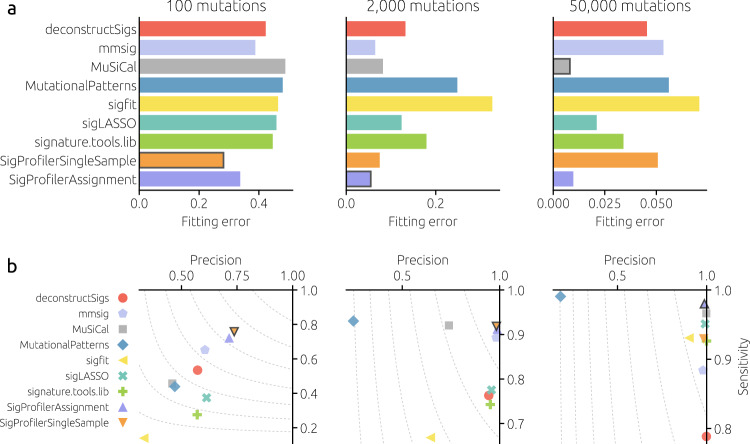
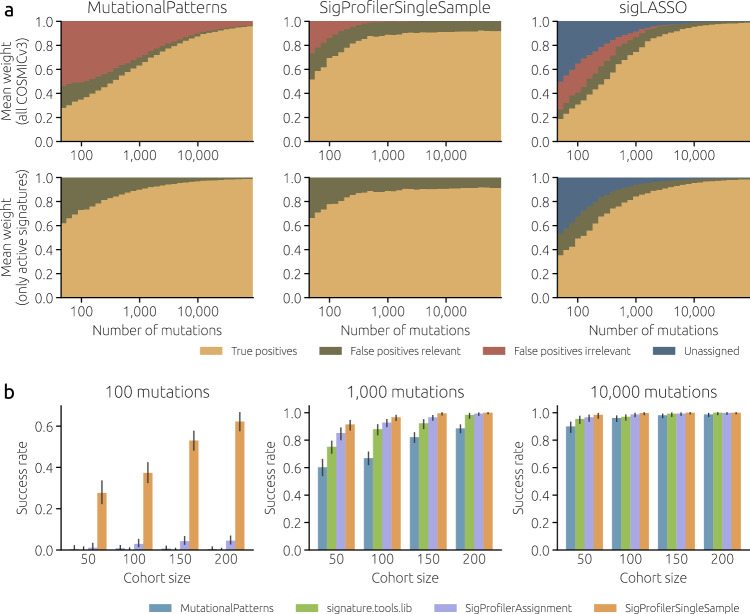
Mutational signatures connect characteristic mutational patterns in the genome with biological or chemical processes that take place in cancers. Analysis of mutational signatures can help elucidate tumor evolution, prognosis, and therapeutic strategies. Although tools for extracting mutational signatures de novo have been extensively benchmarked, a similar effort is lacking for tools that fit known mutational signatures to a given catalog of mutations. We fill this gap by comprehensively evaluating twelve signature fitting tools on synthetic mutational catalogs with empirically driven signature weights corresponding to eight cancer types. On average, SigProfilerSingleSample and SigProfilerAssignment/MuSiCal perform best for small and large numbers of mutations per sample, respectively. We further show that ad hoc constraining the list of reference signatures is likely to produce inferior results. Evaluation of real mutational catalogs suggests that the activity of signatures that are absent in the reference catalog poses considerable problems to all evaluated tools.
突变特征将基因组中的特征突变模式与癌症中发生的生物或化学过程联系起来。突变特征分析可以帮助阐明肿瘤的进化、预后和治疗策略。虽然已经广泛地对新提取突变特征的工具进行了基准测试,但对于将已知的突变特征拟合到给定的突变目录的工具,却缺乏类似的努力。我们通过在具有经验驱动的特征权重(对应于八种癌症类型)的合成突变目录上全面评估 12 种特征拟合工具来填补这一空白。平均而言,SigProfilerSingleSample 和 SigProfilerAssignment/MuSiCal 分别在样本中突变数量较少和较多时表现最佳。我们还表明,随意限制参考特征列表可能会产生较差的结果。对真实突变目录的评估表明,参考目录中不存在的特征的活性给所有评估工具带来了相当大的问题。