Liu Quanri, Zhang Rui, Chen Yujiao, Lu Yanhui, Cui Fangqiang, Zhang Qiang, Zhang Chunmei
Department of Nutrition, Beijing Luhe Hospital, Capital Medical University, Beijing, China.
Prenatal Diagnostic Center, Beijing Obstetrics and Gynecology Hospital, Capital Medical University, Beijing, China.
Nutr Metab Insights. 2024 Oct 29;17:11786388241283779. doi: 10.1177/11786388241283779. eCollection 2024.
This study investigates the association between dietary flavonoid intake and the incidence of mild cognitive impairment (MCI) through a matched case-control design.
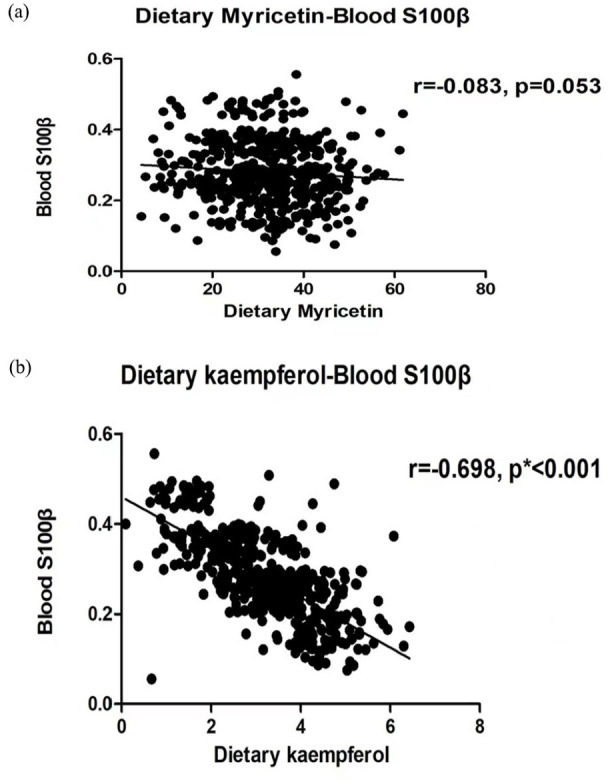
Dietary intake was assessed using a food frequency questionnaire, comparing the intake of flavonoids between individuals with MCI and those with normal cognitive function. Logistic regression analysis was employed to evaluate the correlation between dietary flavonoid intake and the risk of MCI. Additionally, blood concentrations of S100β, a marker of the blood-brain barrier (BBB) integrity, were measured using electrochemiluminescence immunoassay, and Pearson correlation analysis was conducted to explore the relationship between dietary flavonoid intake and blood S100β levels.
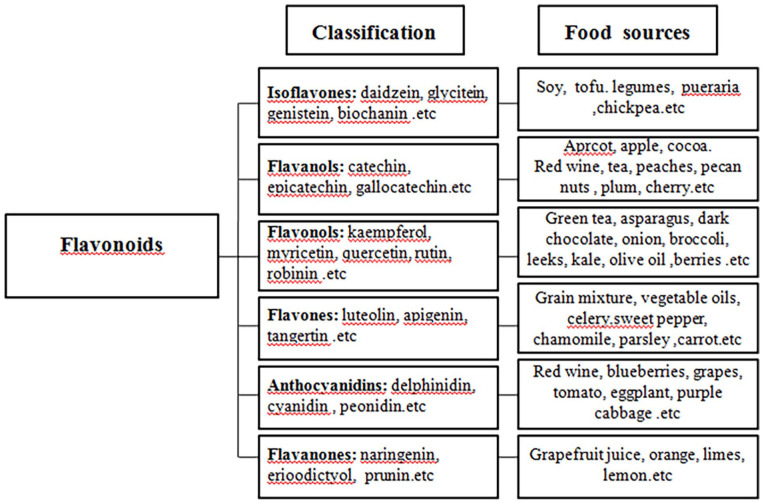
Compared to participants with normal cognition, those with MCI had significantly lower dietary intakes of total flavonoids, isoflavones, daidzein, glycitein, genistein, kaempferol, myricetin, flavonols, and anthocyanidins, while the intake of peonidin was significantly higher. Univariate logistic regression analysis indicated that high dietary intake of total flavonoids, isoflavones, daidzein, glycitein, genistein, kaempferol, myricetin, and flavonols was negatively correlated with MCI, whereas peonidin intake was positively correlated with MCI. Multivariate logistic regression analysis confirmed these findings. Pearson correlation analysis revealed a significant negative correlation between dietary intake of kaempferol and myricetin and blood S100β levels.
Increasing the dietary intake of total flavonoids, isoflavones, daidzein, glycitein, genistein, and flavonols appears to be a protective factor against MCI, while higher intake of peonidin is associated with an increased risk of MCI. The protective or adverse effects of these flavonoids may not be related to the permeability of the BBB. Myricetin and kaempferol intake may protect cognitive function by maintaining BBB integrity.
本研究通过匹配病例对照设计,调查膳食类黄酮摄入量与轻度认知障碍(MCI)发病率之间的关联。
使用食物频率问卷评估膳食摄入量,比较MCI患者与认知功能正常者之间类黄酮的摄入量。采用逻辑回归分析评估膳食类黄酮摄入量与MCI风险之间的相关性。此外,使用电化学发光免疫分析法测量血脑屏障(BBB)完整性标志物S100β的血浓度,并进行Pearson相关性分析,以探讨膳食类黄酮摄入量与血S100β水平之间的关系。
与认知正常的参与者相比,MCI患者的总黄酮、异黄酮、大豆苷元、染料木素、黄豆黄素、山奈酚、杨梅素、黄酮醇和花青素的膳食摄入量显著较低,而芍药色素的摄入量显著较高。单因素逻辑回归分析表明,高膳食总黄酮、异黄酮、大豆苷元、染料木素、黄豆黄素、山奈酚、杨梅素和黄酮醇摄入量与MCI呈负相关,而芍药色素摄入量与MCI呈正相关。多因素逻辑回归分析证实了这些发现。Pearson相关性分析显示,山奈酚和杨梅素的膳食摄入量与血S100β水平之间存在显著负相关。
增加膳食总黄酮、异黄酮、大豆苷元、染料木素、黄豆黄素和黄酮醇的摄入量似乎是预防MCI的保护因素,而较高的芍药色素摄入量与MCI风险增加有关。这些类黄酮的保护或不良作用可能与血脑屏障的通透性无关。摄入杨梅素和山奈酚可能通过维持血脑屏障的完整性来保护认知功能。