Tetzlaff Emily J, Ioannou Leonidas G, O'Connor Fergus K, Kaltsatou Antonia, Ly Valentina, Kenny Glen P
Human and Environmental Physiology Research Unit, School of Human Kinetics, University of Ottawa, Ottawa, Canada.
Department of Automation, Biocybernetics and Robotics, Jozef Stefan Institute, Ljubljana, Slovenia.
Am J Ind Med. 2025 Jan;68(1):3-25. doi: 10.1002/ajim.23672. Epub 2024 Nov 5.
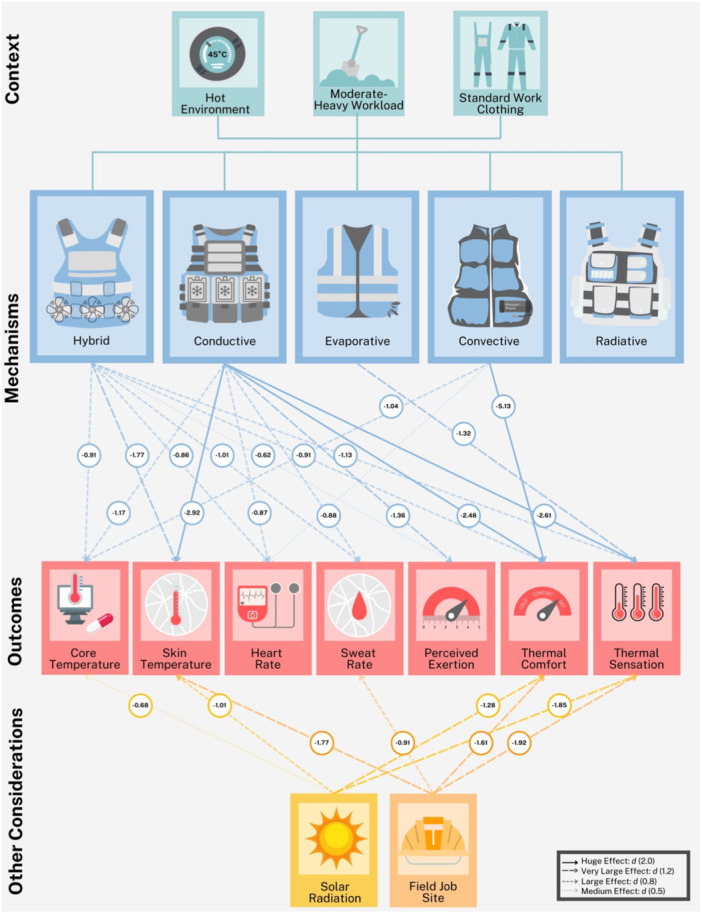
Due to rising temperature extremes, workplaces are seeking new solutions, such as using personal cooling garments (PCG) to mitigate and manage workplace heat exposure. This systematic review sought to assess the physiological and perceptual effects of PCGs on workers in standard work clothing performing moderate-to-heavy intensity tasks in hot environments.
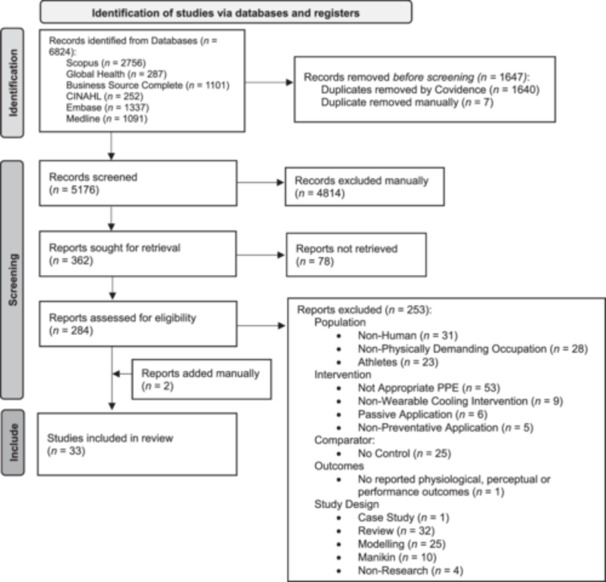
A peer-reviewed search strategy was conducted in MEDLINE, Embase, CINAHL, Scopus, Global Health, and Business Source Complete with no language or time limits. A meta-analysis using a realist evaluation framework was then performed to evaluate the effectiveness of the PCGs.
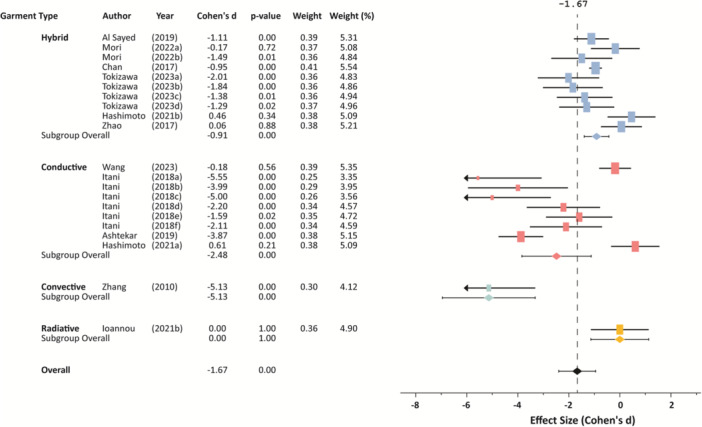
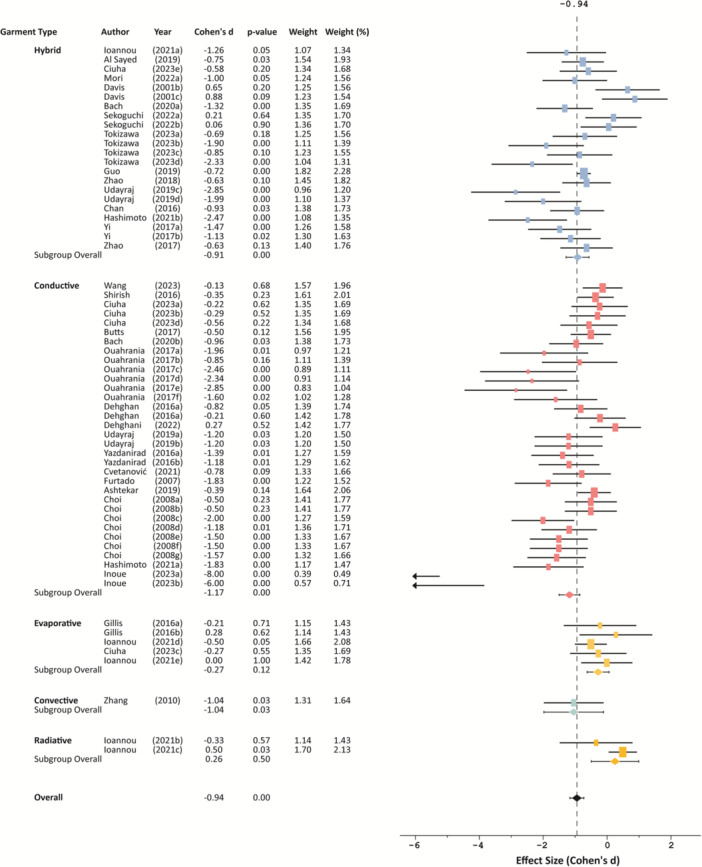
Thirty-three studies with 764 participants (98% male; average 21 ± 34 participants per study), conducted primarily in a laboratory setting (76%) were included. The studies were 193 ± 190 min in duration and consisted of a moderate-to-heavy work effort of 3.3 ± 1.0 METs in hot ambient conditions (temperature: 35.9 ± 3.3°C, 51.4 ± 12.1% relative humidity, wet bulb globe temperature [WBGT] 31.2 ± 2.6°C). The PCGs (n = 67) facilitated heat exchange through conduction (n = 39), evaporation (n = 4), convection (n = 2), radiation (n = 2), or hybrid combinations (n = 20). Conductive and hybrid PCGs offered the greatest thermoregulatory benefit, whereby core temperature (T) and heart rate (HR) reductions were consistently observed (Conductive: T: -0.3°C, HR: -12 bpm; Hybrid: T:-0.2°C, HR: -10 bpm), while PCGs directed at enhancing evaporative and radiative heat exchange had no or minimal effect on the physiological outcomes assessed (i.e., T < 0.1°C, HR: < 0.7 bpm).
While the PCGs had a positive overall effect, conductive options offered the most consistent benefit to workers. WBGT, clothing insulation, and duration of wear significantly affected some physiological and perceptual outcomes.
由于极端气温不断上升,工作场所正在寻求新的解决方案,例如使用个人冷却服装(PCG)来减轻和管理工作场所的热暴露。本系统综述旨在评估PCG对在炎热环境中穿着标准工作服执行中度至重度强度任务的工人的生理和感知影响。
在MEDLINE、Embase、CINAHL、Scopus、Global Health和Business Source Complete中进行了同行评审的检索策略,没有语言或时间限制。然后使用现实主义评估框架进行荟萃分析,以评估PCG的有效性。
纳入了33项研究,共764名参与者(98%为男性;每项研究平均21±34名参与者),主要在实验室环境中进行(76%)。研究持续时间为193±190分钟,包括在炎热环境条件下(温度:35.9±3.3°C,相对湿度51.4±12.1%,湿球黑球温度[WBGT]31.2±2.6°C)进行的中度至重度工作强度,相当于3.3±1.0代谢当量。PCG(n = 67)通过传导(n = 39)、蒸发(n = 4)、对流(n = 2)、辐射(n = 2)或混合组合(n = 20)促进热交换。传导性和混合性PCG提供了最大的体温调节益处,始终观察到核心温度(T)和心率(HR)降低(传导性:T:-0.3°C,HR:-12次/分钟;混合性:T:-0.2°C,HR:-10次/分钟),而旨在增强蒸发和辐射热交换的PCG对所评估生理结果没有影响或影响最小(即T<0.1°C,HR:<0.7次/分钟)。
虽然PCG总体上有积极影响,但传导性选项对工人提供了最一致的益处。WBGT、服装隔热和穿着持续时间显著影响了一些生理和感知结果。