Montreal Heart Institute, Université de Montréal, Montreal, Quebec, Canada.
Montreal Health Innovations Coordinating Center (MHICC), Montreal, Quebec, Canada.
PLoS One. 2024 Nov 5;19(11):e0312735. doi: 10.1371/journal.pone.0312735. eCollection 2024.
Patients can experience persistent cognitive complaints and deficits in long-COVID. Inflammation and capillary damage may contribute to symptoms by interfering with tissue oxygenation.
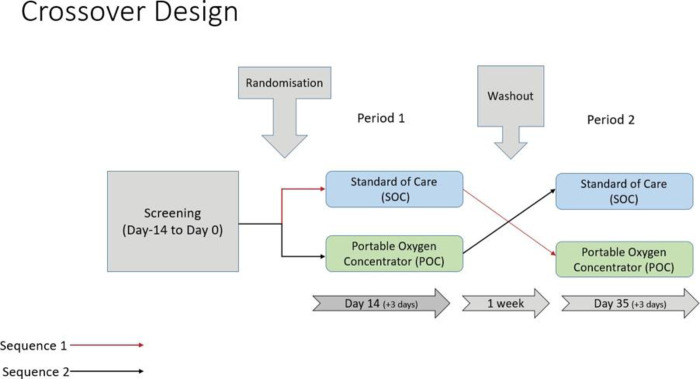
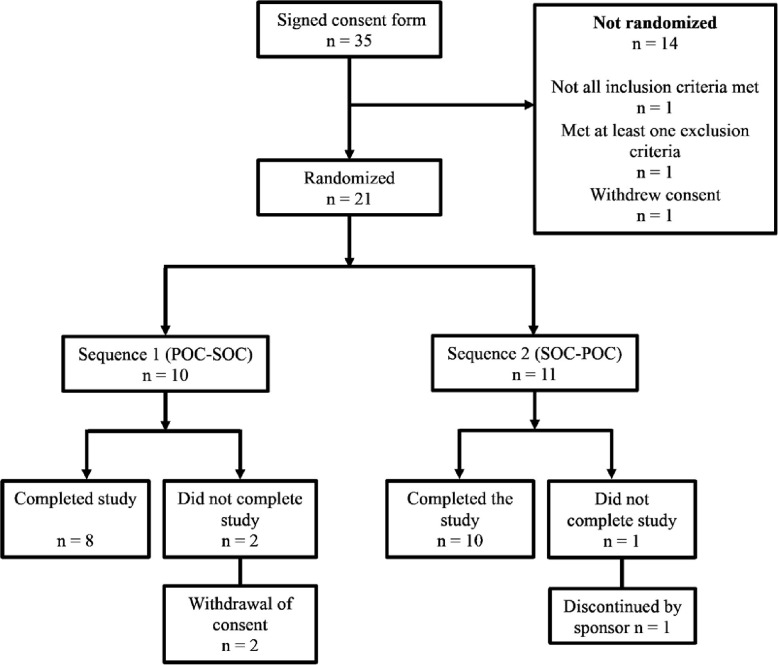
This was an exploratory pilot crossover study designed to describe the effects of supplemental oxygen (portable oxygen concentrator, POC) on cognitive performance and peripheral and cerebral oxygen saturation at rest and exercise. Participants with long-COVID (n = 21) were randomized 1:1 to: 1) POC (3h/day) for 2 weeks followed by standard of care (Control) for 2 weeks or 2) Control for 2 weeks then POC (3h/day) for 2 weeks, with a 1-week washout. Cognitive assessment (global cognition [Montreal Cognitive Assessment, MoCA], episodic memory [Hopkins], working memory [Digit Span], executive function [Verbal fluency]) was performed at baseline and after each treatment period. Patient Health Questionnaire (PHQ-9) and Generalized Anxiety Disorder-7 were completed. Peripheral and cerebral oxygen saturation were measured at rest and exercise (treadmill) at baseline and after each treatment period. Statistical analyses were descriptive without formal testing.
MoCA scores were similar under POC (26.45±2.31) and Control (26.37±2.85); overall POC-Control difference was -0.090 (95% CI [-1.031, 0.850]). Because of a learning effect, post-hoc analyses were performed for Period 1, where the MoCA score difference was 1.705 [0.140, 3.271]. MoCA subscores suggested better performance with POC for Visuospatial/executive (0.618 [-0.106, 1.342]) and Attention (0.975 [0.207, 1.743]). POC trended to have better scores on Digit Span backward (difference: 0.822 [-0.067, 1.711]) and self-reported depressive symptoms (difference: -1.335 [-3.166, 0.495]). For specific PHQ-9 items, POC tended to have lower (better) scores for Q1 (Little interest/pleasure) and Q7 (Trouble concentrating). Cerebral oxygen saturations at end of exercise showed no difference between POC and Control. Peripheral saturations during exercise were similar under POC and Control (difference: 0.519% [-1.675, 2.714]).
An advantage of POC over Control was observed for global cognition, attention, visuospatial/executive performance and depressive symptoms. Results need to be validated in a larger study.
长新冠患者可能会持续出现认知障碍和缺陷。炎症和毛细血管损伤可能会通过干扰组织供氧来导致症状。
这是一项探索性的交叉试验研究,旨在描述补充氧气(便携式氧气浓缩器,POC)对认知表现以及静息和运动时的外周和脑氧饱和度的影响。长新冠患者(n=21)被随机分为 1:1 组:1)POC(每天 3 小时)治疗 2 周,然后接受标准治疗(对照)2 周,或 2)对照治疗 2 周,然后 POC(每天 3 小时)治疗 2 周,1 周洗脱期。在基线和每个治疗期后进行认知评估(整体认知[蒙特利尔认知评估,MoCA]、情景记忆[霍普金斯]、工作记忆[数字广度]、执行功能[言语流畅性])。完成患者健康问卷(PHQ-9)和广泛性焦虑症-7 量表。在基线和每个治疗期后,在静息和运动(跑步机)时测量外周和脑氧饱和度。统计分析是描述性的,没有进行正式检验。
POC 下的 MoCA 评分(26.45±2.31)与对照(26.37±2.85)相似;总体 POC-对照差值为-0.090(95%CI[-1.031, 0.850])。由于学习效应,对第 1 期进行了事后分析,MoCA 评分差值为 1.705[0.140, 3.271]。MoCA 子评分表明 POC 对视觉空间/执行(0.618[-0.106, 1.342])和注意力(0.975[0.207, 1.743])的表现更好。POC 在后向数字广度(差值:0.822[-0.067, 1.711])和自我报告的抑郁症状(差值:-1.335[-3.166, 0.495])方面的评分有改善趋势。对于特定的 PHQ-9 项目,POC 倾向于对 Q1(兴趣/乐趣较少)和 Q7(注意力不集中)有更低(更好)的评分。运动结束时的脑氧饱和度在 POC 和对照之间没有差异。POC 和对照下的运动时外周饱和度相似(差值:0.519%[-1.675, 2.714])。
与对照相比,POC 对整体认知、注意力、视觉空间/执行表现和抑郁症状有优势。结果需要在更大的研究中进行验证。