Csorba Luiela Magdalena, Dabija Dan-Cristian
"Aurel Vlaicu" University of Arad, Faculty of Economics, Department of Economics, Romania.
"Babeș-Bolyai" University Cluj-Napoca, Faculty of Economics and Business Administration, Department of Marketing, Romania.
Heliyon. 2024 Oct 19;10(20):e39560. doi: 10.1016/j.heliyon.2024.e39560. eCollection 2024 Oct 30.
The COVID-19-related pandemic has affected education hugely, particularly in terms of the massive shift towards online teaching and learning. Higher education students and professors have faced new challenges, which might improve future online education behaviour, based on online education experience and learning, and pedagogical strategies during the COVID-19 pandemic.
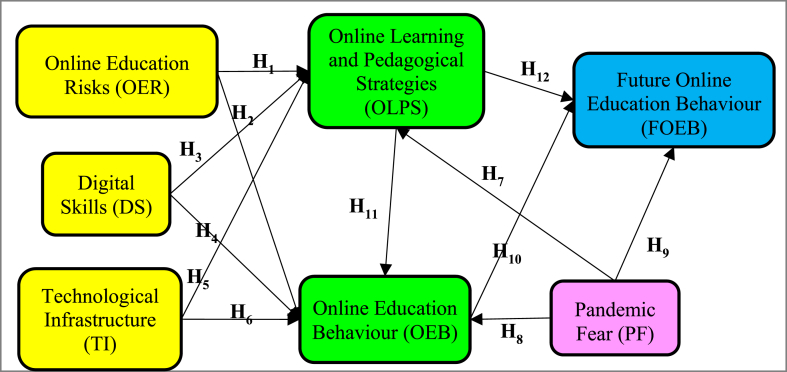
OBJECTIVE/AIM: The aim of this paper is to explore the views of Romanian students towards a possible future online education, highlighting their perceptions regarding the efficacy of digital online learning/pedagogical strategies and of the technological infrastructure, using as support theory the Input-Environment-Outcomes (I-E-O) model.
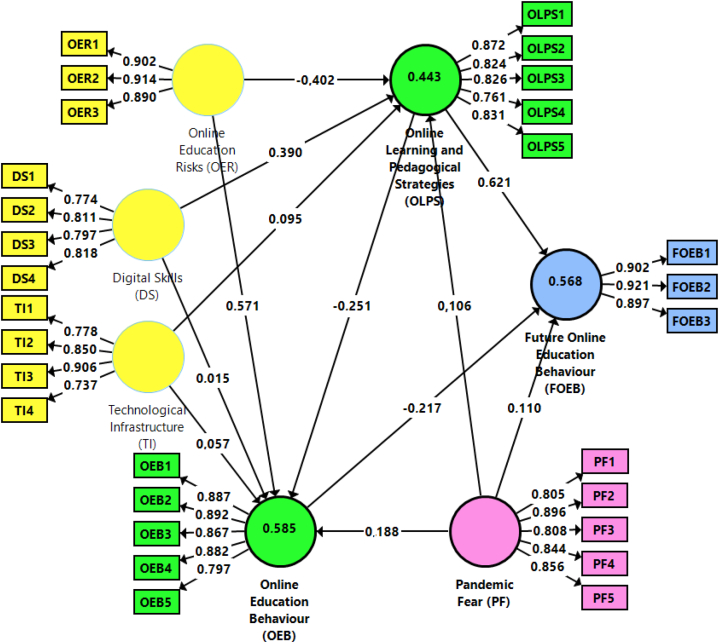
METHODS/INSTRUMENTS: An empirical quantitative-based investigation was implemented; data being collected from almost 800 students in business and economics. Based on the proposed conceptual model, data were analysed with structural equations modelling via SmartPLS 3.0.
The novelty of the paper is that it tries to address students' perceptions regarding the future of online education, by using a few constructs, some of them validated in the literature, in order to establish pertinent links between these and the future of digital education. Results reveal that Romanian students prefer face-to-face teaching rather than online courses.
CONCLUSIONS/IMPLICATIONS: In crisis situations, digital education might be the proper solution for future education, as it ensures effective education through efficient teaching-learning strategies and an advanced technological infrastructure.
与新冠疫情相关的大流行对教育产生了巨大影响,尤其是在向在线教学和学习的大规模转变方面。高等教育的学生和教授面临着新的挑战,基于新冠疫情期间的在线教育经验、学习情况和教学策略,这些挑战可能会改善未来的在线教育行为。
本文旨在探讨罗马尼亚学生对未来可能的在线教育的看法,利用输入-环境-结果(I-E-O)模型作为支持理论,突出他们对数字在线学习/教学策略和技术基础设施有效性的看法。
方法/工具:开展了一项基于实证定量的调查;从近800名商业和经济学专业的学生中收集数据。基于所提出的概念模型,通过SmartPLS 3.0使用结构方程模型对数据进行分析。
本文的新颖之处在于,它试图通过使用一些构建因素来探讨学生对在线教育未来的看法,其中一些构建因素在文献中已得到验证,以便在这些因素与数字教育的未来之间建立相关联系。结果表明,罗马尼亚学生更喜欢面对面教学而不是在线课程。
结论/启示:在危机情况下,数字教育可能是未来教育的合适解决方案,因为它通过高效的教学策略和先进的技术基础设施确保有效的教育。