Gesuita Rosaria, Eckert Alexander J, Besançon Stéphane, Crimmins Nancy A, Cavallo Fred, Kim Jaehyun, Jefferies Craig, Gevers Evelien F, Vamvakis Anastasios, Shah Sejal, Amed Shazhan, Cherubini Valentino
Center of Epidemiology, Biostatistics and Medical Information Technology, Università Politecnica delle Marche, Ancona, Italy.
IRCCS INRCA, Ancona, Italy.
Diabetologia. 2025 Jan;68(1):82-93. doi: 10.1007/s00125-024-06283-5. Epub 2024 Nov 6.
AIMS/HYPOTHESIS: The diagnosis of type 2 diabetes is increasing in young people worldwide. This study evaluated the frequency and clinical characteristics of young people presenting with type 2 diabetes from the multinational SWEET e.V Registry 2012-2021, including the first years of the COVID-19 pandemic.
This is a longitudinal observational study based on the SWEET Registry, which collects demographic and clinical data on children and adolescents with diabetes from centres worldwide, with the diagnosis and classification of diabetes provided locally by each centre according to International Society for Paediatric and Adolescent Diabetes definitions. By July 2022, the SWEET Registry included 96,931 individuals from 130 centres with a total of 1,154,555 visits. Data were analysed by region: Europe (EU), Australia and New Zealand (AU/NZ), South America (SA), North America (NA) and Asia/Middle East and Africa (AS/AF). Trends in proportions for the two-year periods, calculated as cases with type 2 diabetes diagnoses over all cases with diabetes diagnoses, were estimated using logistic regression models adjusted for age at onset and sex.
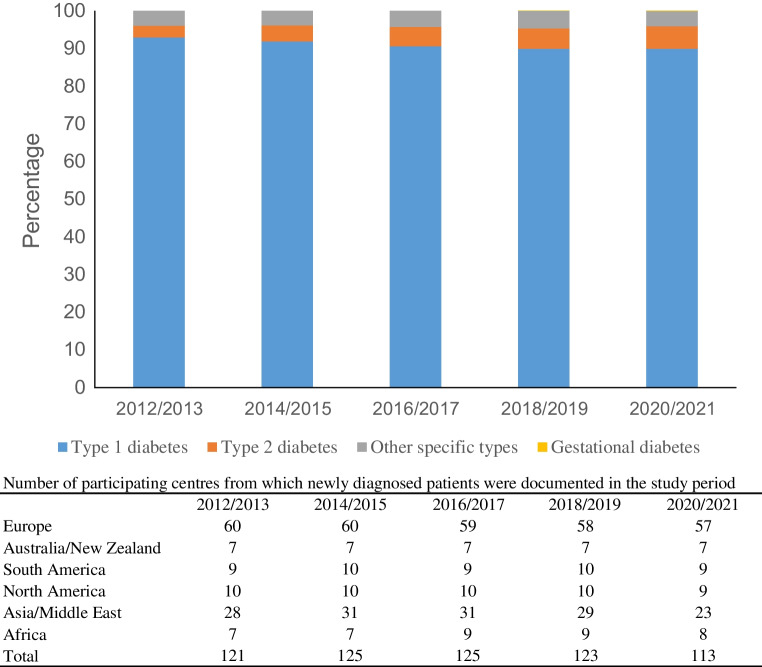
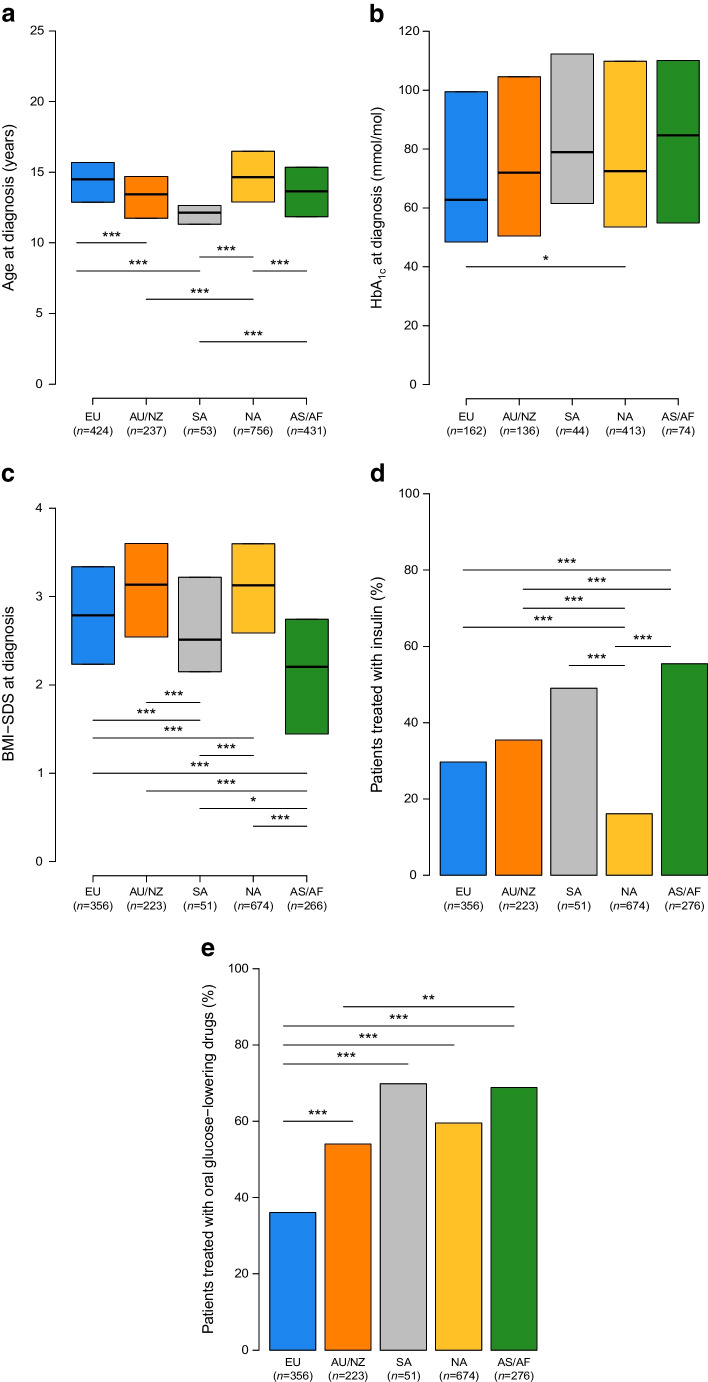
Overall, there were 2819 of 58,170 new cases (4.8%) with type 2 diabetes: 614 in EU, 293 in AU/NZ, 79 in SA, 1211 in NA and 622 in AS/AF. The proportion of type 2 diabetes increased from 3.2% to 6.0% from 2012/2013 to 2020/2021, a relative rate of increase of 9% per two-year period (95% CI 5.9, 12.3; p<0.001). In the two-year period of the COVID-19 pandemic, type 2 diabetes continued to follow the observed trend, with a proportion of 6.0% in 2020-2021 compared with 5.4% in 2018-2019. High variability in the proportion of type 2 diabetes was observed across regions, with the lowest values observed in EU and the highest in NA. A significant increase in the proportion of type 2 diabetes was observed in EU, AU/NZ and NA. The median HbA was not uniform and was highest in AS/AF (85 mmol/mol [9.9%]; IQR 55-111 [7.2-12.3%]) and lowest in EU (63 mmol/mol [7.9%]; IQR 48-99 [6.5-11.2%]), and the difference between EU and NA (median value 73 mmol/mol [8.8%]; IQR 50-105 [6.7-11.8%]) was statistically significant (p=0.047). There was also a difference in BMI SD score by region: the lowest median BMI SD score was 2.2 (IQR 1.4-2.7) in AS/AF and the highest was 3.1 (IQR 2.5-3.6) in AU/NZ.
CONCLUSIONS/INTERPRETATION: The multinational SWEET data from the years 2012 to 2021 inclusive support recent findings of a worldwide increase in type 2 diabetes in young people, albeit with regional differences. This increase highlights the need for ongoing preventive measures and available advanced treatment modalities worldwide.
目的/假设:全球范围内,2型糖尿病在年轻人中的诊断率正在上升。本研究评估了2012年至2021年(包括新冠疫情的头几年)来自跨国SWEET e.V注册中心的2型糖尿病青年患者的发病率及临床特征。
这是一项基于SWEET注册中心的纵向观察性研究,该中心收集了来自全球各中心的糖尿病儿童和青少年的人口统计学和临床数据,各中心根据国际儿科和青少年糖尿病学会的定义在当地进行糖尿病的诊断和分类。截至2022年7月,SWEET注册中心纳入了来自130个中心的96,931名个体,总共进行了1,154,555次就诊。数据按地区分析:欧洲(EU)、澳大利亚和新西兰(AU/NZ)、南美洲(SA)、北美洲(NA)以及亚洲/中东和非洲(AS/AF)。使用根据发病年龄和性别调整的逻辑回归模型,估计以2型糖尿病诊断病例数占所有糖尿病诊断病例数的比例表示的两年期比例趋势。
总体而言,58,170例新病例中有2819例(4.8%)为2型糖尿病:欧盟614例,澳新地区293例,南美洲地区例79,北美洲1211例,亚非地区622例。2型糖尿病的比例从2012/2013年的3.2%增至2020/2021年的6.0%,每两年相对增长率为9%(95%CI 5.9, 12.3;p<0.001)。在新冠疫情的两年期间,2型糖尿病继续遵循观察到的趋势,2020 - 2021年的比例为6.0%,而2018 - 2019年为5.4%。各地区2型糖尿病比例差异很大,欧盟地区最低,北美洲地区最高。在欧盟、澳新地区和北美洲地区,2型糖尿病比例显著增加。糖化血红蛋白(HbA)中位数不一致,亚非地区最高(85 mmol/mol [9.9%];IQR 55 - 111 [7.2 - 12.3%]),欧盟地区最低(63 mmol/mol [7.9%];IQR 48 - 99 [6.5 - 11.2%]),欧盟和北美洲地区之间的差异(中位数73 mmol/mol [8.8%];IQR 50 - 105 [6.7 - 11.8%])具有统计学意义(p = 0.047)。各地区的体重指数标准差(BMI SD)评分也存在差异:亚非地区最低中位数BMI SD评分为2.2(IQR 1.4 - 2.7)而澳新地区最高为3.1(IQR 2.5 - 3.6)。
结论/解读:2012年至2021年的跨国SWEET数据支持了近期关于全球范围内年轻人2型糖尿病发病率上升的研究结果,尽管存在地区差异。这种上升凸显了全球范围内持续采取预防措施和提供先进治疗方式的必要性。