Strengthening Oncology Services Research Unit, Faculty of Health Sciences, University of the Witwatersrand, Johannesburg, South Africa.
SAMRC/Wits Developmental Pathways for Health Research Unit, Faculty of Health Sciences, University of the Witwatersrand, Johannesburg, South Africa.
BMC Womens Health. 2024 Nov 6;24(1):594. doi: 10.1186/s12905-024-03431-2.
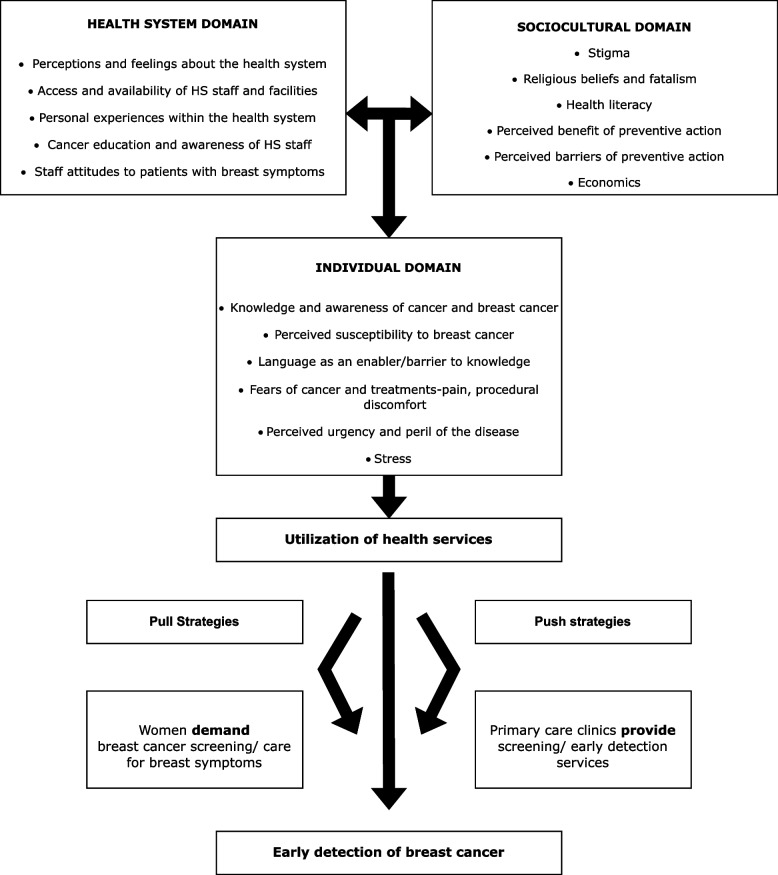
Individual perceptions, socio-cultural beliefs and health system factors are key determinants of people's health seeking behavior and are widely cited as the causes of delayed breast cancer diagnosis among women from structurally vulnerable settings. Asking: "how do women with a non-lived experience of cancer understand the disease and, what informs their health seeking behaviors?", we qualitatively explored, individual, sociocultural and health system elements from a conceptual model derived from the Socioecological, Health Belief and Cancer Stigma Frameworks, to understand perspectives of breast cancer in a South African urban community setting.
Using a deductive approach and allowing new themes to emerge inductively, we investigated phenomenologically, breast cancer perceptions among 34 women from Soweto, Johannesburg (aged 35-74 years) in 6 Focus Group Discussions. We then conducted 20 follow-up semi-structured in-depth interviews to explore novel themes and suggestions for increasing breast cancer screening.
Findings revealed some awareness of breast and other cancers, but confusion and gaps in understanding of the disease, resulting in socio-culturally influenced misperceptions of risks, causes, and outcomes following treatment of breast cancer. This fueled perceptions of profound fear and stigma against people with breast and other cancers. These findings together with participant perceptions of primary healthcare providers being unwelcoming, under-resourced, and insufficiently trained to deal with breast cancer, resulted in women reporting being reluctant to participating in screening/early detection care seeking behavior. Women only accessed primary care when experiencing extreme pain or ill-health. Participants suggested as solutions for future interventions, the need for sustained community engagement, harnessing existing clinic and community stakeholders and resources to provide clear and understandable breast cancer information and encouragement for screening uptake.
Health literacy gaps surrounding breast cancer fuels socio-culturally influenced misperceptions, fear, stigma, and fatalism among women from Soweto. Women perceive primary care providers of having insufficient knowledge, skills, and resources to provide effective breast cancer screening services. Participants suggested the need for greater community engagement involving primary clinics and existing community stakeholders working collaboratively. Clear, understandable, and consistent information about breast cancer must be regularly disseminated and communities must be regularly encouraged to utilize breast cancer screening services.
个人感知、社会文化信仰和卫生系统因素是人们寻求健康行为的关键决定因素,这些因素被广泛认为是结构脆弱环境中女性乳腺癌诊断延迟的原因。我们提出问题:“没有癌症经历的女性如何理解这种疾病,以及是什么影响了她们的健康寻求行为?”,从社会生态学、健康信念和癌症污名框架衍生的概念模型出发,我们定性地探讨了个体、社会文化和卫生系统因素,以了解南非城市社区中乳腺癌的观点。
我们采用演绎方法,允许新主题从归纳中出现,对约翰内斯堡索韦托的 34 名年龄在 35-74 岁的女性进行了 6 次焦点小组讨论,对乳腺癌认知进行了现象学研究。然后,我们进行了 20 次后续半结构化深入访谈,以探索新的主题和增加乳腺癌筛查的建议。
研究结果显示,一些人对乳腺癌和其他癌症有一定的认识,但对疾病的理解存在混淆和差距,导致对风险、原因和乳腺癌治疗后的结果产生了受社会文化影响的误解。这加剧了人们对乳腺癌和其他癌症患者的恐惧和污名化。这些发现以及参与者对初级保健提供者不友好、资源不足以及培训不足以应对乳腺癌的看法,导致女性报告不愿意参与筛查/早期检测寻求行为。只有在出现极度疼痛或身体不适时,女性才会寻求初级保健。参与者建议,未来干预措施需要持续的社区参与,利用现有诊所和社区利益相关者和资源,提供清晰易懂的乳腺癌信息,并鼓励进行筛查。
围绕乳腺癌的健康素养差距加剧了索韦托女性的社会文化影响的误解、恐惧、污名和宿命论。女性认为初级保健提供者缺乏提供有效乳腺癌筛查服务的知识、技能和资源。参与者建议需要更多的社区参与,包括初级诊所和现有的社区利益相关者合作。必须定期传播关于乳腺癌的清晰、易懂和一致的信息,并定期鼓励社区利用乳腺癌筛查服务。