Lappalainen Antti, Hartikainen Juha E K, Teppo Konsta, Halminen Olli, Aro Aapo L, Siponen Rasmus, Virrankorpi Janne, Marjamaa Annukka, Salmela Birgitta, Putaala Jukka, Mustonen Pirjo, Linna Miika, Haukka Jari, Juhani Airaksinen K E, Lehto Mika
Heart Centre, Kuopio University Hospital and University of Eastern Finland, Kuopio, Finland.
Heart Centre, Turku University Hospital and University of Turku, Turku, Finland.
Int J Cardiol Heart Vasc. 2024 Oct 23;55:101541. doi: 10.1016/j.ijcha.2024.101541. eCollection 2024 Dec.
Catheter ablation is a well-established treatment to prevent atrial fibrillation (AF) and atrial flutter (AFL) recurrences and to relieve symptoms, whereas pacemaker implantation and atrioventricular node (AVN) ablation is used for rate control when medical therapy fails.
We investigated temporal trends and patient characteristics in catheter ablation procedures for AF, AFL and AVN in Finland between 2012-2018.
Finnish AntiCoagulation in Atrial Fibrillation (FinACAF) is a registry-based study including all patients with AF or AFL in Finland between 2012-2018.
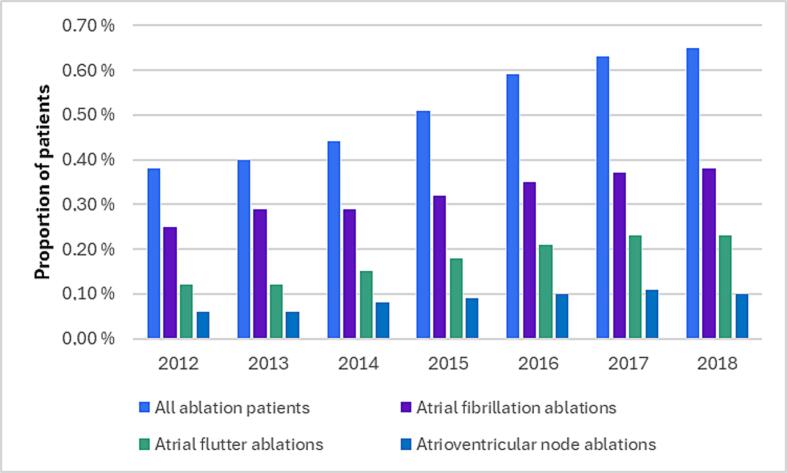
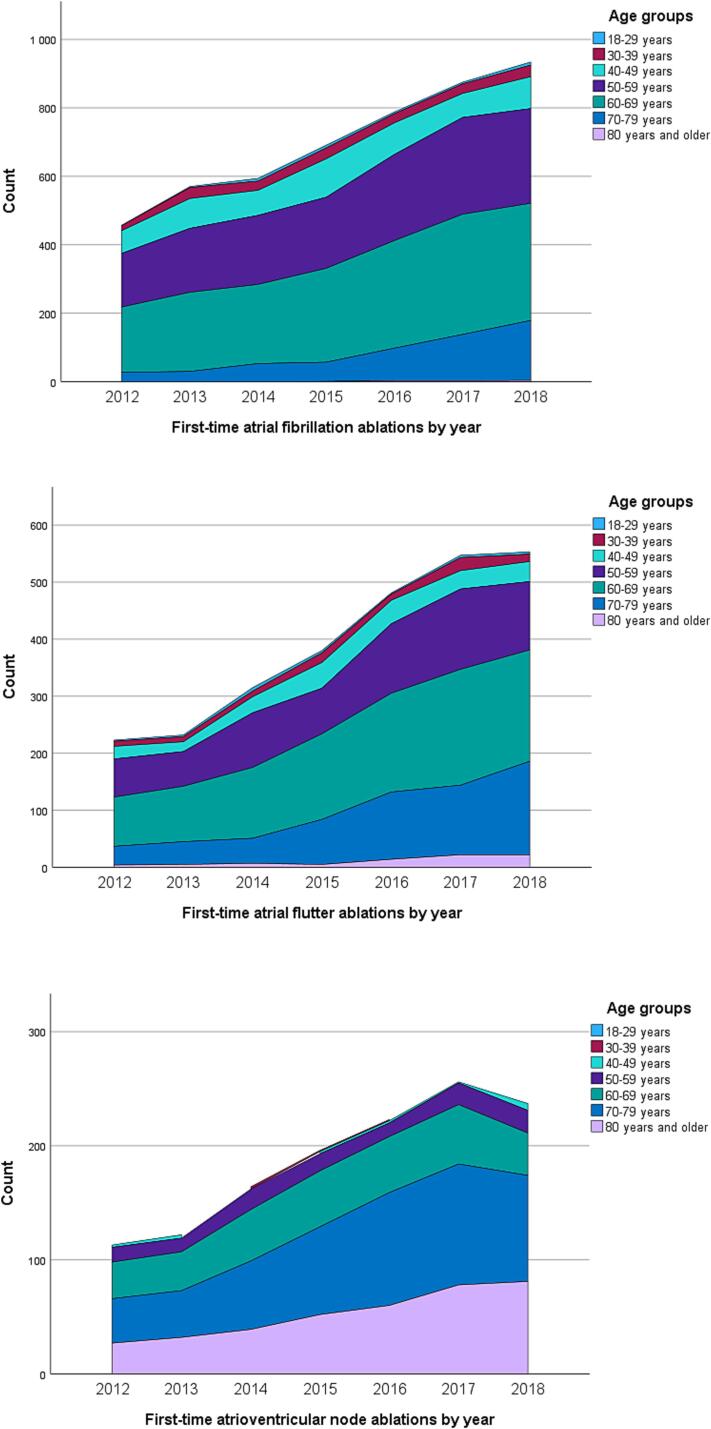
The number of patients with AF or AFL diagnosis in Finland increased from 185 057 to 243 802 between 2012-2018 and a total of 8954 first-time catheter ablation procedures were performed. Of them, 4909 (54.8 %) were AF ablations, 2731 (30.5 %) AFL ablations and 1314 (14.7 %) AVN ablations. The procedural numbers increased from 457/year to 934/year for AF, from 223/year to 553/year for AFL and from 114/year to 238/year for AVN. Altogether, 0.65% of all patients with diagnosed AF or AFL underwent AF, AFL or AVN ablation in 2018. The mean age of the patients increased in all ablation groups. Patients undergoing AF and AFL ablations were predominantly men (69.7 % and 74.6 % respectively) whereas patients undergoing AVN ablation were more often women (56.9%).
The use of catheter ablation more than doubled during 2012-2018 and the increase was particularly seen in the elderly patients. Nevertheless, only a minority of AF and AFL patients were treated with catheter ablations.
导管消融是一种成熟的治疗方法,用于预防心房颤动(AF)和心房扑动(AFL)复发并缓解症状,而当药物治疗无效时,起搏器植入和房室结(AVN)消融用于控制心率。
我们调查了2012年至2018年芬兰房颤、房扑和房室结导管消融手术的时间趋势和患者特征。
芬兰房颤抗凝(FinACAF)是一项基于登记的研究,纳入了2012年至2018年芬兰所有房颤或房扑患者。
2012年至2018年期间,芬兰房颤或房扑诊断患者数量从185057例增加到243802例,共进行了8954例首次导管消融手术。其中,4909例(54.8%)为房颤消融,2731例(30.5%)为房扑消融,1314例(14.7%)为房室结消融。房颤手术例数从每年457例增加到934例,房扑从每年223例增加到553例,房室结从每年114例增加到238例。2018年,所有诊断为房颤或房扑的患者中,共有0.65%接受了房颤、房扑或房室结消融。所有消融组患者的平均年龄均有所增加。接受房颤和房扑消融的患者以男性为主(分别为69.7%和74.6%),而接受房室结消融的患者女性更多(56.9%)。
2012年至2018年期间,导管消融的使用增加了一倍多,这种增加在老年患者中尤为明显。然而,只有少数房颤和房扑患者接受了导管消融治疗。