• 文献检索
  • 文档翻译
  • 深度研究
  • 学术资讯
  • Suppr Zotero 插件Zotero 插件
  • 邀请有礼
  • 套餐&价格
  • 历史记录
应用&插件
Suppr Zotero 插件Zotero 插件浏览器插件Mac 客户端Windows 客户端微信小程序
定价
高级版会员购买积分包购买API积分包
服务
文献检索文档翻译深度研究API 文档MCP 服务
关于我们
关于 Suppr公司介绍联系我们用户协议隐私条款
关注我们

Suppr 超能文献

核心技术专利:CN118964589B侵权必究
粤ICP备2023148730 号-1Suppr @ 2026

文献检索

告别复杂PubMed语法,用中文像聊天一样搜索,搜遍4000万医学文献。AI智能推荐,让科研检索更轻松。

立即免费搜索

文件翻译

保留排版,准确专业,支持PDF/Word/PPT等文件格式,支持 12+语言互译。

免费翻译文档

深度研究

AI帮你快速写综述,25分钟生成高质量综述,智能提取关键信息,辅助科研写作。

立即免费体验

心理药物治疗与产后出血之间的关联。

Association between psychopharmacotherapy and postpartum hemorrhage.

作者信息

Jackson Frank I, Kouba Insaf, Meirowitz Natalie, Keller Nathan A, Bracero Luis A, Blitz Matthew J

机构信息

Northwell, New Hyde Park, NY (Jackson, Kouba, Meirowitz, Keller, Bracero, and Blitz).

Department of Obstetrics and Gynecology, South Shore University Hospital, Bay Shore, NY (Jackson, Kouba, Keller, Bracero, and Blitz).

出版信息

AJOG Glob Rep. 2024 Oct 9;4(4):100402. doi: 10.1016/j.xagr.2024.100402. eCollection 2024 Nov.

DOI:10.1016/j.xagr.2024.100402
PMID:39512763
原文链接:https://pmc.ncbi.nlm.nih.gov/articles/PMC11541838/
Abstract

BACKGROUND

Prior studies evaluating the relationship between psychopharmacotherapy (PPT), and postpartum hemorrhage (PPH) have yielded inconsistent findings. Clarifying this potential relationship is important for effective counseling and risk stratification.

OBJECTIVES

Our primary objective was to evaluate the association between prenatal exposure to PPT (any drug class) and the occurrence of PPH requiring transfusion of packed red blood cells (PPH+pRBC) after systematically adjusting for known hemorrhage risk factors at the time of admission for delivery. Secondary objectives were to evaluate the association between individual PPT drug classes and PPH+pRBC, and the association between treatment intensity of mental health condition and PPH+pRBC. Finally, we evaluated the association between PPT and a broader definition of PPH that included deliveries requiring multiple uterotonic drugs.

STUDY DESIGN

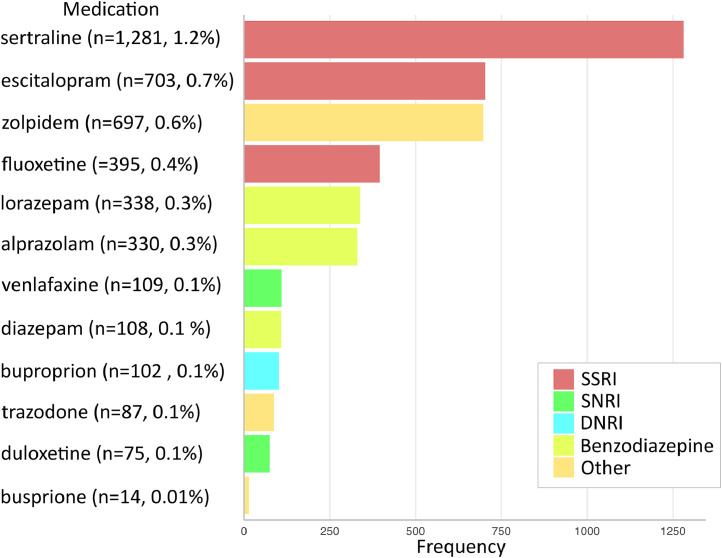
This is a retrospective cross-sectional study of all pregnancies delivered at 23 weeks of gestational age or greater at seven hospitals within a large academic health system in New York between January 2019 and December 2022. There were no exclusion criteria, as postpartum hemorrhage risk assessment is necessary for all patients admitted for delivery. We assessed exposure to prenatal PPT, including selective serotonin reuptake inhibitors (SSRIs: escitalopram, fluoxetine, sertraline), serotonin-norepinephrine reuptake inhibitors (SNRIs: duloxetine, venlafaxine), dopamine-norepinephrine reuptake inhibitors (DNRIs: buproprion), benzodiazepines (alprazolam, diazepam, lorazepam), and others (buspirone, trazodone, zolpidem). Multivariable logistic regression was performed to evaluate the relationship between PPT and PPH+pRBC, while systematically adjusting for known hemorrhage risk factors at the time of hospital admission. Similar regression analyses were performed to address the secondary objectives.

RESULTS

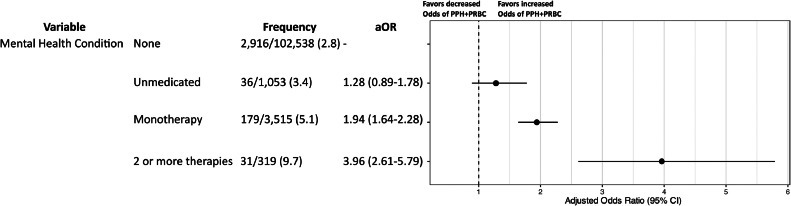
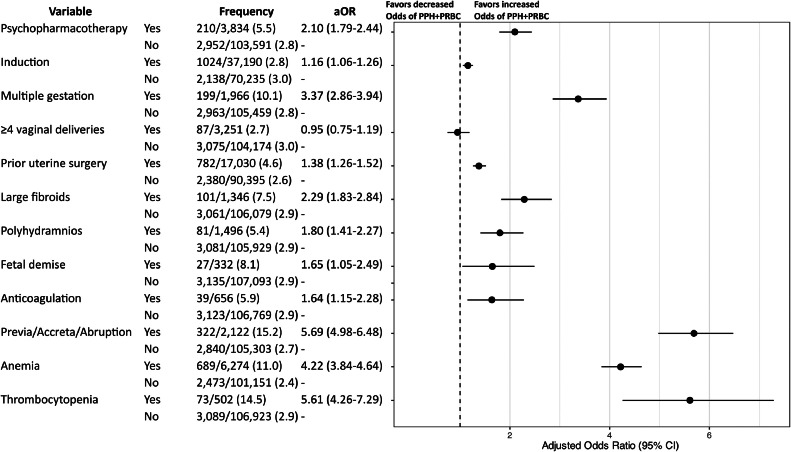
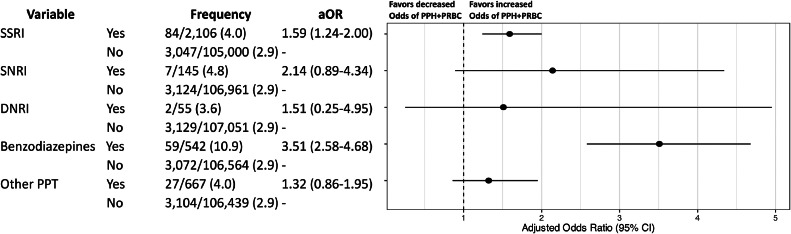
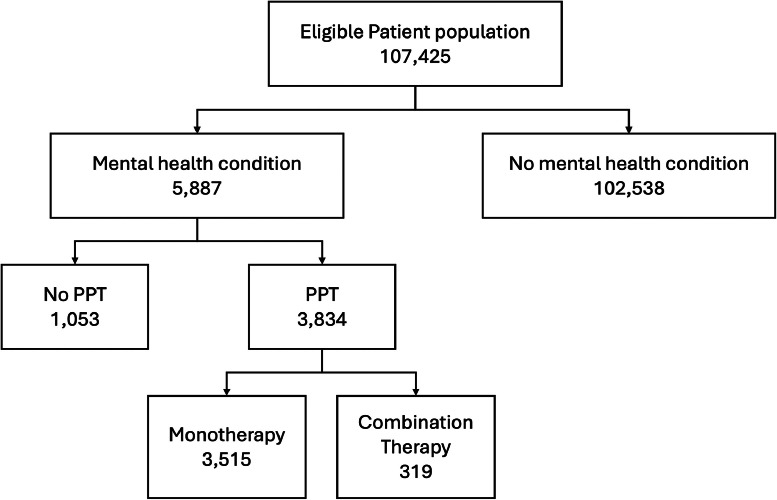
A total of 107,425 deliveries were included. Non-Hispanic White patients constituted the largest race and ethnicity group (43.4%), followed by Hispanic patients (18.7%), Asian or Pacific Islander patients (13.2%), and non-Hispanic Black patients (12.3%). Prenatal exposure to PPT occurred in 3.6% of pregnancies (=3,834). The overall rate of PPH+pRBC was 2.9% (=3,162). PPH+pRBC occurred more frequently in pregnancies exposed to PPT than in pregnancies which were not exposed (5.5% vs. 2.8%, respectively; aOR 2.10, 95% CI: 1.79-2.44). SSRIs and benzodiazepine monotherapy were each associated with higher odds of PPH+pRBC than nonexposure. Compared to patients without a mental health condition, monotherapy was associated with nearly 2-fold increased odds and combination PPT was associated with nearly 4-fold greater odds of PPH+pRBC after adjustment for confounding variables (monotherapy: aOR 1.94, 95% CI: 1.64-2.28; combination PPT: aOR 3.96, 95% CI: 2.61-5.79). Patients with untreated mental health conditions (no PTT) had no increased odds of PPH+pRBC compared to those without mental health conditions. Finally, after adjusting for covariates, a positive association was found between PPT and PPH requiring pRBC transfusion and/or the use of two additional uterotonic agents beyond routine postpartum oxytocin (aOR 1.53, 95% CI: 1.35-1.73).

CONCLUSIONS

Prenatal PPT exposure is associated with increased odds of clinically significant PPH+pRBC after adjusting for other hemorrhage risk factors. Combination PPT was associated with greater odds of PPH+pRBC than monotherapy.
摘要

背景

先前评估心理药物治疗(PPT)与产后出血(PPH)之间关系的研究结果并不一致。明确这种潜在关系对于有效的咨询和风险分层很重要。

目的

我们的主要目标是在系统调整分娩入院时已知的出血风险因素后,评估产前接触PPT(任何药物类别)与需要输注浓缩红细胞的产后出血(PPH + pRBC)发生之间的关联。次要目标是评估个体PPT药物类别与PPH + pRBC之间的关联,以及心理健康状况的治疗强度与PPH + pRBC之间的关联。最后,我们评估了PPT与更广泛定义的PPH之间的关联,该定义包括需要多种宫缩剂的分娩。

研究设计

这是一项对2019年1月至2022年12月期间在纽约一个大型学术医疗系统内的七家医院中孕周达到或超过23周的所有分娩进行的回顾性横断面研究。没有排除标准,因为所有分娩入院的患者都需要进行产后出血风险评估。我们评估了产前接触PPT的情况,包括选择性5-羟色胺再摄取抑制剂(SSRI:艾司西酞普兰、氟西汀、舍曲林)、5-羟色胺-去甲肾上腺素再摄取抑制剂(SNRI:度洛西汀、文拉法辛)、多巴胺-去甲肾上腺素再摄取抑制剂(DNRI:安非他酮)、苯二氮䓬类药物(阿普唑仑、地西泮、劳拉西泮)以及其他药物(丁螺环酮、曲唑酮、唑吡坦)。进行多变量逻辑回归以评估PPT与PPH + pRBC之间的关系,同时系统调整医院入院时已知的出血风险因素。进行类似的回归分析以解决次要目标。

结果

共纳入107,425例分娩。非西班牙裔白人患者构成最大的种族和族裔群体(43.4%),其次是西班牙裔患者(18.7%)、亚洲或太平洋岛民患者(13.2%)以及非西班牙裔黑人患者(12.3%)。3.6%的妊娠(n = 3,834)产前接触PPT。PPH + pRBC的总体发生率为2.9%(n = 3,162)。接触PPT的妊娠中PPH + pRBC的发生频率高于未接触PPT的妊娠(分别为5.5%和2.8%;调整后比值比[aOR] 2.10,95%置信区间[CI]:1.79 - 2.44)。SSRI和苯二氮䓬类药物单药治疗与PPH + pRBC的较高几率相关,均高于未接触情况。与没有心理健康状况的患者相比,调整混杂变量后,单药治疗与PPH + pRBC的几率增加近2倍相关,联合PPT与PPH + pRBC的几率增加近4倍相关(单药治疗:aOR 1.94,95% CI:1.64 - 2.28;联合PPT:aOR 3.96,95% CI:2.61 - 5.79)。未治疗心理健康状况的患者(未进行PPT治疗)与没有心理健康状况的患者相比,PPH + pRBC的几率没有增加。最后,调整协变量后,发现PPT与需要输注pRBC和/或在常规产后缩宫素基础上额外使用两种宫缩剂的PPH之间存在正相关(aOR 1.53,95% CI:1.35 - 1.73)。

结论

在调整其他出血风险因素后,产前接触PPT与临床上显著的PPH + pRBC几率增加相关。联合PPT与PPH + pRBC的几率高于单药治疗。

https://cdn.ncbi.nlm.nih.gov/pmc/blobs/6826/11541838/d899269c201c/gr5.jpg
https://cdn.ncbi.nlm.nih.gov/pmc/blobs/6826/11541838/d4a522c5c9cf/gr1.jpg
https://cdn.ncbi.nlm.nih.gov/pmc/blobs/6826/11541838/73665d881dbd/gr2.jpg
https://cdn.ncbi.nlm.nih.gov/pmc/blobs/6826/11541838/50057739f5b2/gr3.jpg
https://cdn.ncbi.nlm.nih.gov/pmc/blobs/6826/11541838/72a1e1666971/gr4.jpg
https://cdn.ncbi.nlm.nih.gov/pmc/blobs/6826/11541838/d899269c201c/gr5.jpg
https://cdn.ncbi.nlm.nih.gov/pmc/blobs/6826/11541838/d4a522c5c9cf/gr1.jpg
https://cdn.ncbi.nlm.nih.gov/pmc/blobs/6826/11541838/73665d881dbd/gr2.jpg
https://cdn.ncbi.nlm.nih.gov/pmc/blobs/6826/11541838/50057739f5b2/gr3.jpg
https://cdn.ncbi.nlm.nih.gov/pmc/blobs/6826/11541838/72a1e1666971/gr4.jpg
https://cdn.ncbi.nlm.nih.gov/pmc/blobs/6826/11541838/d899269c201c/gr5.jpg

相似文献

1
Association between psychopharmacotherapy and postpartum hemorrhage.心理药物治疗与产后出血之间的关联。
AJOG Glob Rep. 2024 Oct 9;4(4):100402. doi: 10.1016/j.xagr.2024.100402. eCollection 2024 Nov.
2
Twin pregnancy and risk of postpartum hemorrhage.双胎妊娠与产后出血风险。
J Matern Fetal Neonatal Med. 2020 Nov;33(22):3740-3745. doi: 10.1080/14767058.2019.1583736. Epub 2019 Mar 5.
3
The Risk of Postpartum Hemorrhage with Selective Serotonin Reuptake Inhibitors and Serotonin Norepinephrine Reuptake Inhibitors: Preliminary Results from the Massachusetts General Hospital National Pregnancy Registry for Psychiatric Medications.选择性5-羟色胺再摄取抑制剂和5-羟色胺去甲肾上腺素再摄取抑制剂与产后出血的风险:来自麻省总医院全国精神科药物妊娠登记处的初步结果
J Womens Health (Larchmt). 2024 Dec;33(12):1606-1613. doi: 10.1089/jwh.2024.0033. Epub 2024 Jul 22.
4
Pharmacological treatments in panic disorder in adults: a network meta-analysis.成人惊恐障碍的药物治疗:网络荟萃分析。
Cochrane Database Syst Rev. 2023 Nov 28;11(11):CD012729. doi: 10.1002/14651858.CD012729.pub3.
5
Postpartum Bleeding in Pregnant Women Receiving SSRIs/SNRIs: New Insights From a Descriptive Observational Study and an Analysis of Data from the FAERS Database.接受 SSRI/SNRI 治疗的孕妇产后出血:一项描述性观察研究和 FAERS 数据库数据分析的新见解。
Clin Ther. 2019 Sep;41(9):1755-1766. doi: 10.1016/j.clinthera.2019.06.008. Epub 2019 Jul 29.
6
Selective serotonin reuptake inhibitors (SSRIs) and serotonin-norepinephrine reuptake inhibitors (SNRIs) for the prevention of tension-type headache in adults.用于预防成人紧张型头痛的选择性5-羟色胺再摄取抑制剂(SSRIs)和5-羟色胺-去甲肾上腺素再摄取抑制剂(SNRIs)
Cochrane Database Syst Rev. 2015 May 1;2015(5):CD011681. doi: 10.1002/14651858.CD011681.
7
Use of antidepressants near delivery and risk of postpartum hemorrhage: cohort study of low income women in the United States.分娩前后使用抗抑郁药与产后出血风险:美国低收入女性的队列研究。
BMJ. 2013 Aug 21;347:f4877. doi: 10.1136/bmj.f4877.
8
New generation antidepressants for depression in children and adolescents: a network meta-analysis.新一代抗抑郁药治疗儿童和青少年抑郁症:网络荟萃分析。
Cochrane Database Syst Rev. 2021 May 24;5(5):CD013674. doi: 10.1002/14651858.CD013674.pub2.
9
Uterotonic drugs to prevent postpartum haemorrhage: a network meta-analysis.缩宫素类药物预防产后出血的效果:网状 Meta 分析。
Health Technol Assess. 2019 Feb;23(9):1-356. doi: 10.3310/hta23090.
10
Risk of vaginal bleeding and postpartum hemorrhage after use of antidepressants in pregnancy: a study from the Norwegian Mother and Child Cohort Study.妊娠期使用抗抑郁药后阴道出血和产后出血的风险:来自挪威母亲和儿童队列研究。
J Clin Psychopharmacol. 2014 Feb;34(1):143-8. doi: 10.1097/JCP.0000000000000036.

引用本文的文献

1
Drug-associated postpartum hemorrhage: a comprehensive disproportionality analysis based on the FAERS database.药物相关的产后出血:基于FAERS数据库的全面不成比例性分析
Naunyn Schmiedebergs Arch Pharmacol. 2025 Sep 8. doi: 10.1007/s00210-025-04560-7.

本文引用的文献

1
Perinatal Mood And Anxiety Disorders Rose Among Privately Insured People, 2008-20.2008 年至 20 年间,有保险人群的围产期情绪和焦虑障碍发病率上升。
Health Aff (Millwood). 2024 Apr;43(4):496-503. doi: 10.1377/hlthaff.2023.01437. Epub 2024 Mar 20.
2
Fibroid size and number and risk of postpartum hemorrhage.子宫肌瘤大小、数量与产后出血风险
Am J Obstet Gynecol. 2023 Sep;229(3):344-345. doi: 10.1016/j.ajog.2023.05.001. Epub 2023 May 10.
3
Current State and Future Direction of Postpartum Hemorrhage Risk Assessment.产后出血风险评估的现状与未来方向。
Obstet Gynecol. 2021 Dec 1;138(6):924-930. doi: 10.1097/AOG.0000000000004579.
4
Obstetric hemorrhage risk assessment tool predicts composite maternal morbidity.产科出血风险评估工具预测复合产妇发病率。
Sci Rep. 2021 Jul 19;11(1):14709. doi: 10.1038/s41598-021-93413-3.
5
Vasorelaxant effects of benzodiazepines, non-benzodiazepine sedative-hypnotics, and tandospirone on isolated rat arteries.苯二氮䓬类药物、非苯二氮䓬类镇静催眠药和坦度螺酮对离体大鼠血管的血管舒张作用。
Eur J Pharmacol. 2021 Feb 5;892:173744. doi: 10.1016/j.ejphar.2020.173744. Epub 2020 Nov 19.
6
SSRI use during pregnancy and risk for postpartum haemorrhage: a national register-based cohort study in Sweden.孕期使用 SSRI 与产后出血风险:瑞典基于全国登记的队列研究。
BJOG. 2020 Oct;127(11):1366-1373. doi: 10.1111/1471-0528.16210. Epub 2020 Apr 1.
7
Maternal and fetal outcomes following exposure to duloxetine in pregnancy: cohort study.妊娠期使用度洛西汀后母婴结局:队列研究。
BMJ. 2020 Feb 19;368:m237. doi: 10.1136/bmj.m237.
8
Postpartum Bleeding in Pregnant Women Receiving SSRIs/SNRIs: New Insights From a Descriptive Observational Study and an Analysis of Data from the FAERS Database.接受 SSRI/SNRI 治疗的孕妇产后出血:一项描述性观察研究和 FAERS 数据库数据分析的新见解。
Clin Ther. 2019 Sep;41(9):1755-1766. doi: 10.1016/j.clinthera.2019.06.008. Epub 2019 Jul 29.
9
Clinical Management of Bleeding Risk With Antidepressants.抗抑郁药相关出血风险的临床管理。
Ann Pharmacother. 2019 Feb;53(2):186-194. doi: 10.1177/1060028018794005. Epub 2018 Aug 6.
10
Selective Serotonin Reuptake Inhibitors and Serotonin-Norepinephrine Reuptake Inhibitors Are Not Associated With Bleeding or Transfusion in Cardiac Surgical Patients.选择性 5-羟色胺再摄取抑制剂和 5-羟色胺-去甲肾上腺素再摄取抑制剂与心脏手术患者的出血或输血无关。
Anesth Analg. 2018 Jun;126(6):1859-1866. doi: 10.1213/ANE.0000000000002668.