Komalasari Renata, Mpofu Elias, Chen Rita Chang Hui, Talluntondok Eva Berthy, Uligraff Deby Kristiani, Zhan Rongfang, Thiamwong Ladda
Ross and Carol Nese College of Nursing, Pennsylvania State University, State College, PA, USA.
Keperawatan (Nursing), Tzu Chi Hospital Indonesia, Pantai Indah Kapuk, Jakarta, Indonesia.
SAGE Open Nurs. 2024 Nov 13;10:23779608241296629. doi: 10.1177/23779608241296629. eCollection 2024 Jan-Dec.
Multiple studies have reported the association between balance performance and cognitive function among older adults. However, few studies have been conducted in low-income settings.
This cross-sectional study examined the relationships of dynamic and static balance with cognitive function in community-dwelling low-income older adults in Orlando, Florida.
Dynamic balance was assessed with a Short Physical Performance Battery (SPPB) and static balance with BTracks Balance System. Rowland Universal Dementia Assessment Scale (RUDAS) assessed cognition and Patient Health Questionnaire-9 assessed depressive symptoms.
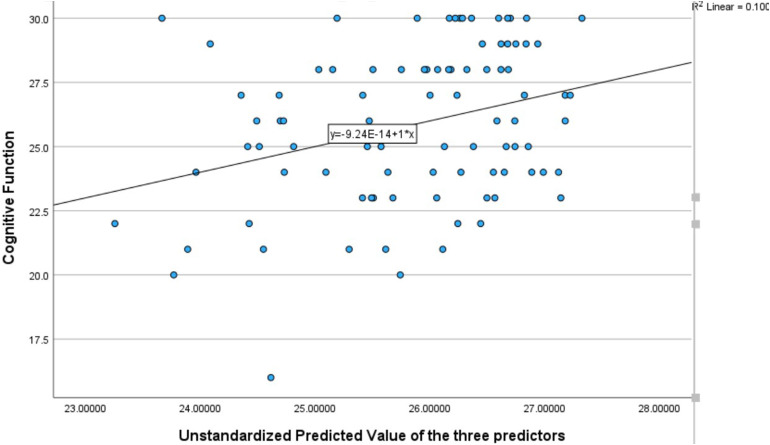
Multiple regression analysis showed dynamic balance was significantly associated with cognition, but static balance was not, controlling for depressive symptoms ( = 89, = 72.70, ± 6.95; females = 79). Specifically, higher dynamic balance was associated with better cognitive function. Cognitively healthy participants (RUDAS scores ≥23) scored 2.526 points higher in SPPB than those with possible cognitive impairment (RUDAS scores <23).
Findings provide the evidence to suggest dynamic balance and cognitive function health disparities affecting older adults from low-income community. By implication, dynamic balance and cognitive function should be part of routine screening with older adults living in low-income communities.
多项研究报告了老年人平衡能力与认知功能之间的关联。然而,在低收入环境中开展的研究较少。
这项横断面研究考察了佛罗里达州奥兰多市低收入社区居住的老年人动态平衡和静态平衡与认知功能之间的关系。
采用简短体能测试电池组(SPPB)评估动态平衡,使用BTracks平衡系统评估静态平衡。罗兰通用痴呆评估量表(RUDAS)评估认知,患者健康问卷-9评估抑郁症状。
多元回归分析显示,在控制抑郁症状后(n = 89,女性 = 79),动态平衡与认知显著相关,但静态平衡与认知无关。具体而言,更高的动态平衡与更好的认知功能相关。认知健康参与者(RUDAS评分≥23)的SPPB得分比可能存在认知障碍的参与者(RUDAS评分<23)高2.526分。
研究结果提供了证据,表明动态平衡和认知功能的健康差异影响低收入社区的老年人。这意味着,动态平衡和认知功能应成为低收入社区老年人常规筛查的一部分。